OPINION

Paraguay vs. France Sparks social media war: Why are the French—and almost all of Europe—so upset by the Paraguayans' 'foul play'?
The Paraguayan national team, true to its history and identity, pushed the French squad to the limit, just as it did in 1998, when one of the few golden goals in World Cup history sealed the albirroja's elimination.
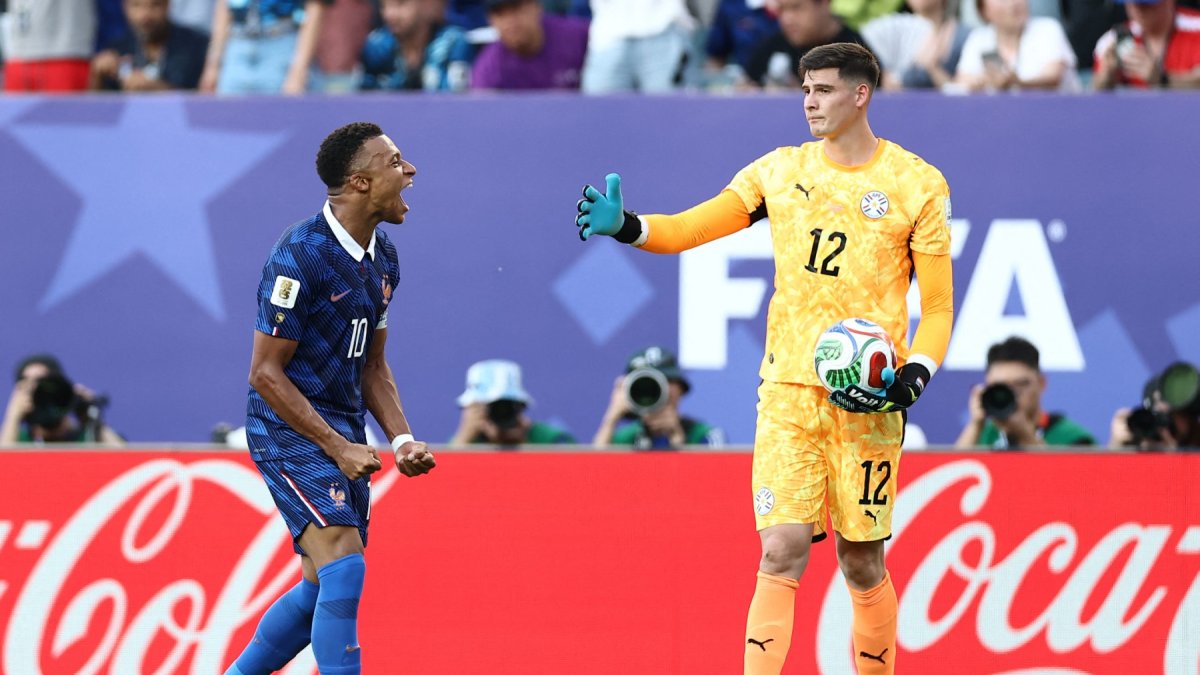
French forward Kylian Mbappé ignores the congratulatory handshake from Paraguayan goalkeeper Orlando Gill
For many French people, the Paraguay vs. France match was a war. Kylian Mbappé, captain, French star and scorer of the match’s only goal, made this clear at a press conference: “We showed Paraguay that if they want to play dirty, we can play dirty too. If they tell us to go to hell, we’ll tell them to go to hell too. Paraguay didn’t want to play soccer… and we showed them that we knew how to do it. We won, and we were better than them. If we have to get our hands dirty, we’ll do it. They thought we were going to show up in tuxedos to play, but we know how to play dirty soccer, too. We’ve shown that we’re not just a team that knows how to play attacking soccer.”
Mbappé’s comments came after a match in which Paraguay—a team that had just knocked out Germany in a penalty shootout—proved that, with discipline, defensive commitment, intensity and a lot of courage, even a team with limited offensive resources can make life very difficult for the world’s best attack. In this case, it was the French attacking midfielders and forwards, who had been averaging at least three goals per game throughout the tournament—dispatching opponents of the caliber of Norway, Sweden and Senegal.
Paraguay, with a rock-solid, well-spaced and well-rehearsed 4-5-1 formation—backed by in-depth tactical analysis to counter the effective French attack—prevented Mbappé, Dembélé, Olise and the top French players from shining. For 70 minutes, France had barely managed to create any danger in front of Orlando Gill’s goal; he was only truly tested once, on a long-range shot by Koné.
Then, in the 68th minute, a run through the Paraguayan box by Désiré Doué, who had come off the bench, was met by an outstretched leg from Diego Gómez, who committed the Guaraní defense’s only mistake in 90 minutes, giving France the opportunity to break the deadlock from the penalty spot. The penalty, incidentally, was awarded by VAR, because initially the play had gone unnoticed by viewers, commentators and the head referee himself. Mbappé was the one to convert the penalty into a goal. The match had been heating up for some time, but from that point on, France got fully drawn into the physical battle the Paraguayans had set out to wage, and on several occasions, there were scuffles, shoving matches, a few scattered insults and controversial moments: a few (mostly minor) blows from Paraguayan players off the ball, Mbappé’s taunting laughter, gestures from both sides and the usual skirmishes in matches that become tense and difficult—especially for the referees.
However, just as happened four years ago after the Netherlands vs. Argentina match, where the Argentines defeated the Europeans in a dramatic and conflict-filled finale, once again the media, pundits, fans and even European politicians lashed out at a South American country—in this case, Paraguay.
With Argentina, on that occasion, it was the gestures made by the "Albiceleste" players at the end of the match (in the lead-up to the game, Van Gaal had stoked tensions by belittling Messi, which provoked anger in Argentina) as they laughed at the Dutch after the penalty shootout. The Argentine players, who went on to become world champions, were branded “sore losers.” But this time, the backlash against Paraguay has been far more aggressive, reaching levels rarely seen before: “anti-soccer,” “savages,” “violent,” “dirty,” “thieves,” among other insults this author has read from fans, columnists, analysts, the media, and French and European authorities.
In particular, the French were especially harsh on Uzbek referee Ilgiz Tantashev, who, according to the newspaper L’Équipe, had a catastrophic performance—“the worst of the World Cup”—giving him a score of one out of 10 for his performance. In France, the consensus is that the referee was excessively lenient toward what they call Paraguayan “dirty play,” with one statistic that particularly annoys them: France received three yellow cards, while Paraguay finished the match without any cautions. This was evidence, to them, that they were wronged, even though they were awarded a penalty—which, to be fair, had not been called in this tournament, since Doué also went a bit out of his way to make contact with Gómez’s leg. These situations in this World Cup, with few exceptions, fall far short of the standard set by European soccer in recent years.
Beyond the refereeing issue—on which we won’t go into in detail—there’s another consensus in France: Paraguay, according to them, was “embarrassing.” They were annoyed by their defensive style, their constant shoving, scrapes, skirmishes and, in general, their South American tenacity. This style of play is not very common on weekends when PSG comfortably and unopposedly thrashes whichever Ligue 1 opponent has a smaller budget.
That’s the underlying problem: Paraguay surprised the world. They started the tournament with a 4-1 loss in a dismal debut against the U.S., and from then on, they were a fortress. They fought tooth and nail to overcome Turkey, receiving a thoroughly unfair red card due to a controversial rule. They had no trouble advancing past Australia, even though that would take them to the tough half of the bracket; and while many Europeans thought they were done for—thinking that Germany would easily defeat them—here in South America we knew that if there’s one thing Paraguay has, it’s the ability to go down swinging. And not only did they prove it, but they defeated Germany in a thoroughly deserved victory in a clash of styles where the "Guaraní" side dictated the pace in the first half and then put on a commendable display of resilience. In the penalty shootout, Gill was the hero, and the story is now known around the world.
Against France it was no different, except that—as every soccer fan knows—the French team is, at this very moment, infinitely better than the Germans. And Paraguay had to take logical precautions and play a perfect defensive game to win. The French, who were somewhat aware of the "Guaraní" team’s limitations on offense, thought it would be an easy win and that they’d run up the score. But that wasn’t the case. Paraguay stood its ground and pushed one of the best French teams in history to the limit. With its own weapons, certainly, and part of those weapons—as its history and tradition indicate—is being a thorn in the side.


Politics
FIFA lifts Balogun's suspension, Trump celebrates ‘reversing a great injustice’
Joaquín Núñez
Paraguay was a thorn in France’s side in ’98, a thorn in Spain’s side in 2010, a thorn in Argentina’s and Brazil’s sides during these qualifiers (they soundly defeated them at the legendary Defensores del Chaco stadium), they were a thorn in the side of Germany, and they were a thorn in the side of this star-studded French team. That’s what it means to be a great rival, whether you like their style or not. And France (not the national team, but the country), instead of acknowledging that they defeated a strong opponent and celebrating their advancement to the quarterfinals, has stooped to the shameful task of disparaging Paraguayan soccer and, in particular, the Guaraní nation. This sparked a war on social media that has already drawn in political voices as well as the worst of both sides, with pathetic individuals seizing the moment to hurl insults, spew racism and rant over a soccer match (the worst, without a doubt, being a Paraguayan senator who unfortunately attacked Mbappé—and was put in her place by the player, the Paraguayan national government itself and the country’s citizens). All of this is something that, really, shouldn’t happen.
But let’s not be mistaken: the ones most outraged here were none other than the French, who have been attacking Paraguay since the end of the match for various reasons.
First, because it was a blow to French morale that Paraguay, with its strengths, demonstrated that it can compete against Didier Deschamps’ team when spaces aren’t left open and duels are contested with intensity. Also because Paraguay, as the proud nation that it is, didn’t go into the match already defeated, as was the case with Sweden and Norway, teams that were on the back foot from the very first minute and barely put up a fight, making it easy for Mbappé, Olisé and Dembélé. To wrap things up, even though it may be hard for many to read this, because Europeans (not just the French) still haven’t been able to shake off their ridiculous Eurocentrism in almost every aspect of life.
In Europe, there is no doubt that soccer can only be played one way: positional play (with each player occupying rationalized spaces), through quick transition and by scoring as many goals as possible. Well, no. This World Cup demonstrated, as is always made clear every four years, that soccer can be played using various strategies: functional play, deep defensive blocks, a slow tempo in midfield, scrappy play or all of the above. Ultimately, part of soccer’s appeal is that teams know their strengths, weaknesses and cultural identities, and put them into practice. And the Europeans, deep down, know this, but they can’t stand that Paraguay—proudly South American—executed its plan so well when they were expecting a decisive and overwhelming victory, just as a debate between CONMEBOL vs. UEFA that has been intensifying for years.
Deep down, it doesn’t really bother them that the referee withheld two or three yellow cards for Paraguay that would have been fair (one for Galarza, another for Cáceres and another for Ávalos)—but rather that conditions were imposed on them from an uncomfortable, foreign and certainly annoying vantage point, with refereeing that applied a high standard of physical rigor equally to both teams. But, of course, the French don’t like the rigor, the physical play, the liveliness and the brazenness of the South American style; they see it as third-world, unsophisticated and cheating. In fact, by South American standards—though some may not realize it—Paraguay’s play was quite “light” at times. There were no unsportsmanlike kicks (as sadly occurred in the Uruguay vs. Spain match), there were no rough challenges up front and there wasn’t even any risk of injury on any foul. No French player came away badly hurt or injured. In a Copa Libertadores match, you see many, many worse things. In Copa América, you see worse things. In World Cups, we’ve seen many, many worse things, even among European teams. What’s more, during that same game, France also played rough (their yellow cards were well-deserved), wasted time while leading 1-0, and engaged in the same game of provocation and taunting.
In fact, just as Paraguay did—taking a step back against Turkey, Germany and France—and play on the counter, which was also done by England vs. Mexico for long stretches and praised by many analysts for defending while outnumbered. The big difference is that England has players of the caliber of Kane, Bellingham and other stars on its roster. Paraguay does not. And because of that simple reality, England is indeed capable of scoring several goals without necessarily playing extremely attacking soccer.
Therefore, the criticism directed at Paraguay is, on the one hand, dishonest, and, on the other, absurd, because Alfaro’s team—in addition to having less offensive talent than France—was physically compromised. Its wingers were injured throughout the World Cup. Enciso was at 60–70% capacity, Almirón was in a similar condition and on top of that, their most solid defender, Omar Alderete, went down with an injury. What else could Paraguay have done besides organizing themselves well and adopting a reactive approach to the match? Clearly, that was the only way forward, and if it weren’t for a mistake, France still wouldn’t have created a clear chance. “But Cape Verde played some beautiful attacking soccer against Argentina”—perhaps, but with players whose styles differed from Paraguay’s, which, moreover, was hampered offensively by a string of injuries and the poor form of its forwards.
Right now in France, Paraguay is still trending. Social media is full of videos, messages, memes and hate fueled by an algorithm that amplifies friction and tension. The media, of course, contributes to this, and it’s absolutely unfair to Paraguay, which has nothing to apologize for and should be proud of the game it played. Europeans, at the end of the day, need to understand, once and for all, that in South America, soccer is played differently, and that each country must respect its own identity—otherwise, it loses its way. Look at Paraguay itself after 2010 or today’s Brazil. Also look at Germany or Italy. See Uruguay. The examples are countless, and the reality of this match is that Paraguay did things right—because it was a thorn in the side of the right people. A word of advice for next time: don’t ever underestimate a South American team again; that way, you can celebrate your victories with more joy and less bitterness.
LATEST