ANALYSIS.
Far-left voters most accept violence against and assassination of political rivals
Twenty-four percent of this group sees the murder of a public figure with whom they disagree as acceptable, while 25% consider the use of force against ideological adversaries justifiable.
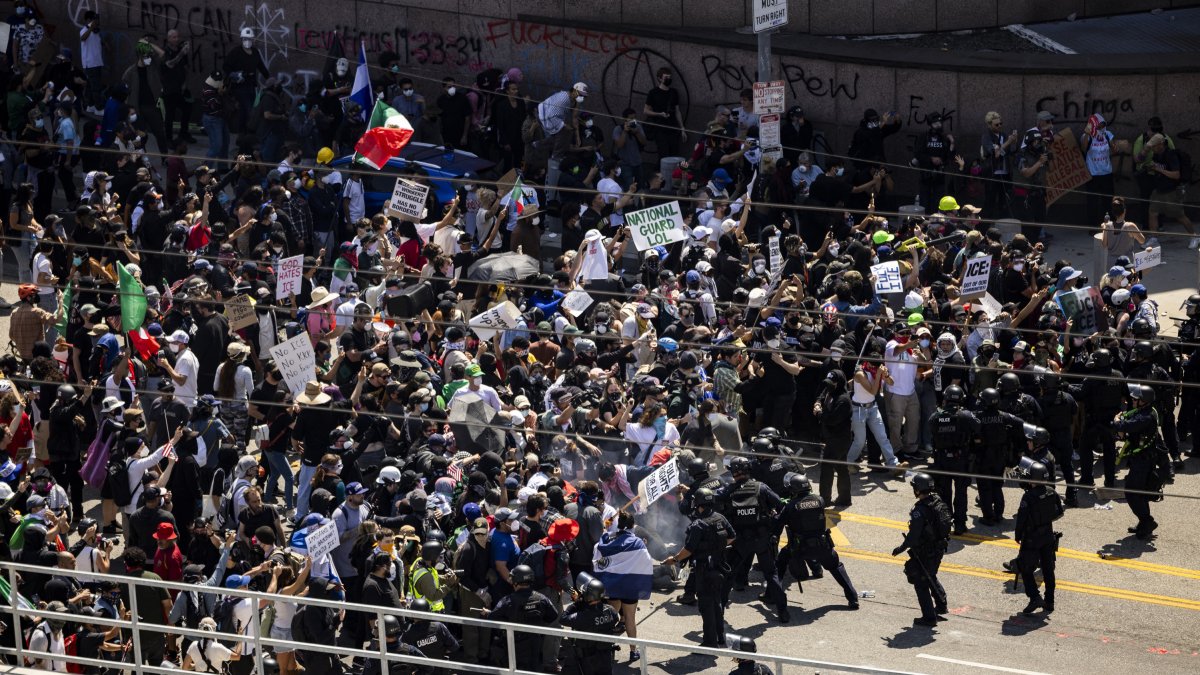
Clash between anti-ICE vandals and law enforcement in Los Angeles

The acceptance or justification of violence against public figures, including their murder, is higher the further to the left of the political spectrum the voter or activist is. This reality has come to light again in the wake of reactions to the murder of conservative influencer Charlie Kirk.
That's the result of a YouGov poll indicating that 24% of people who identified themselves as far-left sympathizers consider the death of a public figure they oppose as "always or usually acceptable." While a majority (56%) of this group see the issue as "unacceptable," another 20% are "not sure" how they feel about it.
Left-wing voters are the second-largest group to defend assassinations
Next, 10% of those who consider themselves just regular left-wingers say the assassination of public figures is acceptable, making them the second-largest group in defending the death of public figures with whom they disagree. Seven percent of moderates and just 4% of "conservatives" would always or usually see the assassination of a political rival as acceptable.
Those who identify as "very conservative" are the least willing to justify the death of a personality, with just 3% of them in favor and 91% against.
Young people, especially those on the left, are more in favor of violence
By age, young people between 18 and 29 are the most likely to advocate violence against their political opponents (12%), especially self-proclaimed liberals (22% of those aged 18-44). Among conservatives aged 18-44, the percentage of those who justify murder reduces to 6%, while among moderates it is 10%.
Those between 30 and 44 follow closely behind the younger generation (11%) in terms of accepting violence. Among the 45-65 age bracket, support drops to 6%, and among those over 65 to 5%.
25% of far-left voters justify violence
These percentages are repeated in terms of support for political violence, to an even greater extent. In this field, 25% of "very liberal" voters consider that violence can be justified, followed by 17% of "liberal" voters who think the same.
In contrast, barely 3% of very conservative voters accept political violence, while conservatives who support the use of violence is 6%. Among moderates, support reaches 9%.
Leftist voters perceive greater danger in right-wing violence
Paradoxically, it is also left-wing voters who consider to a greater extent that violence by right-wing voters is a serious problem than right-wing voters with respect to left-wing voters.
Seventy-five percent of left-wing voters consider violence by right-wing groups a problem, while 73% of right-wing voters consider violence by left-wing groups to be more serious. Thirty percent of moderates see violence from the right as worse, compared to 18% who point to the left.
Vance claims that "people on the left are much likelier to defend and celebrate political violence" on Charlie Kirk's podcast
During the program, Vice President noted that the poll makes it clear that "it's not a both sides problem," but that "one side has a much bigger, malignant problem, and that's the truth that needs to be told."
"In a country of 330 million people, you can of course find one person of a given political persuasion justifying this or that, or almost anything, but the data is clear, people on the left are much likelier to defend and celebrate political violence. This is not a both sides problem. If both sides have a problem, one side has a much bigger and malignant problem, and that is the truth we must be told. That problem has terrible consequences."
Vance, moreover, pointed to the source of this problem, recalling assassination attempts against House Republican Majority Leader Steve Scalise and against Donald Trump during the campaign:
"This violence, it doesn’t come from nowhere. Now any political movement violent or not, violent is a collection of forces. It’s like a pyramid that stacks on top. One support on top of the other. That pyramid has got a foundation of donors, of activists, of journalists, now, of social media influencers and, of course, of politicians. Not every member of that pyramid would commit a murder. In fact, over 99 percent I’m sure would not. But by celebrating that murder, apologizing for it, and emphasizing not Charlie’s innocence, but the fact that he said things some didn’t like, even to the point of lying about what he actually said, many of these people are creating an environment where things like this are inevitably going to happen."
LATEST