Mayor Johnson responds to Trump: 'The people of Chicago will rise up against tyranny'
The Democrat also criticized the president’s spending on the federalization of D.C.

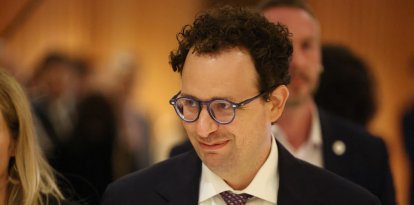
Johnson at the DNC/ Andrew Caballero- Reynolds.

Chicago Mayor Brandon Johnson said Sunday that if President Donald Trump deployed the National Guard to the city, residents would rise up against what he called the president’s “tyranny.”
The Democrat made the remarks came on MSNBC's The Weekend after co-host Jonathan Capehart asked about a recent news report discussing a possible “deployment of thousands of active-duty troops to Chicago."
"What would the reaction be in Chicago if the president of the United States did indeed deploy active military on the streets of Chicago?" asked Capehart, referencing a similar strategy implemented weeks ago in Los Angeles.
Johnson said, "Well, I repeat, the city of Chicago does not need a militarily occupied state; that does not define us. I commend the work of Mayor Bass, my colleague, and all the people of Los Angeles who stood up and fought against this authoritarianism. In short, they have no police power. They can't do anything. They are federal troops and they don't get the same training as our police officers. So they can't even exercise police authority."
The Chicago mayor also criticized the president’s spending on the federalization of Washington, D.C. “He’s clearly shown that he doesn’t have the conscience to understand what it takes to govern cities, let alone an entire country. We’ll stand our ground,” he said.
Johnson warned that he would take legal action if the National Guard were ever sent to Chicago:
"But the people of this city are used to rebelling against tyranny. And if necessary, I believe the people of Chicago will stand firmly behind me as I work every day to protect the people of this city."
The mayor, in office since 2023, reacted after the Washington Post reported over the weekend that the Pentagon is preparing plans for a possible troop deployment to Chicago as part of Trump’s strategy to intensify the fight against crime, homelessness, and illegal immigration in major U.S. cities.

Society
Trump threatens to send troops to Baltimore to 'quickly clean up crime'
Emmanuel Alejandro Rondón

Politics
National Guard began carrying guns in Washington D.C. after Trump administration order
Luis Francisco Orozco
Democrats criticize the president's proposal
Other officials have questioned the president’s plans to curb crime in the nation’s major cities. House Minority Leader Hakeem Jeffries (D-N.Y.) also criticized Trump's threats to crack down on crime in Chicago without a formal request from the state.
Jeffries called the move “an effort to create a crisis and a distraction” during an appearance on CNN’s State of the Union.
Deploying the National Guard to another Democratic-led city, as announced over the weekend, would mark another escalation in the president’s promise to “make our country safe.”
Less than two weeks after Trump deployed National Guard members and federal law enforcement to D.C., the White House declared the operation a success. Now, the president claims that Chicago residents, including “African-American ladies,” are “screaming” for him to bring forces into their city.
Similarly, Illinois Governor J.B. Pritzker (D) responded to the possibility of troops entering his state.
"There is no emergency that would justify the president of the United States federalizing the Illinois National Guard, deploying the National Guard from other states or sending active duty military within our own borders."


Politics
Pentagon plans military deployment in Chicago as Trump steps up crime fight
Emmanuel Alejandro Rondón
Other cities in Trump's crosshairs
President Trump temporarily placed Washington, D.C., police under federal control on Monday and suggested he might intervene in other cities, despite falling crime rates.
The president also labeled Los Angeles, Baltimore, Oakland, New York, and Chicago as “bad, very bad” cities, without providing specific reasons or a timeline for action.
He said D.C.'s crime rates and homeless population are the reasons for his intervention in the nation’s capital, despite the Justice Department reporting in January that violent crime is at a 30-year low.
Crime data
Data from 68 law enforcement agencies also showed a 19% decrease in homicides in most major cities during the first half of 2025, according to the Major Cities Chiefs Association.
Oakland saw a significant decline in crime in 2024, according to the data from the local police department. Violent crime was down 19% compared to 2023, homicides dropped 32%, and motor vehicle theft fell 32%. Robberies decreased 24% and burglaries were down 48%.
Chicago experienced a 15% overall crime reduction since 2023, with murders down 37%, robberies down 36%, and vehicle thefts down 44%.
Baltimore City reported a 17% decrease in violent crime over the past year. Homicides fell 27%, and vehicle thefts dropped 20%, according to the city's Police Department dashboard.
New York City saw a 3% overall decline in crime in 2024, with robberies down 27% and murders down 4%, based on local police reports.
LATEST