Florida bans undocumented students from 28 public high schools
The new regulation will require applicants to prove that they are U.S. citizens or are legally in the country. The restriction also applies to public adult education programs, including classes to prepare for the GED.
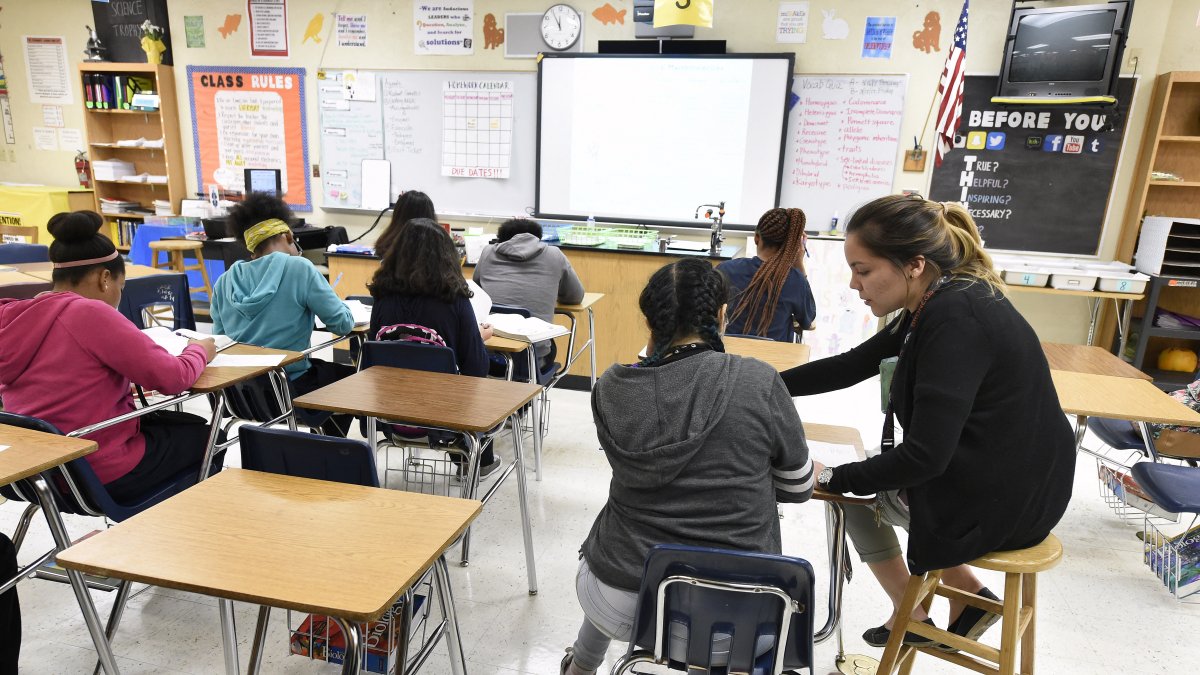
A teacher interacts with her students in a classroom (File photo)

Florida has tightened admission requirements for public postsecondary education by prohibiting the admission of undocumented students to the 28 institutions that make up the Florida College System.
The State Board of Education approved the change on June 30 by amending the admission regulations. Once the change takes effect, only those who can prove they are U.S. citizens or are legally present in the country will be able to enroll.
The measure also restricts undocumented immigrants' access to public general adult education programs, including GED preparation courses, which are used to obtain a certification equivalent to a high school diploma.
The amendments were approved through administrative rules 6A-10.0240 and 6A-6.014. The first will formally take effect on August 5, 2026, according to the official Florida Administrative Rules Register.
Students must prove their legal status
Each institution must establish procedures to verify the immigration status of its applicants.
Before being admitted, a student must declare that they are a U.S. citizen or that they are legally present in the country. They must then submit documents supporting that declaration before completing their enrollment.
The regulation requires that the documentation be "clear and convincing" and provide credible proof of the applicant's immigration status.
The State Board of Education formally included the two amendments among the items submitted for approval during its June 30 meeting.
Education officials maintain that the change aims to establish uniform minimum criteria for admission to the state system and ensure that publicly funded seats are used by citizens or legally present immigrants.

Society
Battle for educational funding in Florida: School voucher system enters its most critical phase
Diane Hernández
The restriction also applies to adult education programs
The Board separately approved an amendment to Rule 6A-6.014, which governs general adult education programs.
According to official documentation, the purpose of the rule is to require that all participants in these programs be U.S. citizens or legally present in the country.
School districts and Florida College System institutions offering these services must adopt specific policies to verify participants' status.
These programs include basic adult education, literacy classes, academic remediation, and GED preparation.
The restriction thus expands the scope of the state's immigration policy beyond traditional college programs and also affects individuals seeking to complete their high school education or acquire the skills needed to pursue higher education.
Does it also affect public universities?
These institutions—including the University of Florida, Florida State University, Florida International University, and the University of Central Florida—fall under the authority of the Board of Governors, not the State Board of Education.
The Board of Governors has initiated its own proceedings to consider a similar restriction, but that policy has yet to complete the appropriate approval process.
The board's next meeting is scheduled for September 2–3, 2026, at Florida Gulf Coast University.
For this reason, there is legal uncertainty regarding whether Florida has definitively banned undocumented students from attending all of its public universities. The ban confirmed so far is limited to the 28 institutions in the Florida College System and certain adult education programs.
What Is the Florida College System?
The Florida College System consists of 28 public institutions located throughout the state.
These institutions offer associate degrees, select bachelor's degrees, professional certificates, and technical and vocational training programs. They also serve as a pathway for students who later transfer to a four-year university.
The regulations do not automatically apply to private universities or other educational institutions that are not part of the state's public system.

Society
Florida will give parents control over the use of artificial intelligence in public classrooms
Diane Hernández
Florida, the fourth state with admission restrictions
With this decision, Florida joins Alabama, Georgia, and South Carolina among the states that maintain some form of admission ban or restriction for undocumented students at public institutions of higher education.
The new policy comes after Florida eliminated the benefit that allowed certain undocumented students to pay in-state tuition, which is considerably cheaper than the out-of-state rate.
That benefit had been in place for approximately a decade and allowed some young people who had attended and graduated from high school in Florida to pay the same tuition rates as other residents.
The elimination of this financial aid made college more expensive for these students. The new rule goes even further by directly barring their admission to the institutions covered by the policy.
A stricter immigration policy in education
The administration of Republican Governor Ron DeSantis has long argued that the state should not offer incentives or taxpayer-funded services to people who are in the United States illegally.
The decision adopted by the State Board of Education reinforces that stance within the education system: first by eliminating reduced tuition rates and now by prohibiting admission to state public high schools and adult education programs.
The next step will be to see whether the Board of Governors extends a similar policy to Florida's 12 public universities. Until that body makes a final decision, the two processes should be considered separate.
LATEST