Battle for educational funding in Florida: School voucher system enters its most critical phase
The lawsuit was filed by the Florida Education Association (FEA), along with families, school representatives and civic organizations.
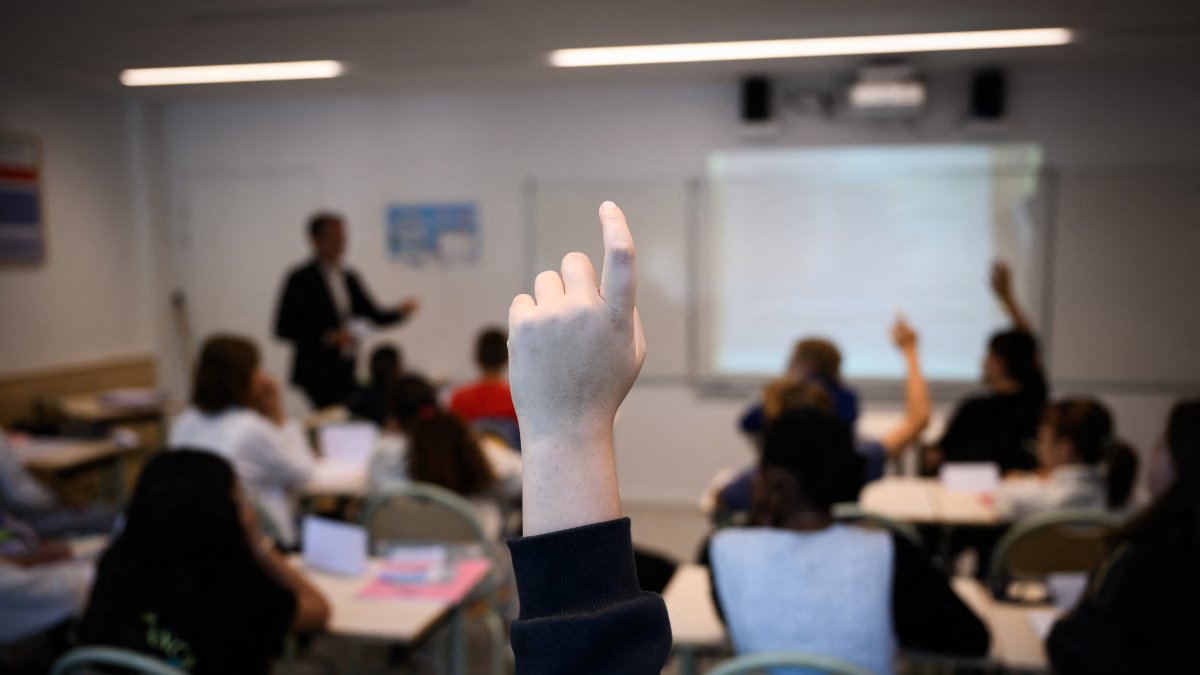
Students in a school classroom (File)

The school choice model pushed by Ron DeSantis faces its biggest court challenge since Florida expanded universal access to education vouchers. What began as a policy presented by the Republican administration as a tool of "freedom for families" now drifted into a substantive dispute over the future of public education, the use of state money and the growth of a publicly funded private system.
The lawsuit filed in Leon County Circuit Court not only challenges the legality of the program. It also exposes an increasingly visible tension within the Floridian education system: as hundreds of thousands of families migrate to state-subsidized private options, public districts report a progressive loss of funding, enrollment and operational capacity.
The lawsuit was filed by the Florida Education Association (FEA), along with families, school representatives and civic organizations. The overall complaint points out that Florida has allegedly created a parallel educational network financed with public funds but without the same requirements of transparency, academic control and supervision that apply to state schools.
A model that changed the educational map of Florida
The accelerated transformation of the system began in 2023, when Ron DeSantis signed HB 1 into law and eliminated income restrictions for accessing school vouchers.
Since then, any student in compulsory formal education in the country can apply for public funds to cover private tuition, tutoring, educational materials or homeschooling programs. The benefit is around $8,000 per year per student.
The magnitude of the program quickly modified the state's educational structure.
Official data included in the lawsuit indicate that more than 521,000 students currently participate in private or homeschooling programs funded with state money. The associated spending already accounts for about a quarter of Florida's education budget, a figure that worries unions and local officials.
For defenders of the system, the growth confirms that families were looking for alternatives and now have the tools to choose. For critics, the phenomenon reflects a massive transfer of resources out of the traditional public system.
The core of the conflict: Who controls the money
The most sensitive aspect of the case is not only how much money goes to school vouchers, but under what mechanisms this spending is controlled.
The lawsuit contends that many private schools receiving funds are not held to standards equivalent to those of public schools in key areas such as:
- academic assessment
- financial transparency
- teaching recruitment
- equal access
- state oversight
The plaintiffs also point out that some of the beneficiary institutions are run by private operators or for-profit educational companies based outside Florida.
This point became especially sensitive after state auditors noticed administrative problems within the scholarship system, including delays in payments, inconsistencies and difficulties in verifying the effective destination of some public resources.
Florida Education Association President Andrew Spar affirmed that the goal of the lawsuit is not to eliminate school choice, but to demand minimum oversight rules for any institution funded with state money.
DeSantis' political strategy
The Republican administration argues that the system empowers parents and breaks with decades of exclusive reliance on public districts.
From the state Department of Education, Commissioner Anastasios Kamoutsas recently defended the model and said Florida will continue to prioritize "the needs of students over institutional interests."
The official narrative presents vouchers as an expansion of educational opportunities and a tool to improve academic outcomes through competition among schools.
The silent impact on public schools
While the political debate focuses on "freedom of choice," school districts face a more practical problem: fewer students means less money.
In Florida, much part of educational funding depends directly on enrollment. When students migrate to subsidized private programs, public districts lose operating funds.
That affects:
- Teacher recruitment
- School maintenance
- Extracurricular programs
- Transportation
- Student support services
Concern is also growing in a complex context for the state education system. Florida remains among the states with lowest average teacher salaries and continues to lag behind the national average in per-pupil investment.
Educators argue that the expansion of the private system is occurring without a parallel strengthening of public education, generating unequal competition between institutions operating under different rules.
The Hispanic factor: Opportunity and risk
The discussion takes on a special dimension within the Hispanic community, which represents a decisive portion of Florida's student body.
For many Latino families, especially middle- and low-income families, school vouchers opened up the possibility of accessing private schools, bilingual programs and religious institutions for the first time that were previously out of reach.
The system also favored the growth of personalized educational models and homeschooling alternatives within conservative Hispanic communities.
However, civic organizations warn that the financial deterioration of public schools could disproportionately impact precisely those Hispanic students who remain within the state system, especially in urban districts with high Latino concentrations.
The result is a political and social paradox: the same program that expands educational options for thousands of Hispanic families could, at the same time, deepen inequalities within the public schools where the majority of Latino students still study.
The court decision now could define not only the future of the school voucher system in Florida, but also the balance between public and private education in one of the most influential states in the country.
LATEST