Washington expands sanctions against Cuba, targeting source of regime’s funding and repression apparatus
The decision is part of the "maximum pressure" policy promoted by President Donald Trump's administration since his return to the White House and is based on Executive Order 14404, signed on May 1, 2026, which significantly expanded the scope of U.S. sanctions against officials, agencies and companies linked to the elite of the Castro dictatorship.
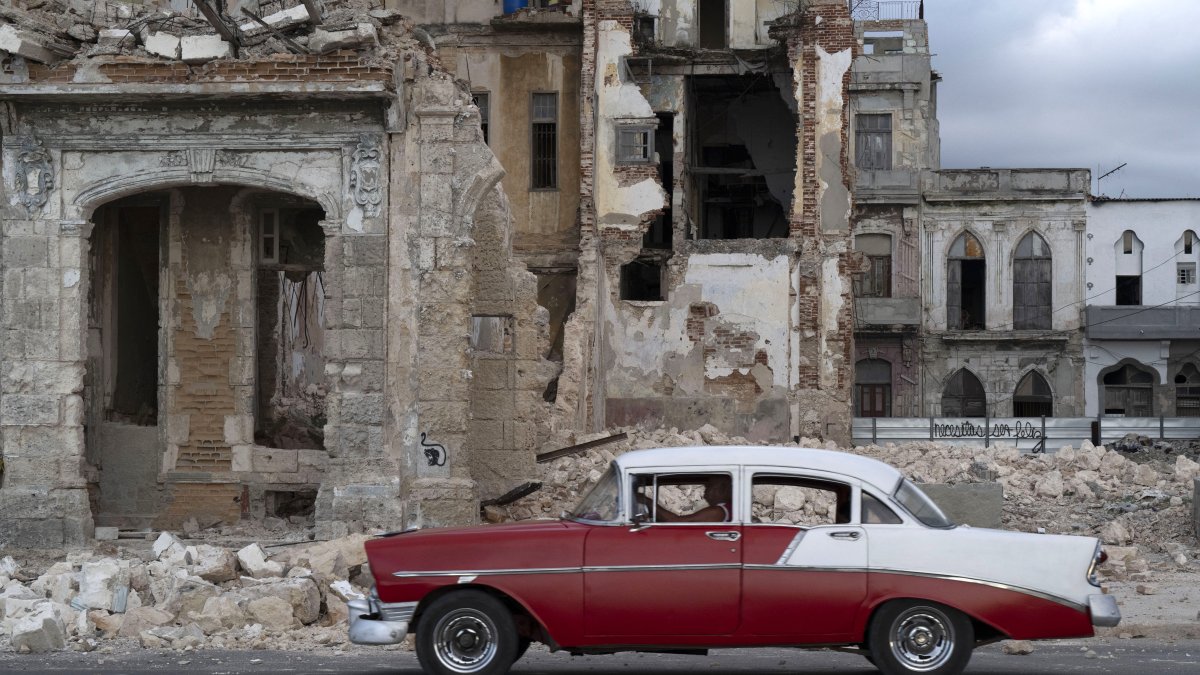
An old car passes by the rubble of a house in Havana (File photo)

The State Department announced on Monday a new package of sanctions against 10 Cuban entities, in a move that, according to Washington, seeks to weaken both the sources of funding for the Cuban regime and the structures involved in internal repression.
The decision is part of the "maximum pressure" policy promoted by the administration of President Donald Trump since his return to the White House and is based on Executive Order 14404, signed on May 1, 2026, which significantly expanded the scope of U.S. sanctions against officials, agencies and companies linked to the elite of the Castro dictatorship.
In the official statement, the State Department noted that the new designations seek to "end the Cuban regime’s malign activities, both in Cuba and across our hemisphere," by targeting "the interlocking pillars" of the state apparatus, including companies that generate revenue for the government, paramilitary organizations, and groups responsible for internal surveillance and control.
The sanctioned entities
The sanctions target two major groups.
On the one hand, Washington sanctioned organizations it considers part of the repressive apparatus of the Cuban regime:
- Territorial Troop Militias (MTT)
- Association of Combatants of the Cuban Revolution (ACRC)
- Rapid Response Brigades
- Antillean Export Corporation (ANTEX S.A.), accused by the United States of managing the export of Cuban labor to Angola
On the other hand, state-owned companies and agencies considered by Washington to be sources of revenue for the Castro dictatorship were included:
- ENETEC S.A.
- COREYDAN S.A.
- Foreign Trade Business Group (GECOMEX)
- Caudal S.A. Higher Business Management Organization (CAUDAL)
- Maritime and Port Transportation Business Group (GEMAR)
- Cuban Ministry of Tourism (MINTUR)
According to the State Department, these entities operate in strategic sectors such as energy, foreign trade, maritime transport, financial services and tourism—areas that the U.S. administration considers fundamental to the economic sustainability of the regime.
Legal framework for the sanctions
The measures were adopted under Executive Order 14404, issued on May 1 of this year, which authorizes sanctions against individuals and entities linked to repression in Cuba, support for the state security apparatus, and activities that, according to Washington, pose threats to the country's national security and foreign policy.
The executive order also expands the risk of sanctions for foreign individuals or financial institutions that conduct significant transactions with sanctioned entities or with strategic sectors of the Cuban economy, including energy, defense, financial services, and security.
What do these sanctions entail?
As a result of the designations:
- All assets and interests of sanctioned entities located within U.S. jurisdiction are blocked.
- U.S. citizens and companies are prohibited from conducting transactions with them unless expressly authorized by the Office of Foreign Assets Control (OFAC).
- Foreign individuals, companies or banks that engage in certain transactions with the listed entities may also face sanctions.
Escalating pressure on Havana
Since May, Washington has issued several rounds of sanctions targeting high-ranking officials of the Cuban regime, companies controlled by the military conglomerate GAESA, and state-owned companies in strategic sectors, particularly energy and foreign trade.
On June 23, for example, the State Department sanctioned five additional entities and one individual linked to Cuba's economic structure, as part of the same strategy of financial pressure.
Washington's position
The announcement comes just two days after the fifth anniversary of the July 11 protests of 2021.
In that context, Secretary of State Marco Rubio stated that the United States will continue to use "all tools at its disposal" to respond to the threats that, according to Washington, the Cuban regime poses to U.S. national security and to promote political and economic reforms on the island.
So far, Havana has not issued an official response to this new package of sanctions.
LATEST