"A legal abomination": Conservatives react to Supreme Court's birthright citizenship ruling
Several conservative lawmakers, governors, and opinion leaders spoke out against the ruling, including Ted Cruz, Ben Shapiro, Ron DeSantis, and Mark Levin.

Ted Cruz in Dallas, Texas/ ARIC BECKER / VARIOUS SOURCES

Conservatives harshly criticized the Supreme Court's ruling on birthright citizenship. In the case of Trump v. Barbara, the nation’s highest court ruled that children born in the United States to parents who are in the country illegally or temporarily are subject to U.S. jurisdiction and, therefore, are U.S. citizens from birth.
Several conservative lawmakers, governors, and opinion leaders spoke out against the ruling, including Ted Cruz, Ben Shapiro, Ron DeSantis, and Mark Levin.
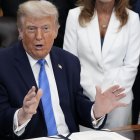
The case centered on the constitutionality of Executive Order 14160, signed by Donald Trump on January 20, 2025, during his first day back in the White House. The measure sought to deny automatic citizenship to the children of undocumented immigrants and foreign nationals with temporary status who were born on U.S. soil. According to the White House, the phrase “subject to the jurisdiction thereof” in the Fourteenth Amendment did not apply to such individuals, and therefore their children did not automatically acquire citizenship at birth.
The executive order was quickly challenged in court. After several filings, a federal district court certified a nationwide class-action lawsuit on behalf of the affected children and blocked enforcement of the order. Subsequently, the Supreme Court agreed to hear the case before the First Circuit Court of Appeals issued its ruling on appeal. The families involved argued that it violated both the Citizenship Clause of the Fourteenth Amendment as well as the Immigration and Nationality Act (INA) of 1952.
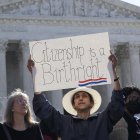
The Trump Administration contended that these individuals were not fully “subject to the jurisdiction thereof” of the United States, while the plaintiffs argued that this interpretation contradicted both the text of the Constitution and more than a century of case law, citing the precedent established by United States v. Wong Kim Ark in 1898.
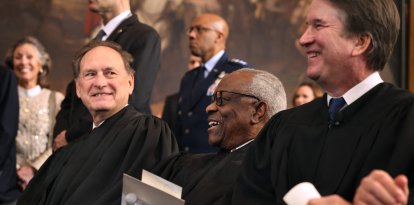
In a 6-3 decision, the Supreme Court ruled in favor of the plaintiffs and declared the executive order invalid. Three conservative justices, John Roberts, Amy Coney Barrett and Brett Kavanaugh, sided with the liberal justices Sonia Sotomayor, Elena Kagan, and Ketanji Brown Jackson. Clarence Thomas, Samuel Alito, and Neil Gorsuch dissented. The majority opinion was written by Roberts, the Chief Justice.
Conservative criticism of the Supreme Court’s ruling
One of the first high-profile conservatives to react was Ted Cruz. The Texas senator called the ruling a “travesty.”
"The Fourteenth Amendment was written to overturn Dred Scott and guarantee citizenship to freed slaves—not to create automatic citizenship for the children of those who violate our immigration laws or are only temporarily in the United States. The Court adopted an interpretation that departs from the original meaning of the Constitution and incentivizes illegal immigration," he added.
">Today’s decision regarding birthright citizenship is a travesty.
— Senator Ted Cruz (@SenTedCruz) June 30, 2026
The Fourteenth Amendment was written to overturn Dred Scott and guarantee citizenship to freed slaves—not to create automatic citizenship for the children of those who violate our immigration laws or are only…
He was joined by Ben Shapiro, a popular conservative commentator, who posted on X: “The Supreme Court's ruling on birthright citizenship is a legal abomination. But it's just more evidence that Congress and multiple presidents, in abdicating their duty on immigration for decades, have screwed America irredeemably."
For author and host Mark Levin, this is a “cowardly” decision by the Supreme Court, “an abomination giving constitutional protection to what is illegal conduct.”
">The Supreme Court's ruling on birthright citizenship is a legal abomination. But it's just more evidence that Congress and multiple presidents, in abdicating their duty on immigration for decades, have screwed America irredeemably. We're going live now:https://t.co/4lDLbY22lT
— Ben Shapiro (@benshapiro) June 30, 2026
For Kevin Roberts, president of The Heritage Foundation, the leading conservative think tank in Washington, D.C., the ruling amounts to a “betrayal of the republic.” “The Justices in the majority have inflamed the all-out assault on our sovereignty and cheapened the sacred value of American citizenship. Universal birthright citizenship erases any uniquely American birthright—a distortion that was never the meaning or intention of the 14th Amendment,” he added.
Among the critics was Florida Governor Ron DeSantis: “No matter how you look at it, the decision is a major defeat.”
“Modern global travel, the liberal love affair with open-borders policies, and a dangerous international security environment make this decision an immediate national security threat. It’s past time for a constitutional amendment,” Dan Bongino wrote, a host and former deputy director of the Federal Bureau of Investigation (FBI).
">If “the Constitution is not a suicide pact,” today’s birthright citizenship ruling is a major step backward.
— Dan Bongino (@dbongino) June 30, 2026
Modern global travel, the liberal love affair with open-borders policies, and a dangerous international security environment make this decision an immediate national…
Matt Walsh, a political commentator and host at The Daily Wire, asserted that "Nobody believes that the Founders ever intended any of this." "This is one of those times where the debate is a facade. The other side doesn’t believe their own bullshit. They know this is ruinous for the country. That’s why they’re so elated. As for the Constitution, they couldn’t care less," he added.
In turn, several Republican lawmakers, including Marsha Blackburn, Tom Cotton and John Cornyn, argued that the ruling leaves conservatives with only one avenue to change the principle of birthright citizenship: pushing for a constitutional amendment.
Unlike an executive order or a law passed by Congress, a constitutional amendment requires a two-thirds majority vote in both houses of Congress and subsequent ratification by three-quarters of the states, an extremely difficult threshold to reach. Following the ruling, the senators argued that as long as the Fourteenth Amendment retains its current wording and the Supreme Court continues to interpret it in accordance with the precedent set in United States v. Wong Kim Ark, any attempt to restrict birthright citizenship through other means will once again face legal obstacles.
">Nobody believes that it’s a good idea, or makes any rational sense, to award citizenship to the babies of illegal immigrants. Nobody believes that the Founders ever intended any of this. This is one of those times where the debate is a facade. The other side doesn’t believe their…
— Matt Walsh (@MattWalshBlog) June 30, 2026
LATEST