ANALYSIS
US and Israeli strikes against Iran's nuclear program have 'substantially' reduced the regime's ability to manufacture atomic bomb
The joint offensive by the two countries removed the country from nuclear "threshold power" status, according to Israeli sources.

Bushehr nuclear power plant, Iran/ Atta Kenare.

The recent attacks by the United States and Israel against nuclear and ballistic targets in Iran significantly reduced the ayatollah regime's ability to make an atomic bomb.
So notes Spencer Faragasso of the Institute for Science and International Security, a U.S. center dedicated to monitoring Iran's nuclear activities. In a report, Faragasso stressed that "overall, this conflict has set back Iran's nuclear programme substantially."

World
US enforces its naval blockade against Iran: Six ships turned away without a single shot fired
Emmanuel Alejandro Rondón
"It will take a significant amount of time, investment, and resources to reconstitute all of those lost capabilities," he said. However, Faragasso said that "the gains from the conflict are not permanent by any means."
It is estimated that some of the highly enriched uranium would be hidden in tunnels at the Isfahan facility, located in central Iran.

"At least 220 kilogrammes – roughly half of Iran's declared stockpile of 60 percent HEU – is believed to be stored in the underground tunnel complex at Isfahan," he said.
"The status of the other half is unclear, but we believe it is buried under the rubble at Fordow as large significant quantities of 60 percent HEU were produced prior to the June 2025 war", Faragasso added.
Iran loses its "threshold power" status
On the other hand, an Israeli diplomatic source told AFP "Iran is no longer a threshold power as it once was," that is, a country with the knowledge, resources and infrastructure necessary to rapidly develop a nuclear weapon.
According to the same source, in addition to material damage, Tehran has suffered a significant blow due to the loss of scientists and key officials, as well as from attacks on universities housing data centers linked to Iranian nuclear know-how.
Washington and Jerusalem put the brakes on Iranian nuclear breakthrough
President Trump authorized the military operations in late February, in part because he felt that Iran was moving toward developing a nuclear weapon after negotiations with the regime failed. Trump has been clear and consistent in stating, "I will never allow the world’s number one sponsor of terror, which they are by far, to have a nuclear weapon."
JNS
‘Operation Roaring Lion’ thwarted Iran’s plans for nuclear Holocaust, Netanyahu says on Yom Hashoah
JNS (Jewish News Syndicate)
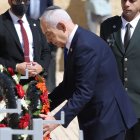
Israeli Prime Minister, Benjamin Netanyahu, asserted Monday night that the "Operation Roaring Lion" against Iranian nuclear facilities fulfilled the Jewish state's promise to prevent a second Holocaust.
As he added, had Israeli and U.S. forces not intervened, "the names Natanz, Fordow, Isfahan and Parchin might have been remembered eternally in infamy, just like Auschwitz, Treblinka, Majdanek and Sobibor." These statements were released during the state ceremony for Holocaust Martyrs' and Heroes' Remembrance Day (Yom HaShoah).
Midnight Hammer destroyed key infrastructure of Tehran's atomic program
The Israeli prime minister noted in June that Operation Midnight Hammer, carried out by the U.S., accurately targeted key Iranian enrichment facilities, destroying key infrastructure and numerous centrifuges. According to Netanyahu, the operation dealt a significant blow that significantly slowed the Iranian regime's advance toward a nuclear weapon.

"We removed two existential threats: The threat of annihilation by nuclear weapons and the threat of annihilation by 20,000 ballistic missiles. Had we not acted now, the State of Israel would have soon faced the danger of annihilation," the prime minister declared after the attacks.
Prior to Operation Midnight Hammer, the International Atomic Energy Agency (IAEA) estimated that Iran possessed about 440 kilograms of uranium enriched to 60%, above the limit set in a 2015 deal that collapsed when the United States withdrew from it.
Russia withdraws nearly all its personnel from Iran's Bushehr nuclear plant
Likhachev explained that those people are heading to Isfahan and that the process is proceeding according to plan. He added that only about 20 employees will remain at the plant, responsible for management and equipment, and will make up Rosatom's "final delegation."
Bushehr, with a 1000-megawatt reactor, is the only operating civilian nuclear power plant in Iran.
The evacuation began after the outbreak of war in the Middle East. Since then, the plant has been attacked on at least four occasions.
LATEST