Takaichi reaffirms Japan's alliance with Trump, while the president brings up Pearl Harbor
Japan faces legal limits on deploying its military forces in combat operations outside of direct defense of its territory, a restriction set by its postwar constitution.
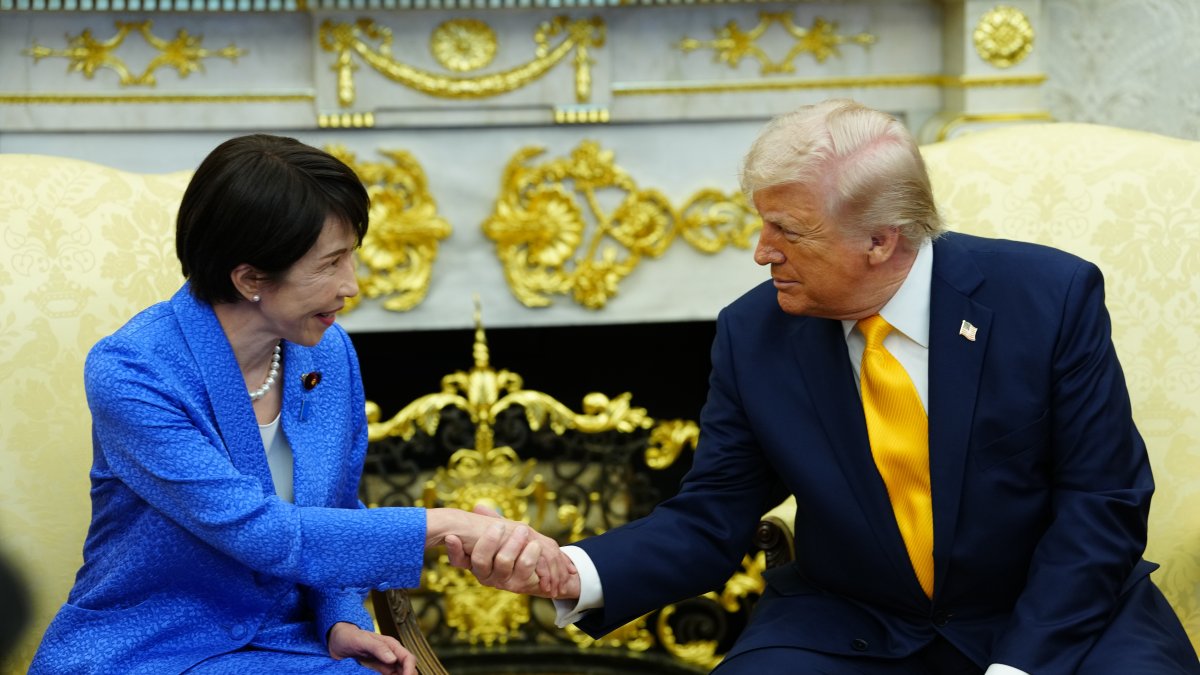
President Donald Trump and Japanese Prime Minister Sanae Takaichi.

Japanese Prime Minister Sanae Takaichi traveled to Washington Thursday to bolster the historic alliance with the United States amid rising tensions in the Middle East and pressure from the White House for Japan and other allies to collaborate on securing the strategic Strait of Hormuz.
Facing pressure from Trump over Hormuz
Takaichi's visit came amist global tensions: President Donald Trump has been pressing allies, including Japan, to contribute more actively to an international effort to secure free navigation through the Strait of Hormuz, a critical sea route through which much of the world's oil transits.
While six countries, including Japan, issued a joint statement expressing general support for the idea of an international coalition to protect the area, no firm commitment to deploy naval assets materialized.
Takaichi noted that Tokyo opposes the development of nuclear weapons by Iran and brings its willingness for dialogue with global partners to achieve common goals to the diplomatic table, although the details of any contribution from Japan remain unclear.

The alliance facing Japanese legal and constitutional challenge
Japan faces legal limits on the deployment of its military forces in combat operations outside direct defense of its territory, a restriction established by its postwar constitution. This complicates how it can support a possible effort in the Strait of Hormuz without violating that pacifist policy.
Ahead of the meeting, Takaichi was scheduled to explain Japan's legal red lines regarding any potential deployment in the Middle East to Trump, stressing that any involvement must conform to Japan's constitutional framework.
A historic comment that was not seen coming
During the joint public appearance with Takaichi, Trump alluded to the Japanese attack on Pearl Harbor in 1941, when he defended his decision not to inform allies in advance of the U.S. attack on Iran. The president's words, "Who knows better about surprise than Japan?" generated a visible reaction of discomfort from the prime minister.
Japan carried out a surprise attack on the U.S. Navy at Pearl Harbor in Hawaii on Dec. 7, 1941, which triggered the entry of the United States into World War II. Japan surrendered in 1945 after being the target of the first and last two atomic bombs used in history, in the cities of Hiroshima and Nagasaki, which caused 214,000 deaths.
Renewed alliance but with strategic challenges
Despite the tensions, both leaders stressed the importance of the bilateral relationship and expressed their desire to strengthen it in areas such as trade, security and economic cooperation. Trump praised Takaichi as a "popular and powerful woman" and reaffirmed the need for Japan to step up in global efforts, especially given its high dependence on energy transiting the strait.
The global context, with the U.S.-Iran conflict and the importance of the Strait of Hormuz to global energy stability, places Japan in a complex position, in which it must balance its commitment to the United States, its own constitutional boundaries and its regional relationships.
The stakes: The Strait of Hormuz
The situation has led to diplomatic efforts and calls for international involvement to stabilize the area following escalating attacks and blockades, and Washington's pressure on its allies reflects the shared strategic importance of this sea passage.
LATEST