ANALYSIS
Trump 2028: The president celebrates the first year of his second term... But can he go for a third?
The Constitution prohibits Donald Trump from running for a third time. However, conservative officials and activists have explored avenues for a third term.

Trump 2028 caps for sale

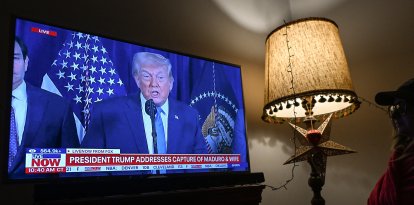
Donald Trump celebrates his second first year in office on Tuesday. Will he go for a third? Can he even do it?
Although he has expressed that he would like to, Trump himself has been contradictory about the possibility: he has said both "there are methods which you could do it" and that he is "not allowed to run." "It’s too bad."
Others in the MAGA camp harbor fewer doubts: "He is running in 2028," his ally Steve Bannon assured in an anniversary interview. "You look at the long-term plans he’s got with Greenland, with Canada. I think he’s telling you he’s got a long-term plan to save the country."
This isn't the first time Bannon has promised a third term. Nor is he the only one. Here are the main proposals for a Trump 3.0 and the legal limits that prevent it.
The 22nd Amendment: The two-term limit
The main legal obstacle is the 22nd Amendment, ratified in 1951 after the four-term presidency of Franklin D. Roosevelt. "FDR" was the only one to serve more than two terms. Although there was previously no legal prohibition, it was customary not to seek reelection, following in the footsteps of George Washington in 1796.
The text of the constitutional amendment is clear: "No person shall be elected to the office of the President more than twice."
Since Trump has already been elected to two terms (2016 and 2024), this amendment prohibits him from running for the presidency again. The president himself acknowledged last year that the Constitution is "pretty clear" in this regard.
It is clear. But does it leave room for doubt?
Amending the Constitution
To circumvent the limit established by the Constitution, the Constitution can be amended. The process, however, is lengthy and requires numbers in Congress and the states that the Republican Party lacks (assuming the entire party throws itself behind the initiative).
It requires:
- Proposal: The proposed change must be approved by two-thirds in both the House and Senate, or a constitutional convention called by two-thirds of the states. Since 1787, this latter avenue has never been explored again.
- Ratification: The amendment must be ratified by three-fourths (38 of 50) of the states.
Senior GOP officials ruled out this possibility. However, in early 2025, Rep. Andy Ogles introduced a joint resolution (H.J.Res.29) to amend the Constitution.
This proposal would allow a president to be elected to a third term, provided that his first two terms were not consecutive, i.e., Trump's case.
If passed, it would literally read:
- "No person shall be elected to the office of the President more than three times, nor be elected to any additional term after being elected to two consecutive terms, and no person who has held the office of President, or acted as President, for more than two years of a term to which some other person was elected President shall be elected to the office of the President more than twice."
It is worth noting that the legislative text presented by Ogles recognizes the impossibility of Trump currently running for a third term: "Currently, under the Twenty-Second Amendment to the U.S. Constitution, a person may not be elected President more than twice."
Bannon also took aim against the constitutional amendment. The proposal: "Drive a Mack truck through the 22nd Amendment," he said in the interview in recent hours. He did not elaborate.

Are there loopholes for a third term?
Some supporters and academics have suggested alternative methods or loopholes for Trump to extend his stay in the White House:
- Succession via vice presidency: Under this theory, Trump could run for vice president in 2028 alongside an ally (such as J.D. Vance or Marco Rubio). If they win, the president-elect could resign, allowing Trump to assume office by succession. However, the 12th Amendment stipulates that no one "constitutionally ineligible to the office of President shall be eligible to that of Vice-President of the United States."
- Speaker of the House: A second path similar to the previous also aims at succession. The speaker of the House of Representatives is second in line of succession. If the president steps aside or dies and the vice president also dies, the speaker assumes the presidency. This option appears to circumvent the 12th Amendment's prohibition. What's more: the Constitution does not say that the speaker must be a member of the House, so the speaker could be elected without even having to win a popular vote (although historically representatives have always opted for one of their own).
- The entire line of succession: The same reasoning could apply to the other offices in the line of succession. After the president pro tempore of the Senate, comes a long succession of Cabinet members such as the secretary of state, the secretary of the Treasury, and the secretary of defense. These are nominated by the president and approved by Congress.
- Marginally, other possible avenues have been weighed (e.g., claiming that war powers prevail over limits or alternating mandates through the 25th Amendment), but experts have dismissed them as lacking a legal basis.
So... Trump 2028?
Therefore, although the tidy way for Trump to return to office goes through amending the Constitution, it is unlikely, both due to its duration and the necessary support needed. More tortuous but quicker would be to take advantage of the line of succession.
However, Trump maintained when asked about the option of running again that "people wouldn't like that." "It's too cute. It wouldn't be right." (It's worth remembering that the 12th Amendment would prohibit it). Be that as it may, official Trump 2028 caps are still on sale. "The future looks bright!" promises the product description: "Rewrite the rules with the Trump 2028 high crown hat."
LATEST