ANALYSIS
An X-Ray of the new GOP: The unexpected coalition built by Trump... and put to the test by his own policies
The coalition that carried the president to his second term is divided on issues such as illegal immigration, abortion, and antisemitism. “Today's Republican Party is a coalition, not an ideological monolith,” Jesse Arm of the Manhattan Institute explains to VOZ.
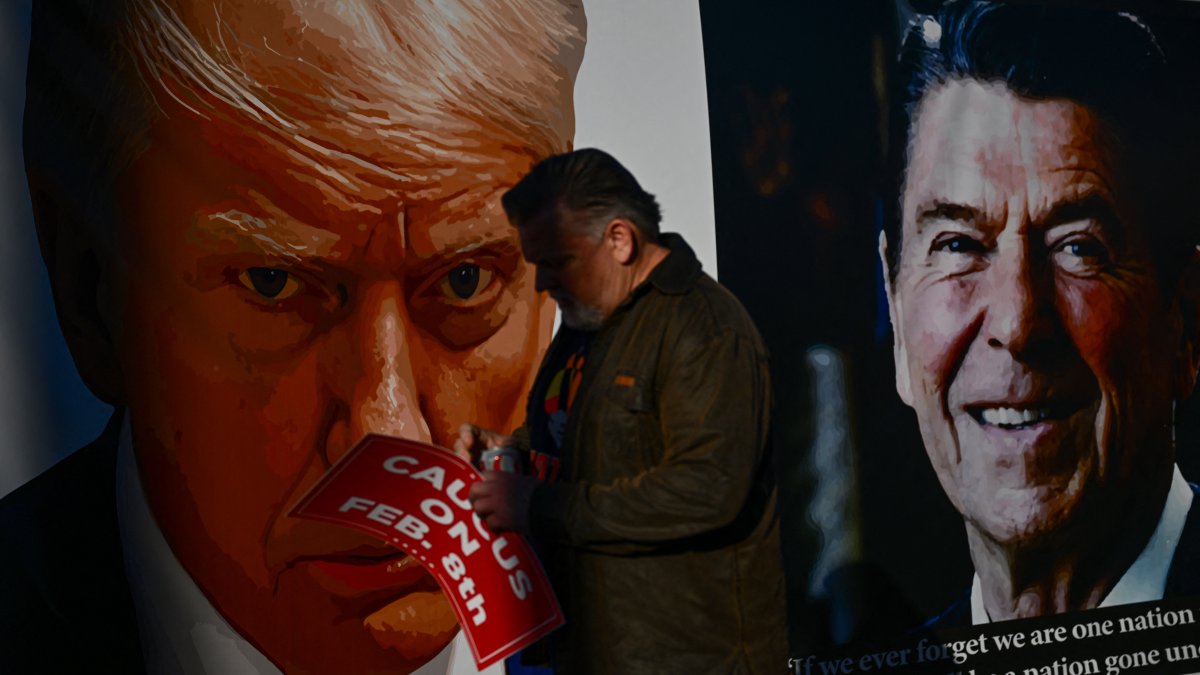
A voter between Donald Trump and Ronald Reagan/ Patrick T. Fallon

What's wrong with the Republican Party? Where is it going? Does it have a new voter base? What about Ronald Reagan? All of these questions arose after Donald Trump's 2024 victory. While the signs may not have been as clear in 2016 and 2020, the coalition of voters that gave the incumbent Trump the win over Kamala Harris was one of the most impressive in recent years.
Hispanics, African Americans, Asians and the famous "only Trump" coexisted to make the tycoon the second person in history to serve two non-consecutive terms, after Grover Cleveland. He was even the first Republican to win the popular vote in 20 years.
Like the "Obama Coalition" of 2012, which seemed indestructible and immortal, his main challenge will be to sustain himself over time, or at least for more than four years.
To try to answer the questions at the outset, the Manhattan Institute put together a big survey, from which nearly 3,000 people participated, divided into four different national groups: Republicans and/or Trump voters in 2024, African-American Republicans and/or Trump voters, Hispanic Republicans and/or Trump voters, and other registered voters.
The study's authors, Jesse Arm and Matthew Knee, also sought to shed some clarity on the major political uncertainty heading into the next few years: "Can President Trump's coalition remain cohesive after he leaves office?"


The two factions of the new Republican Party: Core Republicans and the newcomers
Currently, the GOP is internally facing ideological frictions that go beyond generational divides. Differences of opinion range from policy priorities, leadership style and worldview. Even over what the U.S. position should be vis-à-vis Israel, something that until not so long ago was shielded from debate.
The Manhattan Institute poll identified two major groups:
- Core Republicans (65%): This group comprises long-time Republicans who have supported the party for years. Before Trump's political breakthrough, they were voters for Mitt Romney, John McCain and George W. Bush. They are fiscal and social conservatives, in favor of lowering taxes and red tape, defending the life of an unborn child, a strong stance against China and Russia, the concept of "peace through strength," and fundamentally pro-Israel. Of course, they are very skeptical of the progressive agenda that appeared in recent years.
- Newcomers to the GOP (29%): this second group is younger, diverse and literally newcomers to the Republican Party. They have a high probability of having voted for Democrats in the recent past and are more attracted to centrist policies, even progressive ones in some cases. They do not see China as an enemy, but as a competitor, and they have their doubts about Israel.
Perhaps the most fundamental electoral difference is that, while 70% of the core group said they would "definitely" support Republican candidates in 2026, only 56% of newcomers answered the same.
This evidences the volatility and low loyalty of this latter group, which, just as it elected Trump in 2024, could return to the Democrats in certain elections or not even show up to vote.
Another striking piece of data from the survey is that 17% of Republicans fit into the "anti-Jewish" category.
"A respondent falls into this category if they (1) self-identify as both racist and antisemitic and express Holocaust denial or describe Israel as a colonial state, or (2) do not self-identify that way but nevertheless hold both of those extreme positions. Anti-Jewish Republicans are typically younger, disproportionately male, more likely to be college-educated, and significantly more likely to be New Entrant Republicans. They are also more racially diverse," the Manhattan Institute explained.

Politics
Tucker Carlson or the conspiratorial crusade against Israel, 'America’s most insulting problem'
Carlos Dominguez

"The loudest voices on the Internet do not represent the average Republican voter"
To understand the survey results in depth, VOZ spoke with one of its authors, Jesse Arm, who stated that the main conclusion is that "today's Republican Party is a coalition, not an ideological monolith."
"Understanding that mix — and the fact that the loudest online voices don’t represent the median Republican voter — is essential," he added.
When asked for the most surprising finding of the Manhattan Institute's work, Arm mentioned how inconsistent GOP newcomers are.
"Many who express conspiratorial or bigoted views are also the ones likeliest to support higher taxes, DEI, or progressive positions on transgender policy. They’re not paleoconservative Buchananites or any other group with a completely coherent ideological framework; many are disaffected former Democrats whose politics don’t map neatly onto any familiar conservative faction," he explained.
The survey also measured Republicans on a wide diversity of issues to learn where the party stands.
Taxes and government spending
On taxes, a near-identity issue for the Republican Party, 63% believe no one should pay more taxes, matching the GOP's historical line.
However, it is striking that 30% of respondents do not take a dim view of raising taxes on middle- and upper-income earners.
On spending issues, the difference between core Republicans and newcomers is abysmal. "Core Republicans back spending cuts by a margin of 71% to 26%, yet among New Entrant Republicans, the pattern reverses slightly, with a one-point edge for higher taxes (48% to 47%)," the report states.


Tariffs
When it comes to tariffs, it appears Donald Trump is winning the battle of ideas. Although a traditional Republican would have protested the idea not long ago, today they find themselves supporting the president on the issue.
54% of Republicans responded that tariffs are benefiting the economy, by bringing jobs back, helping pay down the national debt and serving as a way to put pressure on other nations.
"Support is notably higher among college graduates (59%), Current GOP over 50 (60%), Core Republicans (62%), Hispanic Republicans (68%), and self-identified MAGA conservatives (73%). Support is lower among Republicans under 50 (45%) and New Entrant Republican voters (45%)," the Manhattan Institute explained.
At the same time, there are still 25% who see tariffs as "taxes on the American people," raising prices and "not benefiting U.S. manufacturing."
What about abortion?
The current Republican Party is fairly divided on social issues, such as abortion, family and gender issues.
While 42% say traditional values should be defended at every possible lectern, one in four Republicans believes the party should oppose more socially conservative positions. For example, they mentioned banning abortion in all cases or repealing equal marriage.
In turn, 18% prefer a "live and let live" stance, leaving 11% who directly call for supporting progressive social positions.
This is another of the topics where a strong fracture is evident between the core Republicans and the newcomers.

Politics
Due to the Big Beautiful Bill, Planned Parenthood closed five clinics in California
Joaquín Núñez

"Nearly half of Core Republicans (49%) support fighting for traditional values, while New Entrant Republicans are split evenly across all four positions. The younger segment of the coalition is not only moving away from an across-the-board traditional-values stance; it is also not united around opposing super-woke social change," the study stressed.
Evidently, the social agenda is also generational. Only 25% of the GOP under 50 believe traditional values should be upheld in all years, rising to 52% among those over 50.
Deportations
On another core issue of Trump's policy platform, Republicans are much more united. While only 3% believe that no illegal immigrants should be deported, the main difference lies in how to deport them.
While 37%, a plurality of respondents, are in favor of deporting illegals by any means and in any way, 34% prefer to do it more carefully and avoid unjust removals.
However, 22% favor deporting only criminals, but not illegals who are working in the country.
Legal immigration
This is one of the points where the newcomers to the GOP show more progressive tendencies, although important educational gaps were also evident.
While 31% of the traditional Republican core supports an increase in highly skilled immigration, that number rises to 47% among party newcomers.
At the educational level, a majority of college graduates support increasing highly skilled immigration, a figure that drops to 28% among those without a college degree.

Politics
Trump Administration reinforces its mass deportation agenda: 'More important than ever'
Joaquín Núñez
Racism and antisemitism
Most Republicans reject overtly racist or antisemitic people from being part of the party.
While there is a resounding rejection of racism, it is strongest for antisemitism, with a two-to-one ratio. Moreover, almost half say that such people should not be welcome in the coalition under any circumstances.
However, the surprising rise of these ideologies among younger people: "Among the Current GOP under 50, a notable minority report that they themselves openly express racist (31%) or antisemitic (25%) views. Among those over 50 in the Current GOP, these figures drop to just 4% for each."
In addition, newcomers to the party are more likely to be racist or antisemitic. For example, 32% of this group say they express racist views, versus 8% of core Republicans.
"Among New Entrant Republicans who tolerate racism or antisemitism, 78% hold liberal policy positions on at least one of these major topics," the study said.
What should America's role in the world be?
Contrary to what most people read on social media, where lately there has been a lot of noise from the most isolationist sector of the party, 67% of Republicans support the United States taking a proactive role on the world stage.
According to the Manhattan Institute, the concept of "peace through strength" was "one of the least polarized issues analyzed, with strong support in almost all subgroups."
On a curious note, 72% of Republicans who have a favorable opinion of Tucker Carlson agree with an active U.S. on the geopolitical chessboard.
More masculine leaders
When it comes to choosing characteristics of a leader, most Republicans prefer "a bold, attention-grabbing leader who often makes headlines and isn’t afraid of conflict or drama," rather than "a steady, low-profile leader who focuses on results without being constantly in the spotlight." This is true for both coalitions within the GOP, as well as Republican Hispanics and Republican African-Americans.
In addition, an overwhelming Republican majority agreed that American society is "too feminine" and that a more masculine mindset is needed. Hispanics (73%) and African Americans (77%) agreed most strongly with that statement.
LATEST