Iran: The new (old) war
For the United States, combating Iran's de facto privatization of the Strait of Hormuz is part of its traditional defense of freedom of the seas—a key element in its history and in defending its commercial and strategic interests. However, it is also a matter of perception—of not allowing Iran to propagate a narrative of victory, which would undermine America's credibility in the region and the rest of the world.
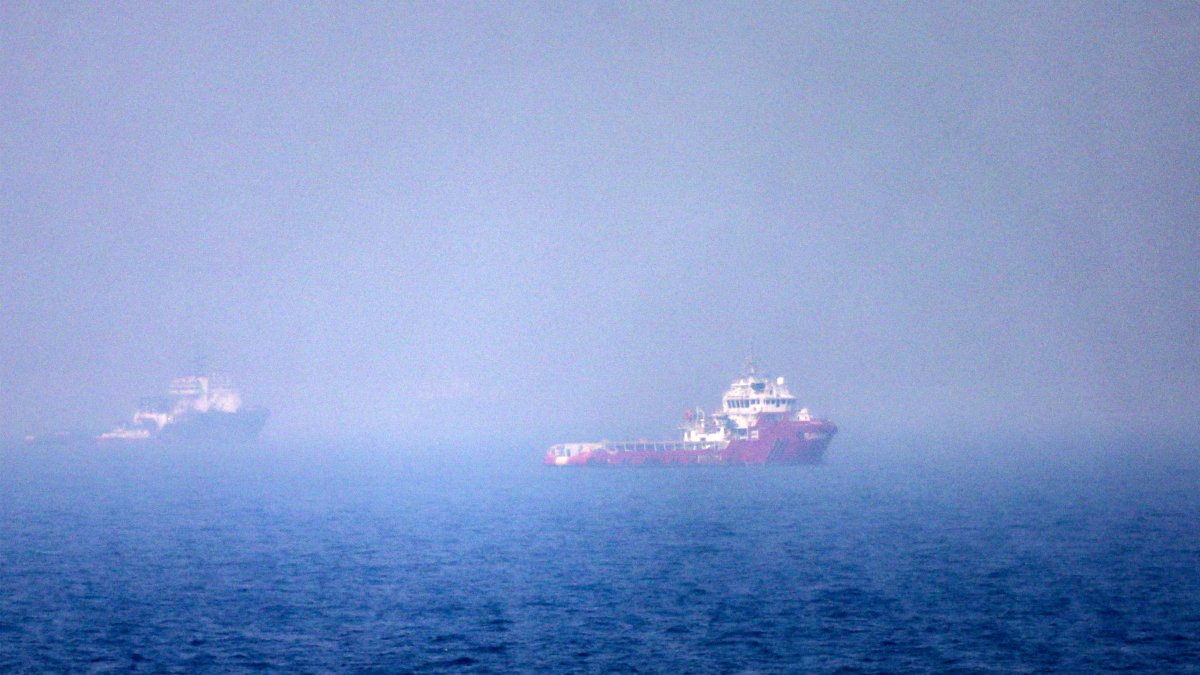
Ships sailing near the Strait of Hormuz on July 13, 2026.
President Trump has declared that the ceasefire with Iran is over and has notified Congress of his intention to launch new military operations against Iran. In fact, there have now been five nights of bombings in the Strait of Hormuz area, and the attacks appear to be spreading to areas within Iran. Although many view these new actions as proof of the failure of the campaign launched in February of this year, in reality—and even though the White House has not explicitly said so—we are facing a new war and not a continuation of the military campaign carried out to end Iran's nuclear program. The distinction is important not so much for the anti-Trumpers around the world, who, no matter what the U.S. president does, will always criticize him. It is also important for those within the United States who believe that this new military action is a departure from the MAGA philosophy of "America First," as well as an Israeli maneuver to force the United States to become even more involved in the Middle East. The latter group even includes Vice President J.D. Vance, based on his latest statements.
It is true that the war with Iran has been justified by the need to prevent Iran from acquiring a nuclear arsenal, which, given the Islamist, revolutionary and expansionist nature of its regime, would have meant a shift in the balance of power throughout the region and a strategic threat to the rest of the world. The 12-day war in June 2025 and this year's war were exactly what they were aiming for. And contrary to what many say, the objectives were largely achieved: Iran's capacity to carry out uranium enrichment is now zero; its industrial capacity to replace the destroyed components is likewise nonexistent; and the likelihood that it could use its more than 880 pounds of enriched uranium is very low, given that it lies buried under the rubble of Fordow and Natanz.

Politics
JD Vance opens up to Joe Rogan: Admits Epstein files missteps, accuses Israel of prolonging Iran war
Emmanuel Alejandro Rondón
Therefore, the issue is no longer about Iran's nuclear program, even though negotiations may be their primary objective. The causes and objectives of this new war are different. For Iran, what is at stake is the survival of its new regime, which sees its ability to control passage through the Strait of Hormuz as its sole source of legitimacy, now that the Revolutionary Guard Corps has lost control of the religious dimension upon which the regime has been based since its establishment in 1979. It is not merely a financial matter of imposing fees on ships transiting the strait to fill its coffers; above all, it is a matter of projecting an image of victory domestically that offsets all its military losses and allows the regime to secure its power.
For the United States, combating Iran's de facto privatization of the Strait of Hormuz is part of its traditional defense of freedom of the seas—a key element in its history and in defending its commercial and strategic interests. However, it is also a matter of perception—of not allowing Iran to propagate a narrative of victory, which would undermine America's credibility in the region and the rest of the world. Whatever happens in the Gulf will not remain confined to the Gulf; rather, it will reverberate across the Pacific and into China. It is, therefore, a war that affects America's core interests, not an action it can disengage from without a cost. Like it or not.
World
U.S. strikes Iranian airport, bridges and train station, reinforces naval blockade with boarding in Gulf of Oman
Emmanuel Alejandro Rondón
The temptation to abandon the region and leave its future in the hands of the Gulf states and the Europeans, as has been suggested on occasion, would only lead to a loss of confidence in Washington, the emergence of other global powers as its replacement in the region or greater chaos throughout the entire Middle East, from the Red Sea to the Levant. It is no wonder that what the Gulf countries are asking of the United States is to end this war on its own terms, not on Iran's. It is no coincidence that they are the ones suffering the consequences the most—not Israel, which is content with the disappearance of an Iran armed with nuclear systems.
The dilemma is that this new war over Hormuz is, in reality, the old war waged by the United States against the Islamic fundamentalist and revolutionary regime in Tehran, insofar as Hormuz has become the Revolutionary Guard regime's primary lifeline.
The strategic objective of this new war is, and must be, to ensure free transit through the strait—not to force Iran's new leaders to negotiate the abandonment of their nuclear program.
A nuclear agreement would be based on a capability they no longer possess except on paper, leaving intact the capacity to threaten ships passing through the Strait of Hormuz, which they do possess on the ground. If that were the outcome—that is, a nuclear agreement and a ceasefire in the strait—the United States would be forced to maintain its maritime patrols in the area indefinitely to assure shipping companies of free passage, something that directly conflicts with the "America First" interests of those on the conservative side who advocate for this option.
Where the most isolationist voices in the U.S. administration are correct is in the impossibility of eliminating threats to maritime traffic without intervention on the ground. Aircraft and drones will never be able to completely eliminate threats posed by other drones and portable missiles launched from the coast, where they can be hidden in facilities that go unnoticed. Either a buffer zone is created, or the airstrikes are neither effective nor credible. And even a coastal strip will not prevent the launch of longer-range missiles.
Therefore, it is a strategic mistake for American interests to limit this war to the coastal area of Hormuz. Attacks must be expanded to inland areas and close to Tehran, where the population currently hears nothing but the regime's triumphant propaganda and remains unaware of what is happening. Seeing bombs fall again would not only destroy command-and-control capabilities but would also shatter the narrative that seeks to legitimize the new IRGC regime.
The regime is much more fragile than it appears to be, even though its image in the Western world is that of a regime strengthened by war. That is not the case. It is more like glass—hard but fragile. A small blow can shatter it.
That is why, in this new war, we should be targeting the very nature of the regime in Tehran. And that is why it is the same old war as always—the war to eliminate the "head of the snake," the most destabilizing force the region has seen since 1979, once and for all. There is no better alternative for defending the interests of the American people or for the legitimate dream of "America First" than regime change in Iran.
LATEST