Rubio in Manila with three open fronts
Rubio arrives in Manila to participate in the 59th ASEAN Foreign Ministers' Meeting. This is his first trip to the Philippines as secretary of state, and it comes at a time when Washington has multiple interests in the region.
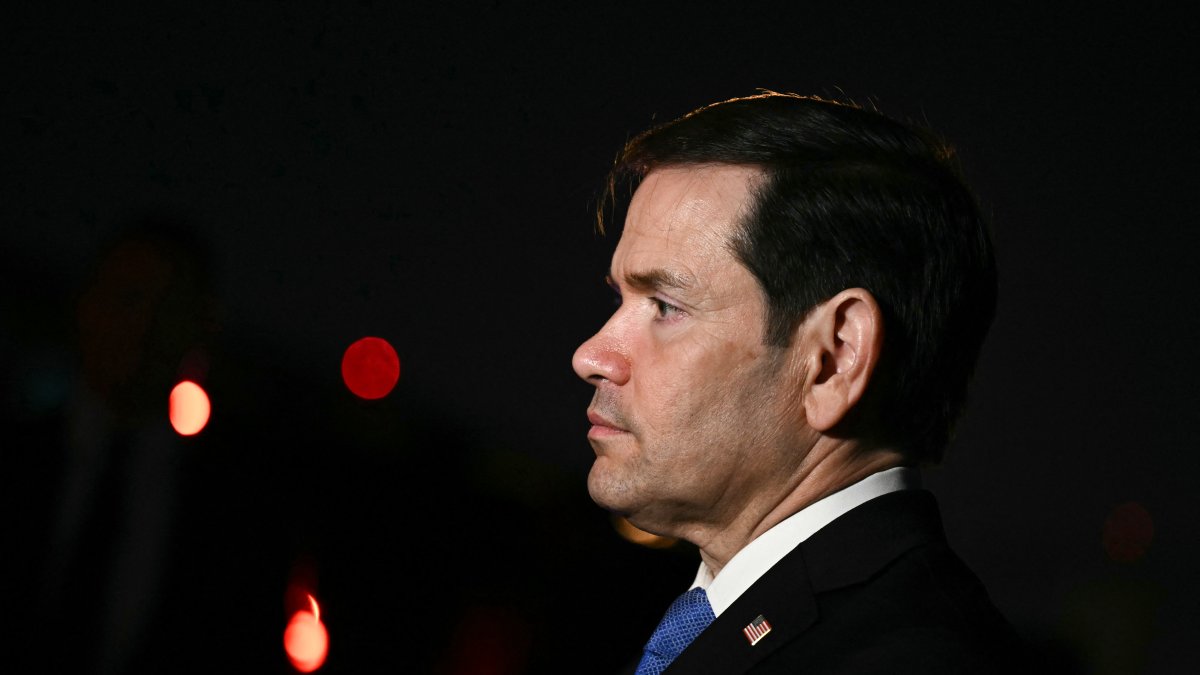
Marco Rubio at Joint Base Andrews in Maryland/ Brendan Smialowski
Marco Rubio arrives in Manila to participate in the 59th ASEAN Foreign Ministers' Meeting and related forums: the Post-ASEAN Ministerial Conference, the East Asia Summit Foreign Ministers' Meeting, and the ASEAN Regional Forum. This is his first trip to the Philippines as secretary of state, and it comes at a time when Washington has multiple interests in the region: while engaged in the conflict with Iran, it needs to convince Southeast Asia that it remains the leading security partner in the face of China, which is exerting increasing pressure in the sea it considers its own backyard. In addition to his meetings with ASEAN, Rubio plans to meet with his counterparts from the Quad (the United States, India, Japan, and Australia), the mechanism designed to counterbalance Chinese influence in the region.
The South China Sea: The never-ending issue
The underlying issue at this summit—which is bringing Rubio, Wang Yi, and much of the bloc to Manila—is the maritime dispute between China and several ASEAN countries, particularly the Philippines. The meeting comes just days after the tenth anniversary of the ruling by the Permanent Court of Arbitration in The Hague, which in 2016 categorically rejected the legal basis of the "nine-dash line" through which Beijing claims sovereignty over nearly the entire South China Sea. China has never recognized that ruling, continues to describe it as "illegal, null, and void," and accused Washington of using it as an excuse to stall negotiations on a regional code of conduct that has remained unresolved for more than two decades.
A recent analysis highlights the bloc's structural problem: of the fourteen countries that signed a joint statement on July 12 to commemorate the ruling, only the Philippines is an ASEAN member. Not even Vietnam, the country with the most at stake in the face of China's advance on new reefs in the Paracel Islands, joined in. The reason, according to the text, is structural: ASEAN operates by consensus, and since several of its members—Cambodia and Laos in particular—are economically dependent on Beijing, the bloc has been unable to adopt a unified stance toward China since 2012.

Politics
'Sovereign states over globalism': Marco Rubio promises a diplomatic offensive to dismantle the ICC
Emmanuel Alejandro Rondón
Against this tense backdrop, Chinese Foreign Minister Wang Yi will arrive in Manila for the China-ASEAN foreign ministers' meeting and is expected to meet on the sidelines of the gathering with his Philippine counterpart, Theresa Lazaro. This would mark the first high-level contact between the two countries since 2024, at a time when Manila has become increasingly outspoken in rejecting China's claims over the disputed waters.
Myanmar: The civil war ASEAN cannot stop
The second conflict overshadowing the summit is the civil war in Myanmar, which, since the 2021 military coup, has claimed more than 8,100 lives and resulted in some 22,500 detentions, according to the Association for Assistance to Political Prisoners. The five-point peace plan that ASEAN itself proposed in 2021 failed to stop the violence, and the bloc continues to exclude the military junta's leaders from its highest-level meetings. Even so, this month ASEAN foreign ministers met in Bangkok with Myanmar's foreign minister, Tin Maung Swe—the first such contact in five years—which drew criticism from human rights organizations, who viewed it as legitimizing the military authorities without any concessions in return. Philippine Foreign Minister Theresa Lazaro responded: "It was not, nor should it be misinterpreted as, an abandonment of the five-point consensus," adding that "the path to peace can only be achieved through firm diplomacy with all parties to the conflict."
The war in Iran reaches Manila
The third front is not in the region, but it is hitting it hard: the war in Iran, which has intensified over the past week, threatens the Strait of Hormuz. Southeast Asia, with more than 680 million inhabitants and a heavy reliance on energy from the Middle East, is already feeling the impact: Philippine President Ferdinand Marcos Jr. declared a national energy emergency in March to secure fuel, food, and other essential goods. According to various media reports, ASEAN foreign ministers plan to issue a joint statement calling for the safe reopening of the strait.
For the Department of State, the challenge of this summit is not only diplomatic but also one of divided attention. The war with Iran is absorbing much of the White House's energy, and that fuels doubts about how much Washington can truly devote to the Indo-Pacific, even though the South China Sea and Taiwan are, on paper, stated priorities of the Administration. Rubio arrives with a strong message: he identified ASEAN as the primary channel for engagement with the region and framed the trip as a demonstration of "tangible results" from the partnership with the bloc, as well as an opportunity to "deepen the comprehensive partnership" with the Philippines. Philippine President Ferdinand Marcos Jr. already has a bilateral meeting scheduled with Rubio, although he has not yet confirmed either the exact date or the specific topics to be discussed.


The Russian Foreign Ministry did not rule out the meeting: "A meeting between Lavrov and Rubio is being considered within the framework of the ASEAN events in Manila," spokesperson Maria Zakharova said and the Kremlin welcomed that possibility. The last direct contact between the two was last September, on the sidelines of the UN General Assembly. The last time the three foreign ministers were present at the same event was in July 2025, at the ASEAN meeting in Kuala Lumpur.
Rubio did not rule out possible meetings with Chinese Foreign Minister Wang Yi or Russian Sergey Lavrov: "We would be willing to meet with them," he said, though he declined to disclose the topics: "I would never tell you at a press conference what topics we would discuss in meetings like that. These are sensitive matters." Regarding relations with Beijing, he struck a conciliatory tone despite the underlying tension: he acknowledged that between "two large and powerful countries" there will always be "points of friction" and "things on which we disagree," but he emphasized that nations of that stature have a responsibility to maintain dialogue, "we owe it to each other, to our peoples, and to the world." The comment comes just days after Donald Trump himself accused Beijing of interfering in the U.S. elections. In this context, Rubio's diplomatic skills will be put to the test like never before.
What is ASEAN, and why is consensus both its strength and its limitation?
Each year, the country holding the rotating presidency organizes this expanded ministerial meeting, which is joined by the United States, China, Russia, the European Union, and others as "dialogue partners." It is, in fact, one of the few forums in the world where the three major powers share an agenda, even if only informally.
Beyond conflict diplomacy, the summit also reflects why Southeast Asia is carrying increasing weight on the technological stage. The region is in the midst of an artificial intelligence infrastructure race, in which Singapore, Malaysia, Thailand, Indonesia, and Vietnam are competing for "reliable" power and water to sustain ever-larger data centers. This race has already sparked local protests over the use of water resources. That same rapid digitalization makes the region fertile ground for generative AI attacks on financial trust, a threat against which ASEAN still lacks a unified regional response mechanism.
LATEST