Díaz-Canel’s “Reforms” to Survive Donald Trump
Cuba does not need quick fixes, but rather a profound economic transformation and a complete political transition. It requires a genuine market economy, where productive forces are unleashed, wealth is generated, jobs are created, and food, goods, and services are produced without the control of the Communist Party.
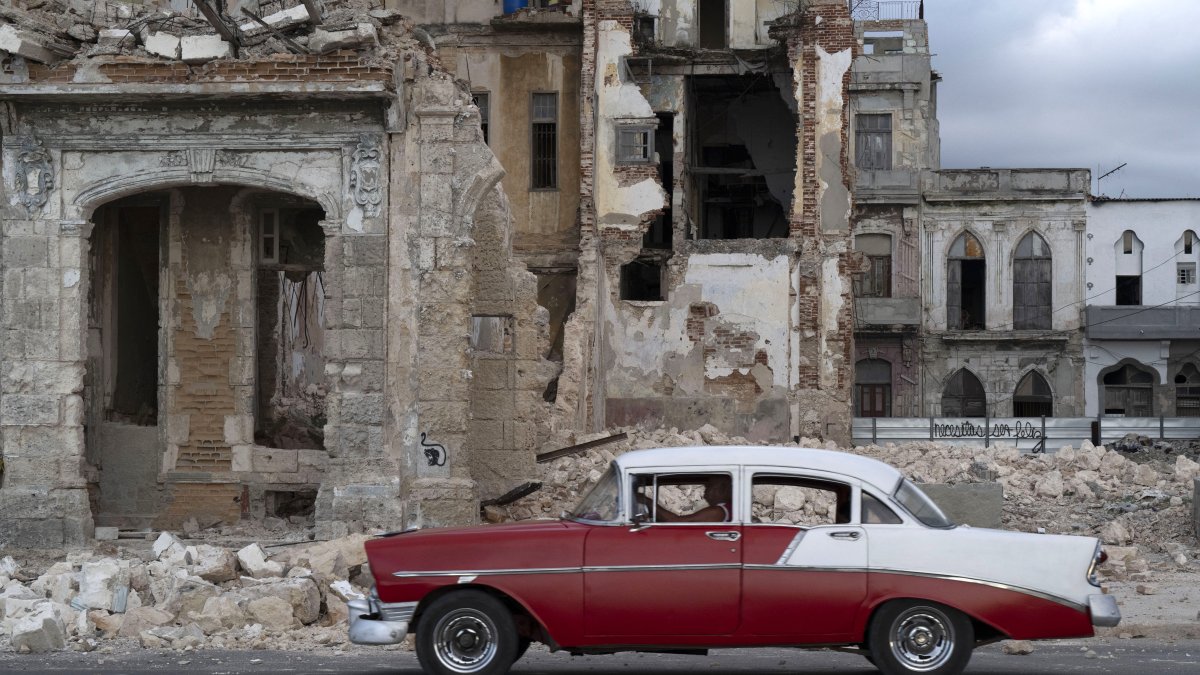
An old car drives past the rubble of a house in Havana (File photo)
The recent appearance by Cuban dictator Miguel Díaz-Canel to announce new “reforms,” attract investors, and grant some leeway to Cubans abroad should not be interpreted as an opening. It is yet another belated, limited, and forced maneuver.
The regime is not reforming because it believes in economic freedom, nor is it opening up opportunities because it respects private enterprise. Nor is it reaching out to the exile community because it recognizes their rights. It does so because it has plunged Cuba into a terminal crisis: protests, hunger, and misery are on the rise; blackouts and the collapse of the system are impossible to hide; and pressure from the United States has become irresistible.
It has happened before. After July 2021, it allowed micro, small, and medium-sized enterprises (MSMEs) as an outlet for popular discontent. It did not do so out of conviction or respect for entrepreneurship, but to buy time, alleviate social pressure, and project the image that something was changing. Now it is repeating the formula: faced with a deeper crisis, it is resorting once again to minor reforms, vague promises, and invitations to invest in a nation without the rule of law.
Cuba does not need Band-Aid solutions, but rather a profound economic transformation and a complete political transition. It requires a real market economy, where productive forces are unleashed, wealth is generated, jobs are created, and food, goods, and services are produced without the control of the Communist Party. The dominant role of socialist state-owned enterprises—responsible for decades of unproductivity, corruption, and ruin—must come to an end. State-owned enterprises must be transferred to the private sector, to genuine cooperatives, real owners, entrepreneurs, and investors capable of producing and competing.
Cuban agriculture, destroyed by collectivization, neglect, and state control, needs a radical transformation. Land must be returned to its rightful owners where appropriate, and the rest must be transferred to full ownership of farmers and citizens interested in making it productive.
That is the liberalization Cuba needs: complete, profound, and irreversible—not a caricature of reform administered by those responsible for the disaster.
The fundamental argument is clear: the regime only grants small concessions when it finds itself cornered. When the situation is favorable to it, it backtracks. During the era of Soviet subsidies, it collectivized the economy, destroyed private property, nationalized agriculture, and copied the Moscow model. When the communist bloc collapsed and it ran out of subsidies, it allowed certain forms of self-employment, but upon receiving oil, money, and political support from Venezuela, it once again restricted, persecuted, and even shut down those opportunities.

It will try to do the same thing now if it manages to survive the current pressures. If it finds a new economic patron—a new Venezuela or any like-minded government willing to subsidize it— if it secures more aid from China, Russia, Vietnam, Mexico, or other allies; if it manages to obtain more resources from the European Union, the United Kingdom, Norway, Japan, Canada, and other Western countries, it will once again shut down what it promises to open today.
Because the Cuban problem is not merely economic. It is political and structural. In Cuba, there is no separation of powers. The judicial system is dependent on the Communist Party. The Public Prosecutor’s Office, the courts, the police, State Security, and the National Assembly all answer to the same political authority. Therefore, no investor, entrepreneur, farmer, or Cuban in exile who invests will have any real guarantees.
Cuba needs more than partial permits to invest. It needs constitutional guarantees, freedom of enterprise, full private property rights, judicial independence, political pluralism, freedom of the press, freedom of association, free elections, and a genuine separation of powers. Without these, any economic reform will be a trap or an illusion.
As long as the Communist Party retains its monopoly on power, any opening will be reversible. And as long as there is no full freedom, the Cuban people will continue to be held hostage by those who caused the ruin. These are not reforms; they are Band-Aid solutions, and Cuba needs freedom.
LATEST