What’s behind the campaign to demonize Israel inside Trumpworld?
Dubious leaks about the Jewish state spying on America signify an effort to break up a valued alliance by those whose motives are rooted in antisemitic conspiracies.
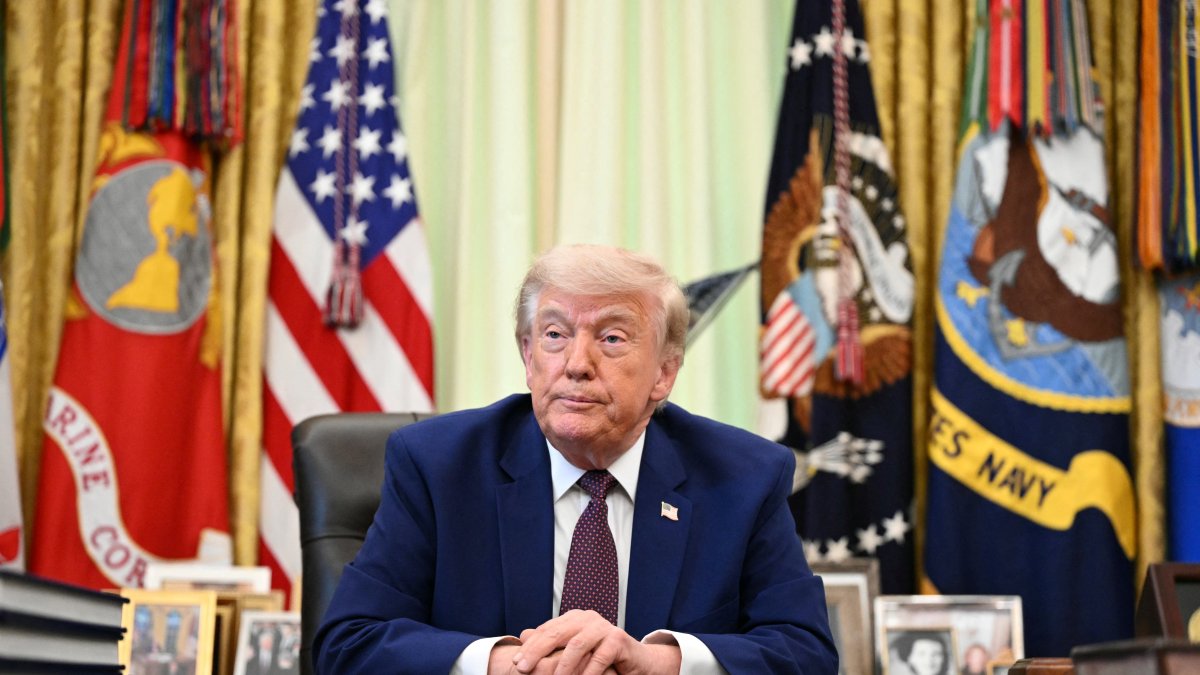
Donald Trump speaks to the press in the Oval Office of the White House in Washington (Photo by Mandel NGAN / AFP)
In recent months, the world has witnessed some of the closest cooperation between the governments and armed forces of the United States and one of its allies. The war launched on Feb. 28 by the United States and Israel against Iran required intense coordination in the areas of intelligence and precision attacks. What followed was an exhibition of high-tech warfare that bespoke both the common purpose of the two nations and the trust that has been built over the years between their militaries. And it resulted in the destruction of much of the Islamist regime’s military forces, the decimation of its nuclear and missile programs, and the targeting of Tehran’s leadership.
It was made possible by the willingness of the two governments to act, at least for a time, in unison strategically, but also for their forces to be engaged tactically on a level that rivals the great alliances of military history, such as the one between the United States and Britain during the Second World War.
That collaboration upsets the political foes of the Trump administration and Israel within the Democratic Party, as well as the broader red-green global alliance of Marxists and Islamists that essentially despise both nations. It’s also galling to the small but vocal faction on the American right that is isolationist in its sensibilities and virulently anti-Israel in a way that often betrays the antisemitic attitudes of its advocates.
Unsubstantiated claims of spying
And that is the context for understanding the story that made headlines at NBC News and The New York Times over the weekend about alleged Israeli spying on the United States.
A deep dive into the details of the story reveals that the hyperbolic headlines that stated that the “Pentagon raised threat of Israeli spying on U.S. to highest level, sources say,” and “Pentagon Sees Growing Espionage Threat From Israel” were not based on any actual revelations about Israeli espionage that had been uncovered. Instead, the articles merely floated suspicions. The leaked reports claimed that “Israel’s ability to conduct human espionage and technical collection is at a ‘critical level” and that Jerusalem was trying to “eavesdrop on senior American officials, including Steve Witkoff, President Donald Trump’s top negotiator, Elbridge A. Colby, the Pentagon’s top policy official, and one of his main deputies, Michael P. DiMino IV.”
That sounds alarming. But it also falls far short of any actual evidence that such activity had taken place or that it means that a crisis of confidence exists between the two allies.
Moreover, it flies in the face of what credible sources about Israeli intelligence say, like left-wing journalist Yossi Melman, who currently writes for Haaretz. No fan of the government of Israeli Prime Minister Benjamin Netanyahu, he has been covering this subject for decades. He confirms what most of those in the know say about the topic when he wrote that “Israel’s intelligence community stopped spying on U.S. soil and against American targets or individuals around the world following the Pollard affair in 1985. Period. Not Unit 8200. Not the Mossad and not the Shin Bet.”
Melman agrees with others who have noted that the real story here isn’t the unsubstantiated allegations about Israeli behavior, but rather why some figures in the Pentagon leaked these claims to liberal media outlets that remain notoriously hostile to the administration they serve.
They are clearly aiming at not only creating a wedge between the two countries but also to score points inside Trumpworld against the far larger faction of officials who are supportive of the alliance with Israel. More than that, they aim to blow it up by blaming Israel for a war that the isolationists didn’t support in the first place. In doing so, they hope to persuade the president to distance himself from a conflict that—like the left-wing publications to which they have fed these claims—they believe is a failure.
Obsessed with Israel
For those on the far right, it isn’t just that they lack enthusiasm about the alliance. They view Israel, and both its Jewish and non-Jewish supporters, as the source of all evil in the world and the root of America’s problems.
Their obsessive hatred for the Jewish state extends to believing without a shred of proof that Jerusalem was behind the Jeffrey Epstein scandal. Like the myths about “The Israel Lobby” that fuel resentments about AIPAC, the Jews and their state are not merely the scapegoats for scandals, but are believed to be manipulating Trump and the United States to work against American interests. In this way, antisemitic shorthand about “Zio-pedos” has become the way the far-right mimics the Marxist formulations about a “white oppressor” state in which Israel and Zionists are demonized as not just wrongheaded, but perverted criminals.
Unsupported allegations about Israeli spying are thus not merely overhyped concerns about security, but simply another layer of the same antisemitic paranoia that fuels some of the discourse about Epstein as well as the war on Iran.
The timing of the leaks is crucial because they came at a moment when the ultimate direction of U.S. policy toward Iran seems to be up in the air.
The president is under enormous political pressure to end the war due to the resulting hike in fuel prices and the way that seems to be impacting the chances of his party holding onto control of Congress in the 2026 midterm elections. Witkoff and Trump’s adviser and son-in-law, Jared Kushner, who have been pursuing some sort of agreement to end the war, seem, like their Democratic predecessors who sought appeasement of Iran in the Obama and Biden administrations, to believe in diplomacy for its own sake.
While Washington and Jerusalem have much in common with respect to Tehran, their positions are not identical. And if Trump is truly committed to getting a deal with Iran that would be on terms that resemble those of Obama’s disastrously weak 2015 nuclear accord with Tehran, it will turn those differences into a major problem. The Iranian regime’s purpose is Israel’s destruction and an endless generational war on the West. Diplomacy that is based on tolerating it or trusting its leaders to keep their word on nuclear or other issues is a trap that sensible policymakers should avoid.

Reversal of fortune
As far as those on the far right whose positions on Israel are little different from those on the far left, the notion that the Iran war is a failure, despite the enormous military success already achieved, is their chance for a reversal of fortune.
Trump agreed with some in the neo-isolationist wing of the GOP about the need to make Europe pay for its own defense and to focus on the threat from China. But they failed to reckon with the fact that, for all of his criticisms of the failed wars in Afghanistan and Iraq, Trump has always been a hawk about the Islamist regime in Iran, its role in international terrorism and the mortal threat its nuclear ambitions posed to the West.
As Eli Lake wrote in an insightful article published in March in The Free Press, this juxtaposition has led to someone like Colby, who is thought of as the leading “war skeptic” inside the administration, becoming a defender of the fight against Iran. Supporters of Israel viewed his appointment with trepidation because he had said that the United States could “live” with a nuclear Iran and appeared on political commentator Tucker Carlson’s podcast in 2024.
Colby’s willingness to go along with the war may well be due, as he said during his confirmation hearings, to Iran’s ballistic-missile program, which made it a threat to the United States. But it seems to indicate that the anti-war faction in the administration was not only powerless but, like its leading figure, Vice President JD Vance, had been forced by Trump to agree with him on the subject, or face isolation and potential eviction from their offices.
If Trump can be convinced to abandon his hopes of defeating Tehran, either by military strikes or a sensible strategy of strangling its economy, then the hopes of the isolationist Israel-haters can be revived.
Pollard’s tragic legacy
It is highly unlikely that Israel is conducting operations that could be characterized as a “critical threat” to American secrecy.
The disastrous Jonathan Pollard affair complicated U.S.-Israel relations for a generation. It also fostered unfair suspicions about the loyalty of American Jews that fueled several ensuing spy scares that proved to be more about the hatred for the Jewish state among some U.S. officials than anything else. Pollard was punished more harshly than he deserved and far more than anyone who had spied for a U.S. ally. But his betrayal, as well as that of his Israeli handlers and their high-ranking political masters (a list that included Prime Ministers Yitzhak Shamir, Shimon Peres and Yitzhak Rabin), stands as a cautionary tale for the Jewish state’s current policymakers and intelligence officers that can’t be ignored.
Those who consider Pollard, who was released from prison after 30 years in jail in 2015 and then allowed to immigrate to Israel in 2020, to be a hero are deeply misguided. The convicted spy’s delusions of grandeur about his misdeeds and terrible advice to American Jews to commit similar crimes should warrant treatment of him as a pariah rather than a role model.
That said, the motives of those who obsess about Israeli spying, whether by exploiting the legacy of the Pollard affair—much as they do about the attack on the USS Liberty by Israeli forces during the confusion of the 1967 Six-Day War—as a reason to distrust or hate the Jewish state, deserve to be questioned.
A mutually beneficial alliance
The feigned righteous indignation about Israeli espionage ignores the fact that all nations, including the closest of allies, constantly seek to find out all they can about each other, and their intentions and policies. Indeed, it is highly likely, if not almost certainly true, that the United States is currently engaged in spying on Israel. Still, as the junior partner in the alliance, Israel should be far more circumspect about its efforts to find out what the Americans intend to do than its partners.
Yet it is equally important to remember that among the main advantages of the alliance for the United States is that Jerusalem shares with Washington vast stores of information about the Middle East and the Islamic world that American agencies have proven unable to provide for themselves. The United States derives enormous benefits from this, coupled with Israeli contributions to joint projects to invent and improve various aspects of defense technology. And the billions in military aid that Israel gets—that its critics never stop complaining about—are almost all spent in the United States and are critical to bolstering American defense manufacturing.
Why then, attempt to blow up the relationship with a country that is not only Washington’s sole democratic ally in the Middle East, but one that has the capability and willingness to fight side by side with its American partners?
Far-right elements within the administration, likely behind the leaks about an Israeli spy scare, share the paranoid hatred of Jews regularly aired on the podcasts of antisemites like Carlson, the even crazier Candace Owens, neo-Nazi groyper Nick Fuentes, and even the supposedly more mainstream Megyn Kelly. They aren’t interested in promoting American interests so much as they are sowing distrust of Israel and its supporters simply to bolster their conspiratorial worldview.
Most of all, they are hoping to seize on what ought to be characterized as fear-mongering about Israel, rather than an actual threat to American security, to undermine the defense of the West against Iran’s Islamist terrorists.
Doubtless, they are encouraged by Trump’s erratic policy statements about Iran. The president’s efforts to restrain Jerusalem’s attacks on Iran and its Hezbollah terrorist auxiliaries in Lebanon have bolstered the belief that the two allies aren’t just having tactical disagreements about the next step in the conflict, but are pursuing mutually exclusive goals. Should Trump embrace an Obama-style deal with Iran, then those who are seeking to crack up the alliance will think they have gained the upper hand.
But what shouldn’t be forgotten is that the past few months of shared combat against Iran have proven that the U.S.-Israel relationship is not a plot imposed on Washington by a lobby. Those who strive to undermine it are making America weaker, not stronger. And their reasons for doing so are rooted in antisemitic conspiracy theories as opposed to rational strategic thought. The alliance is not a matter of American charity or mythical Israeli manipulation. It is a foundational element of U.S. national security against the ongoing threat of Islamist terror that deserves the support of all American patriots.
LATEST