The SPLC's business of hate
The 11-count federal indictment handed down by an Alabama grand jury documents that the organization, which defined itself as the watchdog of extremism in America, was funding, sustaining and in some cases organizing the very thing it claimed to fight.
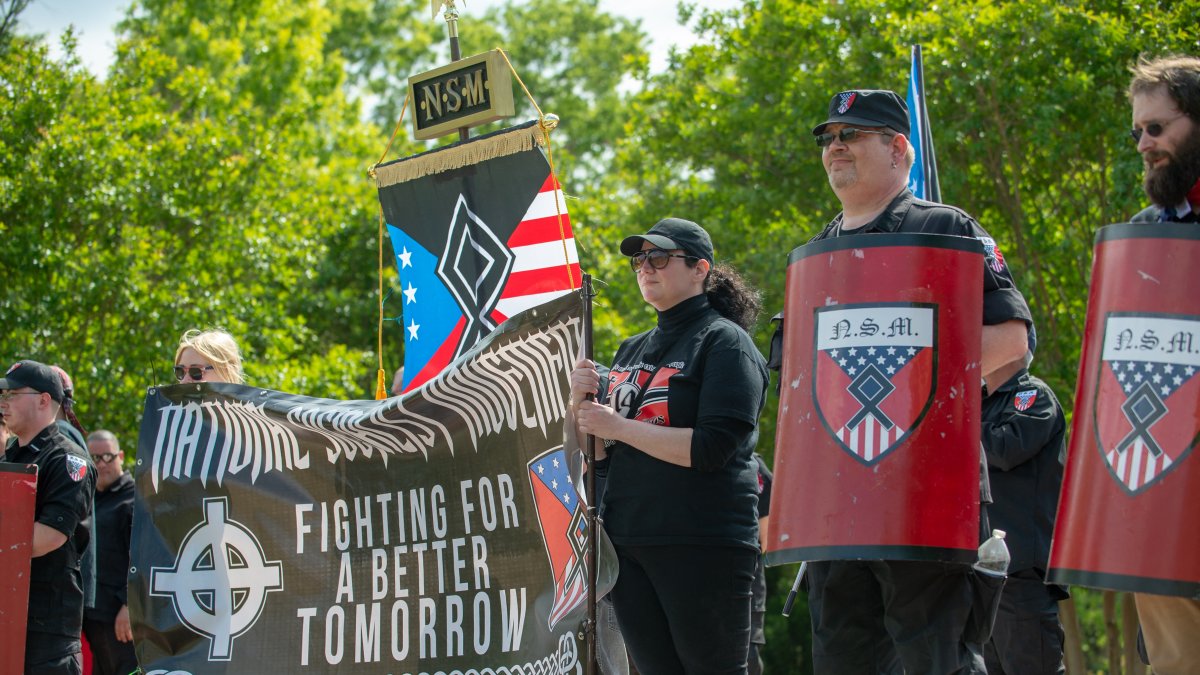
National Socialist Party of America / Bita Honarvar demonstration.
Some organizations start out with a genuine mission and, at some point abandon it so radically that they become the antithesis. The Southern Poverty Law Center (SPLC), founded in Montgomery, Ala., in 1971 to ensure that civil rights legislation was enforced in practice, appears to have gone down that road. The 11-count federal indictment handed down by an Alabama grand jury documents that the organization, which defined itself as the watchdog of extremism in America, was funding, sustaining and in some cases organizing the very thing it claimed to fight.
But the legal fraud, as horrific as it seems to be according to the allegations, runs parallel to moral fraud: the construction for decades of a system of power that operated as an arbiter of political legitimacy without any democratic mandate and without transparency, by witch hunts.
Now the news is picking up the facts described in the indictment; between 2014 and 2023, the SPLC paid more than $3 million to at least eight people who worked as informants within extremist groups: the Ku Klux Klan, the National Socialist Movement, the National Alliance and the Aryan Nations. In some cases, the money was funneled through fictitious entities with names designed to avoid arousing suspicion, inlcuding: "Central Investigation Agency," "Fox Photography," "Rare Books Warehouse." All did no real business activity.
Acting Attorney General Todd Blanche explained it clearly: the SPLC was doing the opposite of what it told its donors: it was not dismantling extremism, but funding it. "The SPLC is manufacturing racism to justify its existence," he said. The SPLC claims that it used these millions in funds to "expose" the activities of the undesirable groups, but the organization reportedly did not inform the FBI about the use of informant networks or the use of shell companies to hide payments. Nor did it tell its donors that part of their contributions directly funded members of hate groups.
Politics
El DOJ presenta cargos contra Southern Poverty Law Center por financiamiento de grupos extremistas
Luis Francisco Orozco
Whether or not the charges succeed in court, the facts documented in the indictment are serious enough to understand the danger of the ecosystem created by the organization.
What the indictment suggests is that the SPLC had a structural incentive for extremism not to go away. Groups like the National Alliance or the National Socialist Party of America are, in real terms, fringe organizations with minimal budgets and a near-zero social presence. Instead, by anabolizing these groups and creating a straw man, fundraising opportunities grow that would not otherwise exist. Donors like J.P. Morgan, Apple's Tim Cook, and George and Amal Clooney, among others, helped fund an ecosystem designed to perpetuate itself.
This is the logical consequence of the incentives revealed by the documented facts themselves. An organization that for decades expanded its definition of "hate group" to include legitimate conservative religious organizations artificially inflated the numbers of extremism, and simultaneously paid informants within those groups was building and maintaining the market to which it sold its product.
The most emblematic case is that of the Family Research Council (FRC), a conservative Christian organization that the SPLC labeled an "anti-LGBT hate group." The consequences of that designation were literal and lethal: in August 2012, Floyd Lee Corkins II walked armed into the FRC's Washington headquarters with the intention of "killing as many people as possible." He confessed to the FBI that he had chosen the target using the SPLC's "Hate Map." Turning Point USA and Moms for Liberty were also included on that list.
The most damaging mechanism was its penetration into the corporate world through a vector most people have never heard of: Benevity, a corporate donation management platform that connects nearly a thousand Fortune 1000 companies with half a million nonprofits and has managed more than $16 billion in donations. In 2021, Benevity's then-CEO, Kelly Schmitt, presented a report to corporate clients explaining that the platform had "verified" nearly 2 million nonprofits using the "Southern Poverty Law Center Hate List" as exclusion criteria. In other words: if the SPLC blacklisted you, you were excluded from the corporate donation system.
Companies did not make the political decision to exclude conservative organizations: they simply outsourced that decision to a platform that in turn outsourced the criteria to the SPLC. The responsibility dissolved down the chain but the result was the same: systematic financial censorship. It could be said that it functioned as a private system of ideological regulation, with no legal mandate, no possible appeal and no transparency.
Society
Federal appeals court upholds Texas law mandating the display of the Ten Commandments in classrooms
Emmanuel Alejandro Rondón
In 2017, Tim Cook announced that Apple would donate $1 million to the SPLC and enabled a special donation app, in response to the events in Charlottesville, Va. Apple's donors were thus indirectly funding the same system that was later accused of having paid one of the Charlottesville organizers.
But it gets worse turning to the federal chapter. In January 2023, an internal FBI office memo revealed that the bureau had labeled "radical and traditionalist Catholics" as potential racially motivated violent extremists. The memo proposed that the FBI develop sources of information within parishes celebrating Latin mass and in online Catholic communities. The primary source of the memo was the SPLC and its list of hate groups. The FBI, in other words, had outsourced its analysis of domestic extremism to a private organization with a documented history of political bias.
The memo was withdrawn after the public leak, but further investigation revealed that it was not an isolated case but that several additional FBI documents and five attachments used the term "radical Catholic traditionalist" and cited the SPLC. During the Biden administration, the memo had been distributed to more than 1,000 FBI agents nationwide before it was leaked.
The indictment will go forward, and the courts will determine whether or not there were crimes and, if so, to what extent. What is not up to the courts is the arbitrary expansion of the "Hate Map," the infiltration of the system to exercise corporate financial censorship, and the FBI's use of the SPLC as a source of intelligence to surveil religious communities. Regardless of the criminal indictment, the scandal is shaped by the story of an organization that built power of a quasi-governmental nature for the enforcement of an ideological agenda using the masquerade of civil rights how was it possible for a private organization to amass so much influence over the American political, corporate and security ecosystem without anyone seriously questioning it for decades?
The answer is multilayered. One is the power of the narrative, the other is the condescension and complicity of the corporate and media world and finally, the absence of real controls over non-governmental organizations exercising quasi-public functions. The damage, beyond the outcome in the courts, will be incalculable.
LATEST