Trump's executive order on the Muslim Brotherhood: Insufficient progress
The decision to implement the project by targeting specific branches, rather than the entire movement, leaves loopholes for other affiliates to renew and evade sanctions. More importantly, Qatar is not listed as a target of the measure.
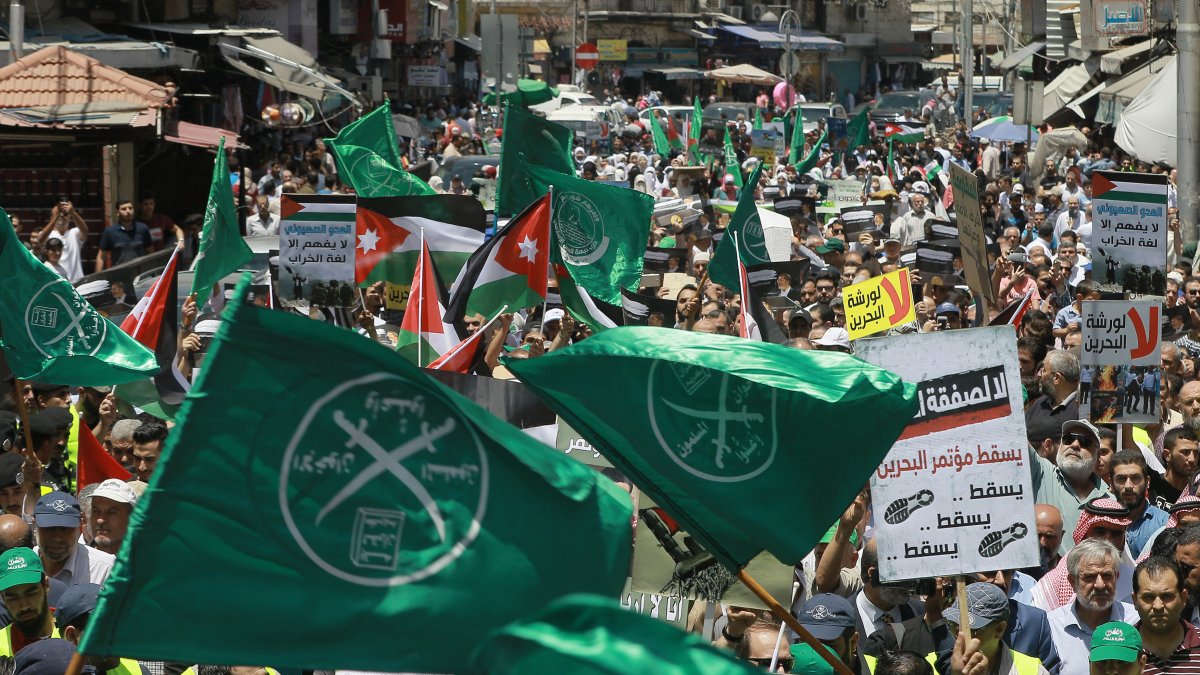
Muslim Brotherhood flags in Jordan.
President Donald Trump's decision to designate certain Muslim Brotherhood chapters as terrorist entities represents a step forward in combating Islamist extremism. However, one critical flaw threatens to render this measure little more than a political gesture: the omission of the role of facilitator states, especially Qatar.
"The executive order did not take immediate action, instead mandating a report to target specific sectors of the Brotherhood and its affiliates in Egypt, Lebanon, and Jordan. The president laid the groundwork for terrorism designations by citing statements and actions by certain groups against Israel following the Oct. 7, 2023, attack and the subsequent war."
If the Trump Administration moves forward with the designations significant financial sanctions could be applied to Muslim Brotherhood groups and associates, such as freezing assets they may have in the United States and or making it a crime to materially support them, which would prevent U.S. citizens, companies and institutions from doing business with them.
To understand the magnitude of this order, it is necessary to understand what the Muslim Brotherhood is. Founded in Egypt in the late 1920s by Hassan al-Banna, a teacher and not a religious cleric, the organization proposed the vision of integrating the Islamic religion into public life through education, charity and grassroots organizations. Over the years, it grew into an organization with branches and local cells that gave it a broad base and significant influence.
"The real concern is that the executive order is primarily a gimmick to appease voters."
The strength of the movement lies in its mass appeal that may not be mediated by religious clerics. Banna himself was not. The quest for global governance based on Islamic values leads to its classification as an Islamist movement. Beginning in the 1970s, the movement began to expand, especially in Europe and the United States, establishing mosques, community associations, charities and student groups. The movement's activists created institutional infrastructures almost everywhere in the West. The Muslim Brotherhood became a source of inspiration for many political movements; in the Palestinian context, it supported Hamas to oppose Fatah.
Trump knows the Muslim Brotherhood very well, this is not his first attempt to designate them as a terrorist organization. In his first term, many hurdles arose because the legal criteria for designating a terrorist organization did not fit well with the Muslim Brotherhood. But this time things are different and the current order seems to be aimed at circumventing that concern by targeting specific delegations with stronger ties to radical militant groups.
Qatar, the elephant in the room
However, Trump's decision to implement the draft by targeting specific branches, rather than the entire movement, leaves loopholes for other affiliates to renew and evade sanctions. But more importantly, Qatar, considered a key facilitator of Brotherhood-linked activities, is not listed as a target of the measure.
Dr. Sebastian Gorka, an advisor to Trump, explained that the decree targets Muslim Brotherhood organizations operating within countries, not the countries themselves. However, this explanation might omit the fact that Qatar, which has been forging close alliances with Trump, supports the Muslim Brotherhood. Several influential figures close to the president expressed outrage at the lack of precision in the executive order, suggesting that the administration would have refrained from targeting the entire Muslim Brotherhood because of Qatar's influence in the Trump administration.
The real concern is that the executive order is primarily a ploy to appease voters. Qatar's role as a funder and protector of the Muslim Brotherhood is longstanding and well documented. The pattern of Qatari funding to boost and strengthen Islamist institutions has continued to influence public opinion in Western countries in general and the United States in particular.

Reports in recent months have shed light on the large number of Islamic centers with ties to the Muslim Brotherhood. The Muslim Brotherhood has learned to use the system to its advantage without being exposed or identified, especially the academic and even the electoral system, and most importantly, to manipulate the media discourse.
After Oct. 7, that network showed its true face. Researcher Dalia Ziada of the Institute for the Study of Antisemitism and Global Politics raises a fundamental problem with the chapter-by-chapter approach: if only one organization in the network is designated, the same people running the network will create a new organization with a new name, which will be perfectly legal and function within the legal system. But this mutation or reincarnation only occurs if factions are designated. If you designate the Muslim Brotherhood, you are designating the ideology itself. And if you ban the ideology, it is like cutting off the oxygen to all factions that align with this ideology or work within its ecosystem.
Leveraging the global offensive
The Brotherhood has suffered significant setbacks in recent years, and one of the most telling was the Gulf crisis. In 2017, Saudi Arabia, Egypt, Bahrain, the United Arab Emirates and the internationally recognized Yemeni government severed diplomatic relations with Qatar, accusing it of destabilizing the region and backing extremist organizations, including the Muslim Brotherhood. That rupture, which involved the closure of borders, the expulsion of diplomats and a complete blockade, exposed the extent to which Arab countries considered the Brotherhood to be a factor of interference and radicalization. Although part of those relations were reestablished years later, the original accusation was not retracted: the political signal was marked and functions to this day as proof of the regional consensus on the destabilizing nature of the Brotherhood.
In that context, the measure announced by the White House is by no means groundbreaking. Numerous countries have already banned or restricted the Muslim Brotherhood. In Syria, the Brotherhood staged an insurrection that resulted in a very severe crackdown by the regime. Russia declared it an extremist organization in 2006, and Kazakhstan included it on its national list of banned entities the same year. Egypt officially outlawed the movement after the 2013 coup, while the United Arab Emirates and Saudi Arabia designated it as a terrorist organization in 2014. More recently, Paraguay adopted a parliamentary resolution in February 2023 labeling it a terrorist group, and Jordan, in April 2025, passed a formal ban with confiscation of assets and closure of its local structures. These decisions reflect a global offensive against the Brotherhood on multiple fronts.
For the UAE and its allies, this is a global struggle. They want to oust the Muslim Brotherhood from power, and block its path in places like Tunisia. The UAE has long led the fight against the Muslim Brotherhood in the region. They see this as a regional struggle.
In this context, Trump's order states that it is U.S. policy to cooperate with regional partners to eliminate the capabilities and operations of Muslim Brotherhood chapters designated as foreign terrorist organizations and to end any threat such chapters pose to U.S. citizens or U.S. national security.
But herein lies the fundamental contradiction: how to cooperate with Qatar when it is an essential part of the problem? Trump's executive order is certainly a step in the right direction. It publicly acknowledges the threat posed by the Muslim Brotherhood and establishes a legal framework for action against its most violent branches. However, without directly confronting the movement's financial, media and ideological support, the strategy risks being ineffective in curbing its global influence.
As long as Qatar remains outside the scope of this order, the Muslim Brotherhood will simply mutate, reinvent itself and continue its expansion. If the president truly seeks to cut off the oxygen to the Muslim Brotherhood, he must be willing to confront its real enablers. Otherwise, this order could go down in history as another missed opportunity.
LATEST