Iran's tentacles are still at work in the West
Regime propaganda does not always arrive labeled as such. Sometimes it comes in the form of an opinion column, an NGO statement, or coverage that systematically portrays IRGC victims as aggressors.
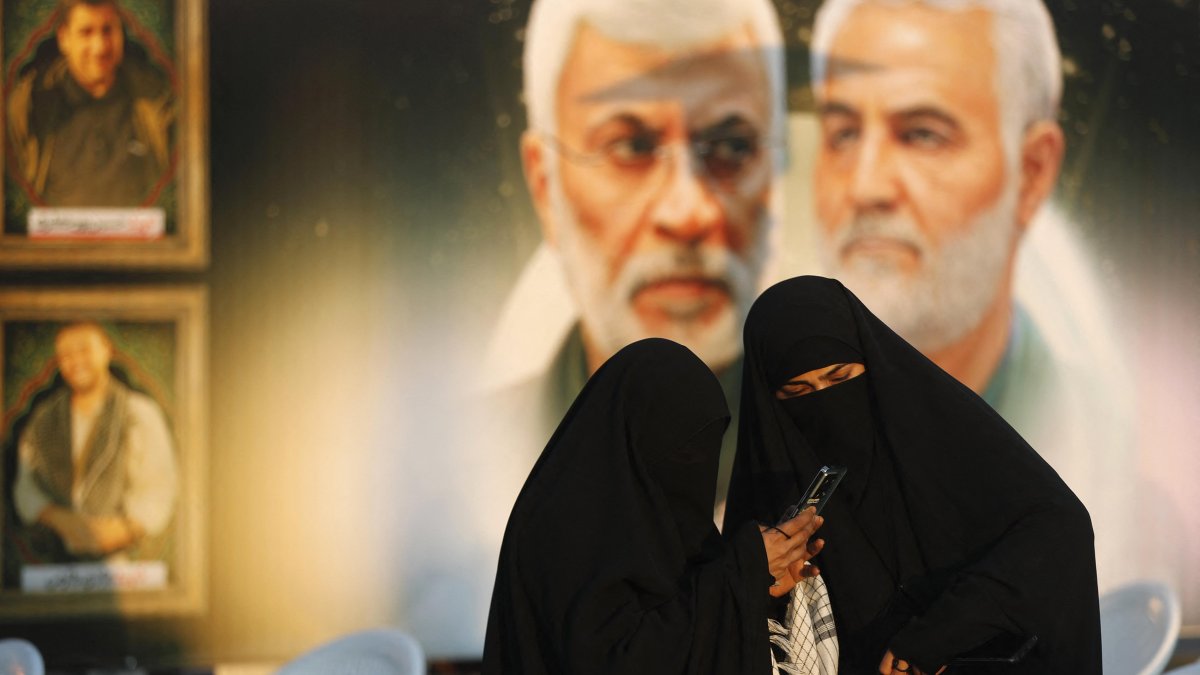
Women in front of Qasem Soleimani's portraits.
That the ayatollahs' regime has been weakened in Iran does not mean that its extensive network of influence in the West has been dismantled. New reports indicate that it has refined its methods, expanded its networks and taken its campaign of violence into the heart of Western democracies.
While Europe debated whether to designate the Revolutionary Guard (IRGC) as a terrorist organization, its operatives were still at work. The IRGC controls the Iranian state and its operations abroad under diplomatic cover, through front groups, paying local criminals in cryptocurrencies, and coordinating attacks against synagogues, Jewish schools and Iranian dissidents.
A classified dossier accessed by Euractiv identified Mohammad Naghizadeh, Iran's military attaché in Poland, as an active member of the Revolutionary Guard, capable of promoting the organization's financial and operational interests from Warsaw. The European Union (EU) finally designated the IRGC as a terrorist organization in February 2026, but that decision was belated. Civil society organizations, security experts and threatened communities had been calling for such designation long before the crisis forced Europe's hand.
How many Naghizadehs operate in other European capitals doing exactly the same thing. Berlin, Paris, Rome, Madrid: any Iranian embassy could house IRGC officers working with diplomatic immunity. Designating the organization as terrorist without expelling its accredited representatives is a half-hearted gesture.
In March 2026, a previously unknown group appeared on the scene: Harakat Ashab al-Jamin al-Islamiyya. In seven days, it carried out or claimed responsibility for four attacks in different countries: a synagogue in Liege was blown up, another in Rotterdam was set on fire, an Orthodox school in Amsterdam received an explosive device, and a fleet of ambulances belonging to a Jewish volunteer organization in London was found burned out overnight. The pattern shows that these were not isolated cases; what happened in Europe between March and May 2026 was a coordinated campaign, and investigators quickly confirmed that was indeed the case.
At the center of the network was Mohammad Baqer Saad Dawood Al-Saadia 32-year-old Iraqi with a long history within Kata'ib Hezbollah and direct ties to the IRGC dating back to his personal relationship with Qasem Soleimani. Under his leadership, the campaign totaled 18 attacks and attempts in Europe between March and May 2026: explosives in Amsterdam, arson in Skopje, stabbings in London.
But the reach did not stop on the continent. Al-Saadi also sent a contact (who turned out to be an informant for the FBI posing as a member of a Mexican cartel) photographs and maps of a synagogue in Manhattan, a Jewish center in Los Angeles and an institution in Scottsdale, Arizona. Among the targets reported was also Ivanka Trump.
He was arrested in Turkey on May 15 while allegedly traveling to Russia, and extradited to the United States. Shiite militia specialists who have been following his career for years described him as one of the most important architects of the Iranian network in the West: someone who not only executed orders but built the tactical and logistical structure that remains operational today, with or without him.
The tactical novelty is not the violence itself, but the architecture with which the IRGC executes it to maintain plausible deniability. Instead of sending agents of its own, the regime hires local criminals through encrypted platforms and pays them in cryptocurrencies. It creates front organizations with new names for each campaign, so that when one is disbanded, the next one is ready. It uses the network of allied militias (Kata'ib Hezbollah, Lebanese Hezbollah, the Houthis) as intermediaries that put distance between Tehran and the act itself.
The campaign is not only physical. EPP MEP Tomáš Zdechovský MEP warned about a vast network of accounts and websites spreading IRGC-linked propaganda across the EU. Authorities managed to remove thousands of links and block the organization's main account on X, but the digital networks of the Iranian regime are resilient by design: when one channel is shut down, three more appear.
This media dimension is the most difficult to combat, especially in information ecosystems where certain media amplify the "resistance" narrative without questioning who is financing it and for what purpose. Regime propaganda does not always arrive labeled as such. Sometimes it arrives in the form of an opinion column, an NGO statement, or coverage that systematically portrays IRGC victims as aggressors.
One piece of information that the classified documents mention is the growing wave of Iranian diplomatic defections. In 2026 alone, an Iranian diplomat in Copenhagen, the chargé d'affaires in Canberra sought asylum in the West., the charge d'affaires in Vienna, and a senior official of the Iranian permanent mission to the UN in Geneva, among others. This is a sign that those who know the regime from the inside are choosing to jump before the ship sinks, or before they become complicit in operations they can no longer sustain. Mass defections of diplomats are historically one of the best indicators of the real state of a regime. These are officials with access to sensitive information, who know the real operations behind the official facade, and who decided that the risk of defecting was less than that of staying. That calculation alone speaks volumes.
In July 2025, fourteen governments (including France, the United States, the United Kingdom, Germany, the Netherlands, Sweden and Canada) issued a joint statement condemning Iranian intelligence services for murder, kidnapping and persecution plots against individuals in Europe and North America, and for their growing articulation with international criminal networks. These networks were not dismantled, they are still operational.
German intelligence further warned that, once direct military confrontations with Israel and the United States cease, Iran will probably intensify its covert operations in Europe. The logic is clear, the regime is preparing to multiply its tentacles. The hybrid war has no end date nor does it accept a ceasefire.
Designating the IRGC as a terrorist organization was a necessary and long overdue step. But it is just that: a first step. Expelling the operatives with diplomatic cover is fundamental and urgent. Dismantling the financial networks that sustain the operations is also key. Judicially pursuing those who spread pro-terrorist propaganda in the West should be part of the immediate agenda of governments. Without these measures, the designation is a bureaucratic gesture that protects no one.
Iran is not defeated. The IRGC today controls more functions of the Iranian state than at any time before, operates active networks in at least half a dozen European countries, funds attacks against Jewish communities throughout the free West. All this while its accredited diplomats enjoy immunity in the capitals of the world's most important countries.
World leaders continue to disagree on how much pressure to exert on Tehran. Political calculation, misdiagnosis, cowardice or expediency, some push for tougher measures; others prefer not to burn diplomatic bridges at a time of unprecedented regional tension and with a growing pro-Islam population. The electioneering bickering comes at a cost: every day of indecision is one more day that the network operates in comfort. The West has the tools. What is lacking is the will to use them.
LATEST