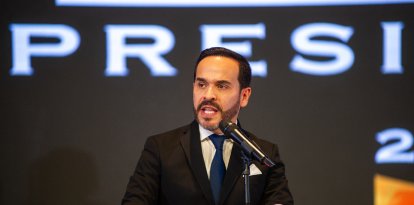
Q Manivannan, a dangerous identitarian prop
What exactly is Scotland's differential responsibility? Historians do not generally consider that Scotland played a greater role in the British Mandate of Palestine than the rest of the United Kingdom.
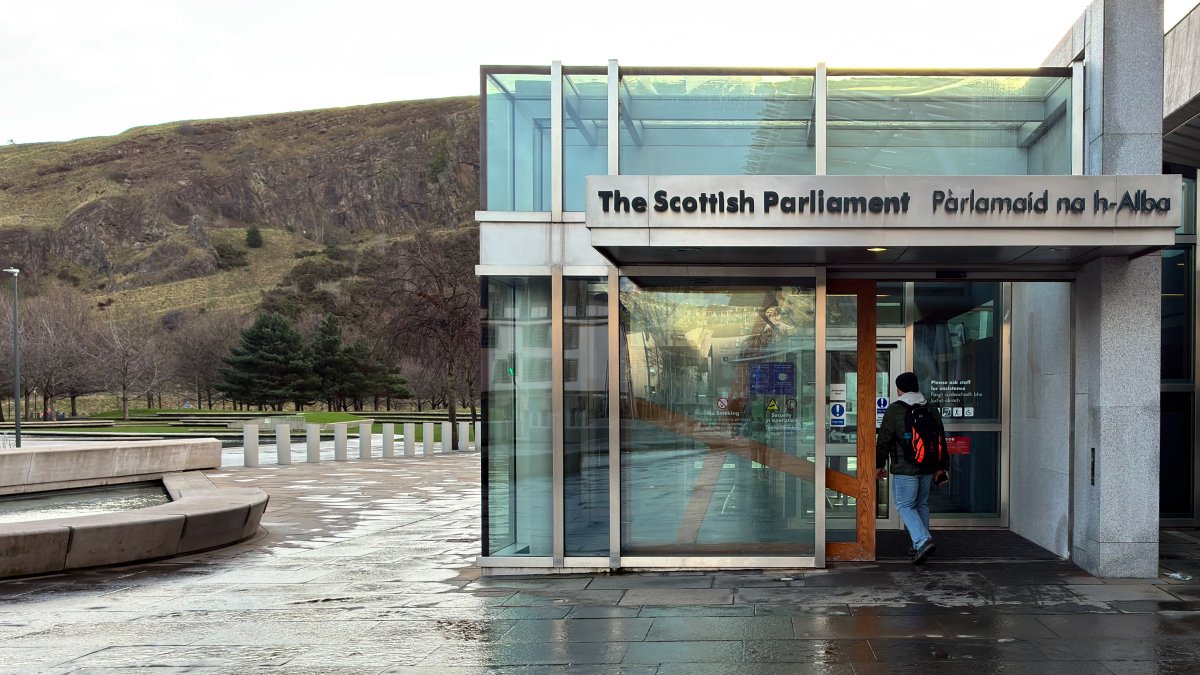
The Scottish Parliament building (Archive).
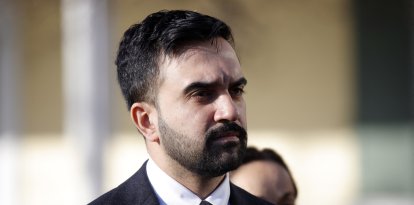
As if it were a fantasy figure, the archetype of the woke politician, British politics has given birth to a representative whose only real platform is his own existence. His name is Q Manivannan, and he has just been elected a member of the Scottish Parliament for the Scottish Greens.
When he addressed his supporters after learning of his election, Manivannan said as if throwing a teenage temper tantrum: "My name is Dr Q Manivannan, I am a transgender Tamil immigrant, my pronouns are they/them. I am to some in this country everything that the hateful despise and I am standing here as your MSP now with care." The truth is that he did not talk about housing, healthcare, employment or public transport. He talked about himself. His performative identity; immigrant, Tamil, queer, non-binary, was presented as a political program in itself. The problem is that identity, however minority and striking, is only what lies on the surface.
Manivannan was born in Tamil Nadu, studied at O.P. Jindal University in Delhi, did a master's degree at Trinity College Dublin and came to Scotland in 2021 to pursue a PhD in International Relations at the University of St. Andrews. His academic career includes poetry and anthropology. But what is truly revealing is not Manivannan's biography, but the mechanism that brought him to Holyrood. He was only able to stand for election after the SNP government changed the electoral rules in Scotland in 2025, allowing immigrants with limited residence permits, such as a student visa, to stand as candidates.
Before that change, as in the rest of the United Kingdom, only immigrants with indefinite residency were eligible for public office. Q was third on the regional list for Edinburgh and East Lothians, which in practice means he was selected by a small inner-party group and catapulted into Parliament without needing to convince anyone beyond his own co-religionists. The result is an M.P. who was elected not so much for his proposals as for what he represents as a symbol. The Scottish Greens were not looking for a legislator. They were looking for a flag.
Here begins the legal problem, announced from the beginning and yet ignored with Olympic indifference by those who nominated him. Manivannan will receive a salary of 77,711 pounds (roughly $105,000) per annum funded by Scottish taxpayers, despite not being entitled to hold a full-time job in the U.K. Why? Because of a loophole unique to Scotland, the product of a combination of two regulatory changes. The Conservative government introduced a rule in October 2022 that holding elected office in local or devolved government is not considered a form of employment. The SNP last year extended the right to candidacy to people with any form of residence permit. The combination of the two measures created an unprecedented situation that its promoters present as an achievement of inclusion and that, looked at coldly, is simply a botched job.
World
United Kingdom: 78-year-old pastor fined for reading the Bible inside a "safe zone"
Diane Hernández
If Manivannan fails to regularize his immigration status, he would be automatically disqualified from office and replaced by the next candidate on the Green list, without the need to call any by-election. In other words: the electorate has no say in the matter.
The Home Office has made it clear that being a member of the Scottish Parliament alone does not entitle one to a global talent visa. And Ross Greer, co-leader of the Scottish Greens, has conceded that Manivannan might not complete the full term, although he said he saw "no reason" why the visa application "would not be accepted," which is precisely the kind of guarantee that guarantees absolutely nothing. In the meantime, Manivannan asked his party colleagues for a contribution of thousands of pounds sterling to fund a temporary graduate visa.
But Q's real agenda did not take long to emerge. Curiously, the party that presents itself as the champion of Scottish workers must not only set aside internal funds to pay for its own M.P.'s immigration paperwork, but ends up being the party proposing to take money from poor Scots to pay "reparations" to Palestinians.
Indeed, this is the twisted logic of the "luxury beliefs" of the flamboyant and exotic M.P.
Manivannan, along with fellow transgender Scottish Greens M.P. Iris Duane, backed a manifesto by Art Workers for Palestine Scotland that calls for a "program of restorative justice from Scotland for the Palestinian people" and demanded that the Scottish government produce a report on Scotland's "historical and contemporary complicity in the colonization and occupation of Palestine."
What exactly is Scotland's differential responsibility? Historians do not generally consider that Scotland played a greater role in the British Mandate of Palestine than the rest of the United Kingdom. The connection adduced by some activists is that Arthur Balfour, author of the famous 1917 declaration endorsing the creation of a Jewish national home in their ancestral land, was born in Scotland. This is the argument for establishing a collective reparatory debt from the average Scottish taxpayer.
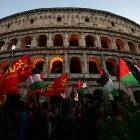
What Manivannan is proposing, in short, is that Scots fund symbolic foreign policy with their taxes that is designed to satisfy the consciences of those who will never pay the real price for such solidarity and who would immediately find themselves backing some of the most virulently anti-Western activism of today.
Rachael Hamilton, deputy chair of the Scottish Conservative Party, summed it up bluntly: "Ordinary Scots will be appalled that these Green MSPs are not only aligned with an organi[z]ation pushing anti-Semitic tropes but are advocating that taxpayers pick up the tab for a misguided virtue-signalling stunt."
None of this occurs in a vacuum. The Scottish Greens obtained in the May 2026 election a historic result: 16 M.P.s elected, including two transgender people. The party has built a brand identity based on the intersection between environmentalism, independentism, the gender ideology and identity politics, and has found in that niche a loyal and well-organized electorate.

What the Scottish Greens presented as a political achievement is in reality, first and foremost, an institutional, political and economic risk. They nominated someone whose immigration status made it impossible to guarantee that he could exercise his full mandate, with no concrete policy beyond his own identity and with the backing of proposals such as Palestinian reparations, decriminalization of prostitution and administration of experimental drugs to minors who identify as transgender, which could hardly be defended in a public policy debate without generating widespread conflict.
When the identitarian left talks about "diversity in power," this is exactly what it is. Manivannan does not come to Holyrood with a platform on fiscal policy, infrastructure or healthcare. He comes with one of institutional demolition. The identitarian left continues to grow in Britain, possibly without its voters understanding the consequences. It is similar to what was seen in Mamdani's New York. These are voters who consider the scope of the political system of representation to be, in itself, a government program. Manivannan is the logical consequence of that conviction. The problem comes when it comes to footing the bill for the "luxury beliefs" of this exotic identity decorum.
LATEST