The Empire Strikes Back: Calif. lawmakers, Kansas judge block efforts to help gender-confused kids
Oregon "gender affirming care" providers settle before trial on detransitioner's malpractice claims, after jury awarded $2 million to New York detransitioner. Kansas judge belittles expert witness that helped save Alabama's similar ban.
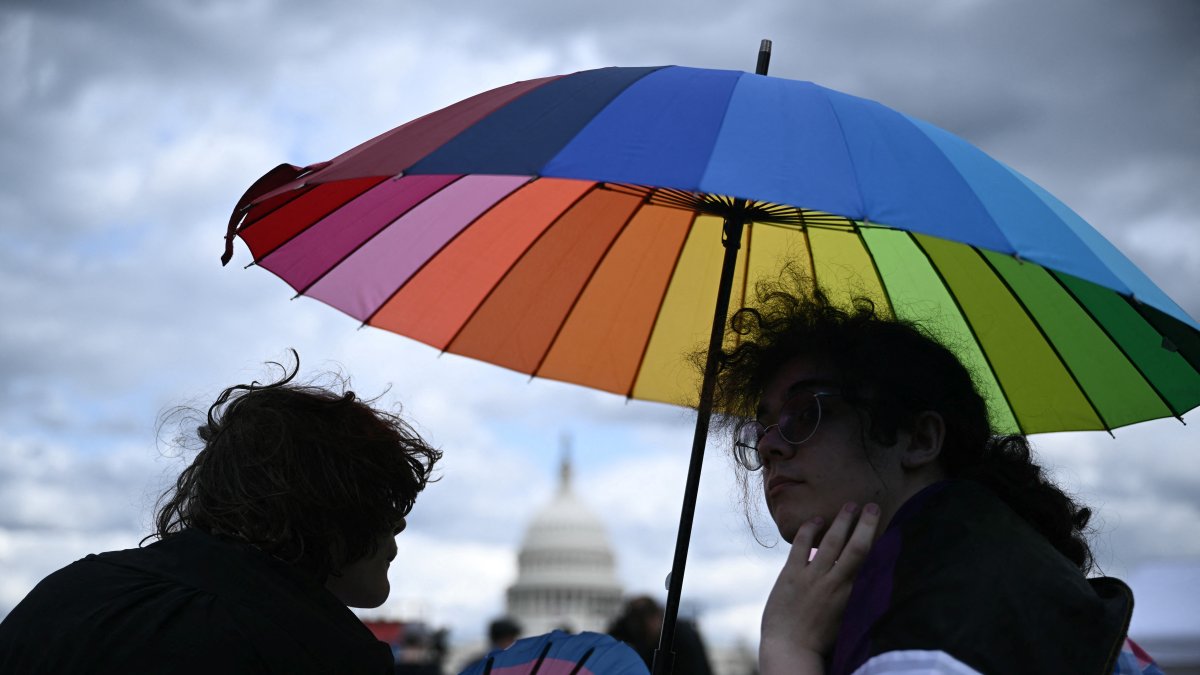
People attend a rally for Trans Visibility Day in Washington

The so-called gender-affirming care industry is in retreat across much of the U.S., as courts uphold bans on medicalized gender transitions for minors and shield counselors from compelled affirmation of gender confusion, while red states remove barriers to older detransitioners suing their providers and facilitate the medical mitigation of their regretted procedures.
The lucrative field of puberty blockers, cross-sex hormones and surgical interventions, a routine next step for children whose gender confusion is affirmed via social transitions such as using opposite-sex pronouns, is also facing potentially crippling jury awards, as evidenced by a $2 million medical malpractice payout in New York for detransitioner Fox Varian.
Practitioners got mixed signals in recent weeks on their prospects going forward, with gender-affirming providers in Oregon coming to terms with an adult detransitioner before trial, a Kansas judge blocking the state's ban on medicalized gender transitions for minors and the California Senate putting a target on therapists who help children resolve their gender confusion.
Camille Kiefel announced she had resolved her nearly four-year-old malpractice suit against her mental-health providers, whose allegedly rushed and fraudulent evaluation before recommending her for a double mastectomy closely resembles Varian's successful allegations. Kiefel, who founded Detrans Help, told Just the News the terms are confidential.
An Oregon court resurrected the lawsuit in late 2023 after it inadvertently lapsed due to a paperwork mix-up when Kiefel's lawyer had to withdraw due to a fatal cancer diagnosis. Kiefel's parallel lawsuit against the clinic and surgeon who performed the breast removal, filed two years ago, was dismissed on the grounds that the statute of limitations had expired.
It's the first settlement reached "at the 11th hour before a jury trial" and would have been the first trial over a medicalized gender transition undertaken as an adult, according to gender medicine journalist Ben Ryan, who broke the news.
"It’s difficult because now I’m the most mentally healthy and most mentally stable I’ve been in my entire life, but I now no longer have my breasts," Kiefel told Fox News.
Ryan said he has tracked 27 detransitioner lawsuits in the U.S. since 2022, many of which foundered over statutes of limitation, including detransitioner Kaya Clementine Breen's suit against Children's Hospital Los Angeles pediatrician Johanna Olson-Kennedy. Breen is appealing last fall's dismissal.
Olson-Kennedy is known for admitting to hiding the results of her taxpayer-funded study that failed to find mental health improvements in children who underwent gender-affirming care.
Freedom of Information Act productions to another gender medicine journalist, Jesse Singal, revealed that the National Institutes of Health backed down on requiring Olson-Kennedy to use a control group in the trial after she protested that withholding puberty blockers was unethical, despite the point of her study being to test how blockers affect mental health.
The North Carolina Court of Appeals is considering whether to reinstate detransitioner Prisha Mosley's malpractice lawsuit against her providers, which a lower court dismissed for exceeding the statute of limitations despite the Legislature having extended the statute to 10 years.
Judge belittles expert witness that saved Alabama's similar ban
Douglas County District Judge Carl Folsom, a short-lister for the Kansas Supreme Court, temporarily blocked the state's ban on medicalized gender transitions for children, passed by the GOP-led legislature over Democratic Gov. Laura Kelly's veto.
He said pseudonymous minors Lily Loe and Ryan Roe, and their parents, are likely to prevail on their claim that SB 63 violates the "right to personal autonomy" in the Kansas Constitution and a "parent’s fundamental right to make medical decisions for their children."
Folsom conflated sex with gender identity and sex stereotypes with gender dysphoria, respectively, just three pages into the 117-page opinion. Loe was "assigned male at birth" but "her gender identity is female," as confirmed by Loe's desire for "dolls, make-up, and traditionally feminine toys" at 18 months old, Folsom wrote.
The judge found the plaintiffs' expert witnesses "credible and reliable," saying they testified that gender-affirming care is "only provided after a rigorous informed-consent process that requires initial and ongoing informed consent from parents and assent from the adolescent."
One of them is University of California San Francisco child psychiatrist Jack Turban, whose study purporting to discredit "rapid-onset gender dysphoria" — a social-contagion explanation for adolescent gender confusion — has been challenged on methodological grounds. Gender medicine journalist Singal wrote a lengthy critique of Turban's study at the time.
Folsom also credited the state's Gender Pathways Services Clinic, which provides the care the plaintiffs use, with following Endocrine Society guidelines.
Olson-Kennedy had invoked the society's guidelines to dissuade NIH from making her use a control group in her puberty blocker study, but Singal argued the guidelines are missing "many of the guardrails that seek to attenuate the role of human bias in guideline development" and are not backed by "quality evidence."
Folsom belittled Kansas Attorney General Kris Kobach's expert witnesses including sexologist James Cantor, whose unsealed expert report in Alabama's successful defense of its similar ban revealed that the Biden administration pressured the World Professional Association for Transgender Health to ditch recommended age minimums for various forms of care.
Olson-Kennedy had also leaned on WPATH guidelines to compel NIH to relent.
"The Court does not credit the testimony of Dr. Cantor as to the actual or potential effects of puberty blockers or hormone therapies because he lacks the qualifications to offer his opinions and failed to support them," Folsom wrote. "His opinions are supported only by cherry-picked information, conjecture, and research taken out of context."
Kobach blasted the judge for creating "a new right of parents to obtain otherwise-illegal treatments for their children," the Kansas Reflector reported.
The California Senate passed legislation last week to drastically extend the statute of limitations for suing providers of so-called conversion therapy, using the template for "childhood sexual assault."
SB 934 defines "sexual orientation or gender identity change efforts" as licensed mental health providers' practices that "seek to direct a patient toward a predetermined sexual orientation or gender identity outcome," including efforts to either discourage or promote "any particular gender identity or gender expression."
It does not appear to exempt talk therapy of the sort the Supreme Court said Colorado could not punish in this year's Chiles precedent, or to exempt patient-directed efforts to mitigate unwanted gender confusion.
Clients can seek damages against their providers within 22 years of turning 18 if the plaintiff was a minor when the therapy took place, within 10 years if the plaintiff was an adult at the time, or within five years of discovering "that psychological injury or illness occurring after the conduct was caused by sexual orientation or gender identity change efforts."
California state Democratic Sen. Scott Weiner said he introduced the bill "when it became clear the Supreme Court would put youth conversion therapy bans, like California’s, in legal jeopardy." The state pioneered such bans in 2012.
Since the high court has ruled that "this psychological torture is subject to the First Amendment — a radical & horrific ruling — California must step up to protect people from this malpractice," Wiener wrote. "Fortunately, the Supreme Court ruling made clear that it did not apply to malpractice claims. So malpractice it is."
LATEST