ANALYSIS
Hispanics in World War II: The forgotten effort that changed the United States
While hundreds of thousands of Latinos fought in Europe and the Pacific, the U.S. economy faced a critical labor shortage. In August 1942, Washington and Mexico signed the Mexican Agricultural Labor Agreement, which gave rise to the Bracero Program.
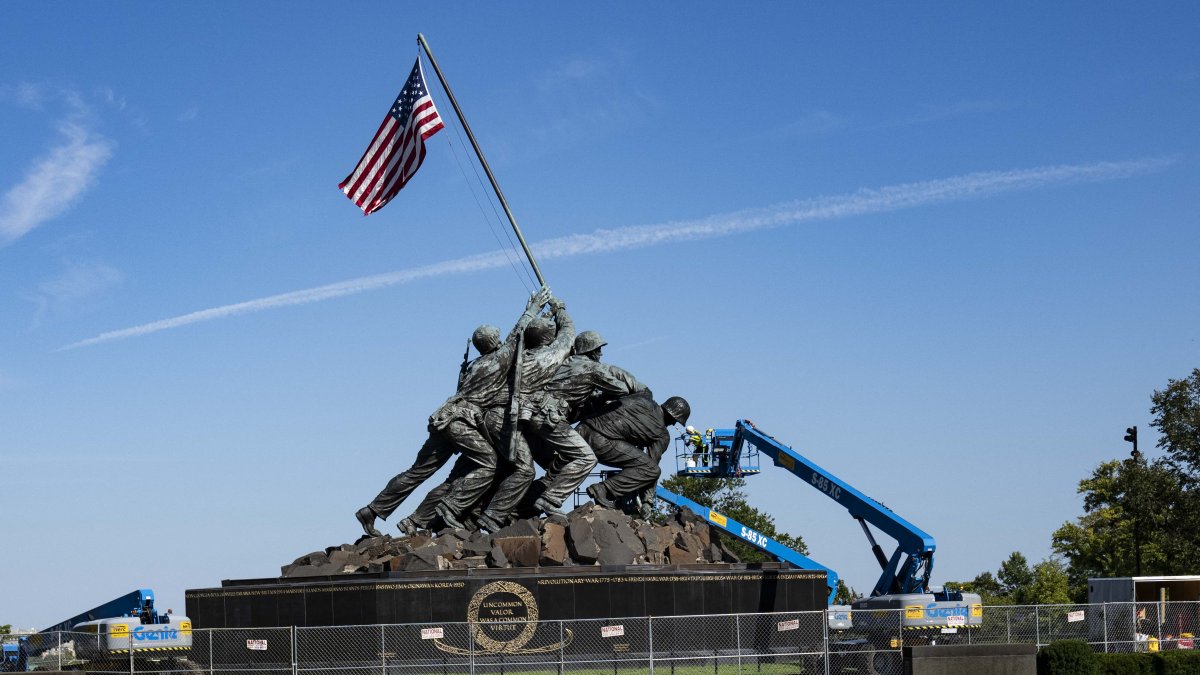
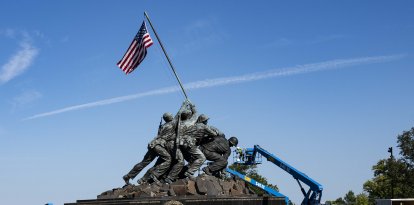
The Iwo Jima Memorial in Arlington, Va.

More than 300,000 Hispanics, mostly Mexican Americans and Puerto Ricans, served in the U.S. military during World War II, a massive contribution that transformed entire communities and fueled the first organized civil rights struggles of the Hispanic population in the country.
There is no ethnic census of enlistees: on military records, most were listed as "white." Estimates range from about 340,000 to 500,000 Hispanics who were drafted or volunteered between 1941 and 1945. The lower figure comes from later veteran surveys; the higher figure is used by museums and in congressional resolutions.
According to the Voces Oral History Center at the University of Texas at Austin, which collects testimonies from Latino men and women who served in World War II, for many, the experience was accompanied by an unprecedented sense of belonging.
Private Armando Flores, from Corpus Christi, Texas, for example, fondly recalled being reprimanded for putting his hands in his pockets on a cold day during basic training. "American soldiers stand at attention," a lieutenant told him. "They never keep their hands in their pockets." Years later, Flores was still amazed by what that moment meant to him: "Nobody had ever called me an American before!"
An unprecedented mobilization of the Hispanic community
The United States' entry into the war, following the Japanese attack on Pearl Harbor on Dec. 7, 1941, sparked an unprecedented mobilization. Of the approximately 16 million Americans who served, estimates place the number of Hispanics at between 340,000 and 500,000. Of these, more than 53,000 were Puerto Ricans, and the remaining bulk—ranging from 300,000 to just over 400,000—were Mexican Americans.
Often, the sacrifice involved the entire family. One story that has been passed down in Hispanic historiography of the war is that of the Sánchez family, comprising 10 siblings, who came from Bernalillo, N.M., to Southen California. Three of the sisters became "Rosita the Riveter" working in factories, and five brothers served. Two were Army soldiers, one a military doctor, another Seabee in the Navy Construction Battalion and the eldest, aged 50, a civil defense patrolman. One was killed in the Philippines; they didn't know if another had survived the Battle of the Bulge.

Unlike black soldiers, Hispanics were not segregated into specific units, with exceptions such as the 65th Infantry Regiment from Puerto Rico. That unit, later known as the "Boriqueneers"—a nickname that became particularly popular during the Korean War—already existed and served in World War II.
The available statistics, though imperfect, paint a picture of disproportionate contribution. While Hispanics accounted for approximately between 2% and 3% of the U.S. population in the 1940s, their presence in the ranks exceeded 3% of the total force. Estimates of Hispanic casualties in the conflict range from 9,000 to higher figures, although the lack of precise ethnic records prevents a definitive count.
Decorated Hispanic heroes: 17 Medals of Honor
The bravery of Hispanic soldiers was reflected in the number of decorations they received. Seventeen Hispanic soldiers received the Medal of Honor, the United States' highest military distinction, for acts of extreme heroism in combat.
- Joe P. Martínez. Private. Attu, Alaska, 1943. He relaunched the assault on the snow-covered pass with a BAR and grenades; he died while capturing the position. First Hispanic to receive the Medal of Honor in World War II.
- Marcario García. Sergeant. Grosshau, Germany, 1944. Despite being wounded, he refused to be evacuated and single-handedly destroyed two machine-gun nests; he killed six and captured four.
- José M. López. Sergeant. Krinkelt, Belgium, 1944 (Ardennes). Using a machine gun, he repelled a German attack; the citation credits him with killing at least 100 enemy soldiers.
- José F. Valdez. Private First Class. Rosenkrantz, France, 1945. He covered his patrol's retreat under attack from an enemy company; he died from his wounds.
- Manuel Pérez Jr. Paratrooper. Luzon, Philippines, 1945. He neutralized a bunker that was holding up his company and killed 18 Japanese soldiers. He later died from a sniper's bullet.
- Silvestre S. Herrera. Private First Class. Mertzwiller, France, 1945. He stormed a nest and captured eight Germans; he continued fighting after losing both feet in a minefield.
- Ysmael R. Villegas. Sergeant. Villa Verde, Luzon, 1945. He cleared sniper nests one by one; he was killed while storming the last one.
- Rudolph B. Dávila. Sergeant. Artena, Italy, 1944. He silenced three German machine guns. He was awarded the medal in 2000.
- Pedro Cano. Private. Schevenhütte, Germany, 1944. In two days, he eliminated several machine-gun nests that were holding up his unit. Medal awarded in 2014.
- Joe Gándara. Paratrooper. Amfreville, France, 1944 (Normandy). He destroyed three machine guns and was mortally wounded. Medal awarded in 2014.
- Salvador J. Lara. Private First Class. Aprilia, Italy, 1944. He led the assault on several strongpoints for two days. Medal awarded in 2014.
- Manuel Mendoza. Sergeant. Monte Battaglia, Italy, 1944. While wounded, he repelled a German counterattack. He survived, served in Korea, and died in 2001; the medal was awarded to him in 2014.
- Lucian Adams. Staff Sergeant, 30th Infantry, 3rd Division. Saint-Dié, France, 1944. He advanced practically alone under heavy fire, destroyed several machine-gun nests, and captured several enemy soldiers; his action broke German resistance in that sector and allowed his company to advance. Medal awarded in 1945.
- David M. Gonzales. Private First Class, 127th Infantry, 32nd Division. Villa Verde, Luzon, April 25, 1945. A shell buried several of his comrades; under fire, he dug them out and was killed while attempting to rescue another. Medal awarded posthumously.
- Alejandro R. Rentería Ruiz. Private First Class, 165th Infantry, 27th Division. Okinawa, April 28, 1945. His company was pinned down by a pillbox; he approached it, his rifle jammed, he repaired it under fire, entered the pillbox, and killed all 12 occupants. He survived.
- Cleto L. Rodríguez. Private, 148th Infantry, 37th Division. Paco Station, Manila, February 9, 1945. Together with John N. Reese Jr., he stormed the Japanese defenses at the station; between them, they are credited with killing more than 80 enemy soldiers. Rodríguez survived; Reese was killed in action. Medal awarded in 1945.
- Harold Gonsalves. Private First Class, Marine Corps, 15th Marines, 6th Division. Okinawa, April 15, 1945. During an artillery advance, he threw himself on a Japanese grenade to save his squad. Medal awarded posthumously.
Many of these awards came decades after the war, as a result of a review ordered by Congress that identified cases of overlooked heroism. This belated recognition does not change the fact that Hispanics received the highest per-capita rate of Medals of Honor among all minorities in the country during the war.
Hispanic women and the IISGM
Many Hispanic women joined the war effort even though it was unusual in their communities for a daughter or wife to leave home alone and travel across the country. Their proficiency in Spanish and English made them especially valuable: they encrypted messages, operated communications and served as interpreters.
Others cared for the wounded as nurses in the Army Nursing Corps, a separate unit from the auxiliary unit, or as volunteers with the Red Cross. They also enlisted in the women's corps created during the war: the Women's Army Auxiliary Corps (WAAC), which became the Women's Army Corps (WAC) in 1943; the Navy's WAVES; and the Women's Marine Corps Reserve.
According to Voces, at age 19, María Sally Salazar, from Laredo, Texas, used her sister's birth certificate to meet the minimum age requirement of 21 and enlist in the Women's Army Corps. Assigned to New Guinea and later to the Philippines, she spent a year and a half in the jungle, working in the Surgeon General's office and, when needed, tending to the wounded.

The home front: The Bracero Program and the war economy
While hundreds of thousands of Hispanics were fighting in Europe and the Pacific, the U.S. economy faced a critical labor shortage. In August 1942, Washington and Mexico signed the Mexican Agricultural Labor Agreement, which gave rise to the Bracero Program. Between 1942 and 1945, some 170,000 to 220,000 Mexican farmworkers entered the country legally; tens of thousands more were hired by the railroads—around 80,000 during the war years.
The Braceros sustained the harvests and rail lines of the so-called "Arsenal of Democracy." Their experience, however, was marked by substandard housing, discrimination, low wages and, along the border, DDT spraying. In the fields, workers frequently used "el cortito," a short-handled hoe that forced them to work in a hunched position and caused spinal injuries in many day laborers—a problem that persisted throughout the entire program, which remained in effect until 1964.
Society
How Hispanics travel in the US: Discover which destination they prefer over Miami and New York
Carlos Dominguez
Discrimination and early civil rights struggles
Despite their service, Hispanic veterans returned to a country that often denied them equal treatment. Many faced segregation in schools, restaurants and movie theaters, especially in the Southwest. In Texas, for example, Hispanics were officially classified as "white" but suffered de facto discrimination in all areas of public life.
This contradiction between sacrifice on the front lines and marginalization at home fueled a burgeoning civil rights movement. Organizations such as the League of United Latin American Citizens (LULAC) and the American G.I. Forum stepped up their activism in the postwar period, denouncing police violence, school segregation, and political exclusion. Iconic cases, such as that of Private Félix Longoria, whose funeral was refused by a Texas funeral home in 1949, highlighted the problems of a system that demanded loyalty in war but denied dignity in peace.
A legacy that redefined the Hispanic identity in the United States
For many families, the war also meant the first generation of veterans with access to benefits such as the G.I. Bill of 1944, which provided education, mortgage loans, and support for re-entry into the workforce. Although access to these benefits was not equitable and many Hispanic veterans faced administrative and racial barriers, the experience laid the groundwork for the expansion of the Hispanic middle class in the following decades.
LATEST