God's role in the Declaration of Independence: Why the Founding Fathers mentioned him four times
Far from being a mere anecdotal detail, the references to God were at the heart of the revolutionary argument. To understand why they appear in the Declaration and why they are not present in the Constitution, it is necessary to explore the nature of each document.
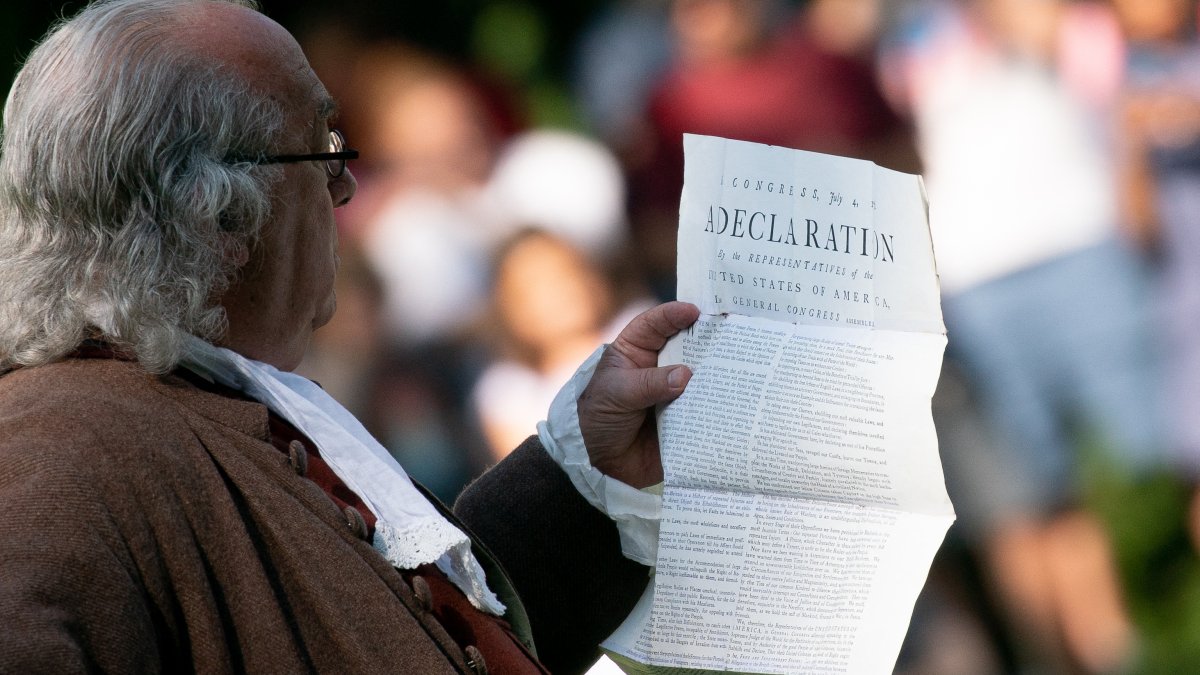
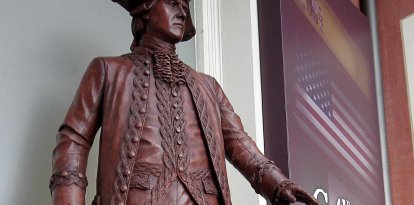
A Benjamin Franklin impersonator reads the Declaration of Independence/ Stefani Reynolds

Before becoming a country, the United States had to justify its existence, both at home and abroad. That was the mission of the Declaration of Independence. Much more than simply announcing a break with Great Britain, the document was meant to justify a revolution against the most powerful empire of the 18th century and explain why the thirteen colonies could proclaim themselves free.
However, between the lines of that founding text lies a detail that often goes unnoticed. The Declaration of Independence mentions God four times, whereas the Constitution, drafted just eleven years later by many of the same key figures, does not.
Far from being an anecdotal detail, the references to God were at the heart of the revolutionary argument. To understand why they appear in the Declaration and why they are absent from the Constitution, it is necessary to explore the nature of each document.
A text to justify a revolution
In June 1776, the Second Continental Congress tasked a committee of five delegates with drafting a declaration explaining why the thirteen colonies were breaking away from Great Britain for good. The group consisted of Thomas Jefferson, John Adams, Benjamin Franklin, Roger Sherman, and Robert Livingston, although it was Jefferson who wrote the first draft in a rented room in downtown Philadelphia.
Before it reached the full Congress, the text was reviewed by Adams and Franklin. Later, the delegates made further changes before adopting it on July 4, 1776.
By its very nature, the Declaration of Independence was a defense of the revolution, an explanation of the grounds that led the thirteen colonies to separate from the British Crown. It was not designed as a government program. It was crafted as an argument to convince both the colonists and foreign powers that the revolution against King George III was legitimate.
The four references to God in the Declaration of Independence
In this context, the references to God played a central role in strengthening the moral argument. There are four references, each with a specific purpose.
The first appears in the opening paragraph, when the text invokes “the Laws of Nature and of Nature’s God” to assert that people may dissolve the political bonds that bind them to another state.
The second is probably the best-known, the most widely cited passage in the document. The text asserts that all men are created equal and are “endowed by their Creator with certain unalienable rights.”
The Continental Congress itself incorporated the other two references. Before concluding the document, the delegates appeal to the “Supreme Judge of the world” as a witness to the righteousness of their intentions and, finally, express their “firm confidence in the protection of Divine Providence.”
What do the references to God mean?
The references combine deistic elements, such as the first two, with some more Christian references, which presuppose an active God who intervenes in the course of History. This is particularly evident in the reference to divine providence, which implies the belief that God guides, protects, and directs the destiny of individuals and nations.
Brenda Hafera, deputy director and research associate at the Simon Center for American Studies at the Heritage Foundation, spoke with VOZ about the nature of the Declaration of Independence.
As she explained, the Founding Fathers were primarily influenced by the tradition of natural law, the Scottish Enlightenment, ancient philosophy, and Christianity.
"The Great Awakening swept through America in the 1730s and 1740s, the most referenced work of the Founding generation was the Bible, and about 70-80% of American colonists attended service on a regular basis," she added, citing the book We Still Hold These Truths: Rediscovering Our Principles, Reclaiming Our Future, by Matthew Spalding.
Regarding the Great Awakening, it was a movement of religious renewal that transformed the spiritual life of the colonies decades before independence.
Hafera noted that the document appeals to both "reason and Revelation, to Nature and Nature's God, to eternal laws and immutable truths." For the founding generation, he argued, these traditions were not incompatible but complementary.
“Endowed by their Creator”
Regarding the famous passage from the Declaration, Hafera emphasized that, for its time, the concept was revolutionary.
Until then, many European monarchies held that rights ultimately depended on the authority of the sovereign. The authors of the Declaration reversed that logic: rights existed prior to any government because they belonged to human nature itself. Therefore, if those rights had been granted by God, no king or Parliament could override them.
“The government recognizes, rather than grants, inalienable rights and has limited, enumerated powers. That understanding is a reflection on what it means to be human and calls for a system of government that is respectful of human dignity and conducive to human flourishing,” Hafera noted.
“In stating that people’s rights were given to them by their creator, the Continental Congress endowed those rights with a legitimacy that knows no parallel in mortal sources. What God has given to man is not enjoyed at the sufferance of any monarch or government. Liberty is the inviolable birthright of all,” lawyer and historian Anthony J. Minna wrote in an article published on the Journal of the American Revolution website.
Why doesn’t the Constitution mention God?
The absence of similar references in the Constitution often comes as a surprise, but it stems from a simple reason: the two documents pursued entirely different objectives.
One of the most famous metaphors in this regard was popularized by Abraham Lincoln. In December 1860, he compared the Declaration of Independence to an “apple of gold” and the Constitution to a silver frame. For Lincoln, the principle that all men are created equal was the true heart of the American project; the Constitution, on the other hand, was the instrument designed to protect and preserve that ideal. In his own words, the frame was made for the apple, not the apple for the frame.
Along these same lines, Hafera emphasized that "the Declaration lays out America's principles, and the Constitution protects those principles through practical mechanisms."
“All men are men and not beasts”
More than 250 years later, those four references to God continue to spark interpretations and debates. For Hafera, their importance lies in the fact that they express the conviction that there are fundamental and immutable truths about human nature: “They are an indication that there are fundamental and unchangeable truths and that there is order to the universe.” That idea, she argued, was the starting point upon which the Founding Fathers built their conception of liberty, rights, and self-government.
That vision was summarized years later by President John Adams, who wrote the following reflection on the concept of equality in the Declaration:
“Really means little more than that We are all of the same Species: made by the same God: possessed of Minds and Bodies alike in Essence: having all the same Reason, Passions, Affections and appetites. All Men are Men and not Beasts…. All these are Men and not Angels.”
LATEST