ANALYSIS
Miami, Austin and Orlando solidify themselves as the most favorable markets for homebuyers
Buyers gain ground in major real estate markets after pandemic boom cools. Seven major metropolitan areas are ranked as buyers’ markets.

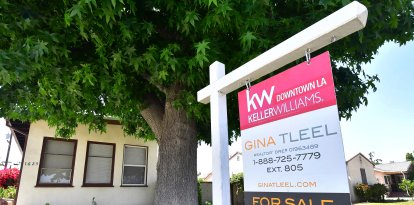
A “for sale” sign is seen on a house in California, on Sept. 17, 2025. The Federal Reserve on this date lowered interest rates for the first time this year.

A Realtor.com report indicated that the U.S. real estate sector is showing clear signs of change. According to the analysis, seven major metropolitan areas were classified as buyer's markets in June 2025, by recording more than a six-month supply of available homes. In this scenario, Miami, Austin and Orlando emerged as the epicenters where the balance tipped most heavily toward buyers.
The months of supply, an indicator that reflects how long it would take to sell current inventory at the current sales pace-reached record highs in these cities, generating an environment where buyers have more bargaining power vis-à-vis sellers.
Miami leads the national ranking
The city of Miami took the lead among the 50 metropolitan areas analyzed by Realtor.com. In June, its inventory reached 9.7 months' supply, which equates to nearly 10 months to sell out listings at the current buying pace. This volume represents a 35% increase compared to 2024.
The median list price in Miami stood at $510,000, down 4.7% from the previous year. At the metropolitan level (Miami-Fort Lauderdale-West Palm Beach), the data shows:
- Active listings: +24.3% year-over-year.
- New listings: -8.3% year-over-year.
- Median listing price: $500,000.
- Year-over-year change in median price: -5.7%.
Austin: Falling prices and more inventory
The second most advantageous market for buyers was Austin, Texas, with 7.7 months of supply in June. The demand that took off after the pandemic now is showing a slowdown, while the number of homes for sale soared. According to Realtor.com, Austin recorded the second-largest increase in inventory from pre-COVID levels.
In June, nearly 33% of listed properties had price cuts, reinforcing the downward pressure. The typical price in the city remained below $500,000, down 4.8% from a year ago.
For the Austin-Round Rock-San Marcos region, the numbers indicate:
- Active listings: +15.4% year-over-year.
- New listings: +3.6% year-over-year.
- Median list price: $499,000.
- Year-over-year change in average price: -5.0%.
- Months of supply: 7.1.
Orlando solidifies its spot as a buyers’ market
Third position was held by Orlando, Fla., with 6.9 months' supply inventory in June. The number of available properties grew 34% over last year, while the median price dropped 3.4% to $429,473.
In the Orlando-Kissimmee-Sanford metropolitan area:
- Active listings: +19.5% year-over-year.
- New listings: -10.7% year-over-year.
- Median list price: $422,695.
- Year-over-year change in median price: -2.8%.
Orlando became a buyer's market in January, when its supply exceeded the six-month threshold.
Other notable markets
In addition to Miami, Austin and Orlando, the Realtor.com report identified four additional areas that meet buyer market conditions:
- New York-Newark-Jersey City (N.Y.-N.J.):
- Active listings: +7.7% year-over-year.
- New listings: +6.5% year-over-year.
- Median list price: $760,000.
- Year-over-year change in median price: +0.1%.
- Months of supply: 6.7.
- Jacksonville, Fla.:
- Active listings: +12.0% year-over-year.
- New listings: -4.3% year-over-year.
- Median list price: $399,000.
- Year-over-year change in median price: -2.6%.
- Months of supply: 6.3.
- Tampa-St. Petersburg-Clearwater, Fla.:
- Active listings: +16.3% year-over-year.
- New listings: -7.6% year-over-year.
- Median list price: $415,000.
- Year-over-year change in median price: 0.0%.
- Months of supply: 6.3.
- Riverside-San Bernardino-Ontario, Calif.:
- Active listings: +30.4% year-over-year.
- New listings: -3.3 % year-over-year.
- Median list price: $599,000.
- Year-over-year change in median price: 0.0%.
- Months of supply: 6.1.
The reasons: Increase in inventory and slowing sales
Realtor.com senior economist Jake Krimmel explained that all seven markets share a common pattern: increased inventory and slowing sales, resulting in increased competition among sellers and less pressure from buyers.
"The housing market is particularly weak in the South and West, especially Florida. Seeing four of its major metro areas on the list of buyers' markets is no surprise. Rather, it confirms the weakness we've been seeing: more inventory, longer time on the market, more cutbacks and declines in list prices, along with a slowdown in new listing growth," he said.
Krimmel warned that the months of supply indicator has a predictive component on the direction of prices. An example of this is reflected in the fact thateach of the seven buyer markets posted year-over-year declines in price per square foot in August.
In particular, the declines were:
- Miami: -3.9%.
- Austin: -3.5%.
- New York: -3.5%.
Interest rates
Interest rates are also a factor that directly influences the behavior of the real estate market. The Federal Reserve (FED) cut rates this Wednesday for the first time so far this year. The central bank decided to lower its benchmark rate by 0.25 percentage points (4% and 4.25%), as most analysts expected. Previously, this rate was in a range between 4.25% and 4.50%. The Fed contemplates two rate cuts of a quarter percentage point in the remainder of 2025.
The CEO of Invierte en Miami Real Estate, Gabriel Perozo, anticipated this scenario a few months ago and pointed it out as positive because it encourages buyers to make the final decision to purchase a home. Likewise, he left a recommendation as an expert to all those buyers:
"The ideal time to buy a house is personal, it does not depend solely on the market. However, conditions could be more favorable, as the Federal Reserve is considering a controlled inflation around 2% and a weaker labor market, which could lead to cuts in interbank rates. This would make interest rates more affordable toward the end of the year," he said.

LATEST