OPEC on the brink: UAE's farewell justifies Trump's pressure on the oil market
The organization has prevented free market forces from stabilizing gasoline costs.
OPEC logo.

The global energy landscape is undergoing a seismic transformation that points to the end of an era of price controls. The Organization of Petroleum Exporting Countries (OPEC), which for decades has influenced the world economy by restricting supplies, is facing an existential crisis.
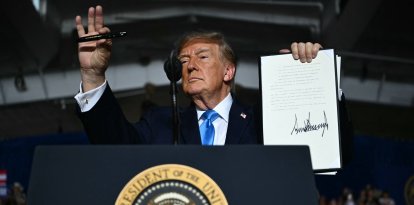
This scenario, recently analyzed by Fox Business, represents a political and economic victory for the Trump administration. President Donald Trump has maintained a steady campaign of pressure against what he calls a structure that "rips off the rest of the world."
The possible disintegration of the group vindicates the position of the U.S. president, who always maintained that OPEC kept gasoline prices high in an unfair way for U.S. consumers.
By limiting the amount of barrels each member country can pump daily, the organization has prevented free market forces from stabilizing costs. However, the departure of a key player has begun to fracture the institution's credibility.
Arab Emirates regains its energy sovereignty
The catalyst for this collapse came in late April, when the United Arab Emirates (UAE) announced its withdrawal from OPEC and the expanded OPEC+ alliance as of May 1. This decision not only detracts from the group's production weight, it also removes its institutional credibility at a time of high geopolitical tension.
Phil Flynn, senior market analyst at The PRICE Futures Group and Fox Business contributor, links this move to the strategic outcomes of "Operation Epic Fury."
According to Flynn, this conflict has forever changed the face of OPEC and shifted energy dominance back to the Western Hemisphere. The UAE, tired of taking a back seat to Saudi Arabia, the group's de facto leader, has chosen to prioritize its own national interests and production capacity.
The Emirates' goal is ambitious: they plan to increase their daily output from just over three million barrels to five million by next year. This desire to control their own economic destiny is a sentiment that could spread to other members.
Elaine Dezenski, director of the Center on Economic and Financial Power at the Foundation for Defense of Democracies (FDD), noted that we are witnessing "one of the final nails in OPEC's coffin." Dezenski adds that this alignment of the UAE with U.S. market interests is part of a broader "state economic strategy."
A production domino effect: The impact on the free market
The UAE's exit could trigger a domino effect among other members of the organization. Countries such as Iraq, facing urgent financial needs, could be tempted to abandon restrictive quotas in order to maximize their revenues through increased exports.
This breakup is seen as positive news for the end consumer. Flynn explains that "competition is good as it lowers prices and collusion by producers raises them."
With more players setting prices based on market forces rather than bureaucratic decisions, supply will tend to stabilize at levels that favor lower fuel costs at U.S. stations.
However, the transition to a fully free market is not without skepticism. Saudi analysts such as Salman Al-Ansari argue that OPEC+ can continue to function and that the UAE's exit is a symbolic move rather than a major economic rupture.
"The institution has managed internal differences before," Al-Ansari told Fox Business, stressing that the group's strength depends on disciplined coordination.
Toward a new energy stability
Despite the doubts, experts such as FDD member Bernard Haykel predict that the effects of this decision will be felt strongly in the medium term. "We are likely to see lower prices in the future.... say a year from now, once things get back to normal, you will see a much lower price due to this decision by the United Arab Emirates," he explained.
For large U.S. energy companies, a scenario of lower but market-dictated prices represents an innovation challenge that they have overcome for decades.
Unlike OPEC's centralized control, the U.S. free-market system prioritizes efficiency and technology. Although OPEC's demise could bring greater initial volatility, analysts such as Earle suggest that companies can use financial tools to mitigate those risks.
The collapse of OPEC as we know it would mark the ultimate success of the Trump administration's energy doctrine.
LATEST