A dangerous attempt to whitewash a reputation
The agreement signed between Mexico's National Human Rights Commission and a Cuban university is not academic cooperation, but rather the political legitimization of a repressive university system.
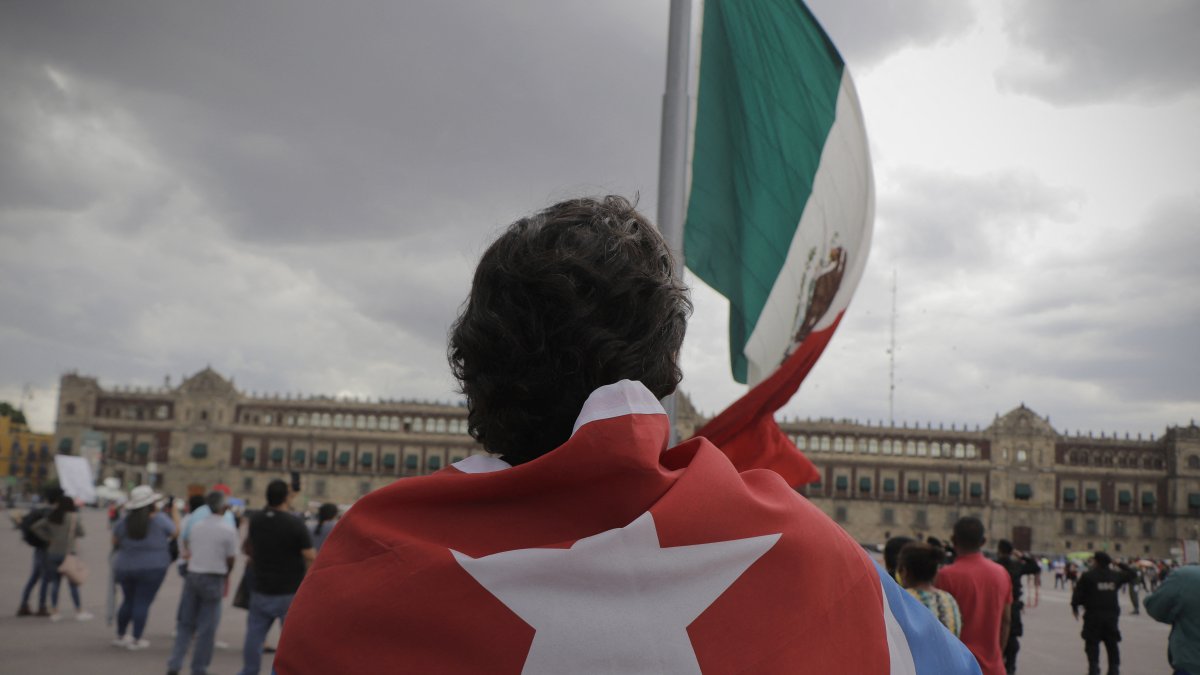
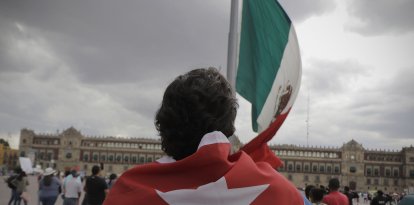
A person wearing a Cuban flag in front of the Mexican flag (File photo)

We are astounded by the announcement from the National Human Rights Commission of Mexico (CNDH) to "join forces" with the Marta Abreu Central University of Las Villas, in Cuba, to promote "education, research, training and knowledge in support of human rights and a culture of peace."
This is not a gesture of academic cooperation, but rather the political legitimization of a university system that, for decades, has used enrollment, teaching positions and degrees as instruments of ideological punishment.
According to documentation compiled by the Observatory on Academic Freedom and independent media outlets, the University of Las Villas ranks among the Cuban institutions with the highest number of cases of expulsion and harassment on political grounds.
In 2017, it expelled journalism student Karla María Pérez González for belonging to a civic movement and exercising her freedom of speech, and professor Dalila Rodríguez González for her political "attitudes." Rector Andrés Castro Alegría signed those decisions. The pro-government University Student Federation (FEU) declared that "university students will never accept the counterrevolution within our universities." This is not human rights education, but rather the doctrine of "the university only for revolutionaries" applied with institutional approval.
This pattern did not begin in Las Villas, nor in 2017. In 2002, in Camagüey, authorities and the José Martí Higher Pedagogical Institute expelled students for signing the Varela Project, a citizen-led initiative protected by the nation’s constitution. Among them were Roger Rubio Lima, Yoan Columbié Rodríguez and Harold Cepero Escalante. They were dragged out of the classroom amid shouts, threats and a public act of condemnation. The president of the FEU in Camagüey said it without mincing words: "We stand above the constitution." Harold Cepero died on July 22, 2012, alongside Oswaldo Payá. In 2023, the Inter-American Commission on Human Rights concluded that the Cuban state is responsible for those deaths.
In 2003, the University of Pinar del Río dismissed law professor Yaxys Dallan Cires Dib—now director of strategies at the Cuban Human Rights Observatory (OCDH)—after he signed the Varela Project and refused to bow to the political ritual. State security authorities dictated the criteria; the university carried out the order. There was no due process. The message was explicit: "Anyone who does not defend the achievements of the Revolution is not fit to teach."
This is the system with which Mexico's National Human Rights Commission claims it wants to build a "culture of peace."
International and national human rights institutions do not lose their dignity when they denounce an inconvenient government, but rather when they choose their victims according to the geopolitical landscape of the moment. An ombudsman's office that signs "human rights" agreements with universities in a state that makes the right to education conditional on ideological loyalty ceases to be a counterweight and becomes a tool for reputational whitewashing.

Cuba is not an "imperfect partner" when it comes to human rights. It is a systematic violator. This is documented by Amnesty International, Human Rights Watch, the Inter-American Commission on Human Rights, U.N. special rapporteurs, the country's own registry of political prisoners and reports from the OCDH. To claim otherwise is not a "critical perspective from the Global South." It is alignment.
The case of Mexico is not a curious exception. It is part of a broader deterioration. Too many national organizations, inter-American networks and multilateral forums have replaced the universal standard—the individual versus power—with a partisan standard: ideological adversaries are rigorously denounced, while allies are downplayed, relativized or "contextualized." The result is predictable. Dictatorships learn that all they need to do is invoke blockades, imperialism or the "culture of peace" to buy silence. Victims learn that their suffering only counts if it fits the narrative of whoever is holding the microphone.
We are not disputing Mexico's right to maintain relations with Cuba, but rather the use of the name, budget and mandate of an ombudsman's office to whitewash universities that have turned freedom of thought into grounds for expulsion.
LATEST