America Must Reckon with Havana's Malign Influence
It begins with promises of free programs, government-controlled prices, and punishment of the supposedly wealthy. It ends with shortages, economic collapse, and a government powerful enough to take away citizens’ rights, property, and livelihoods.
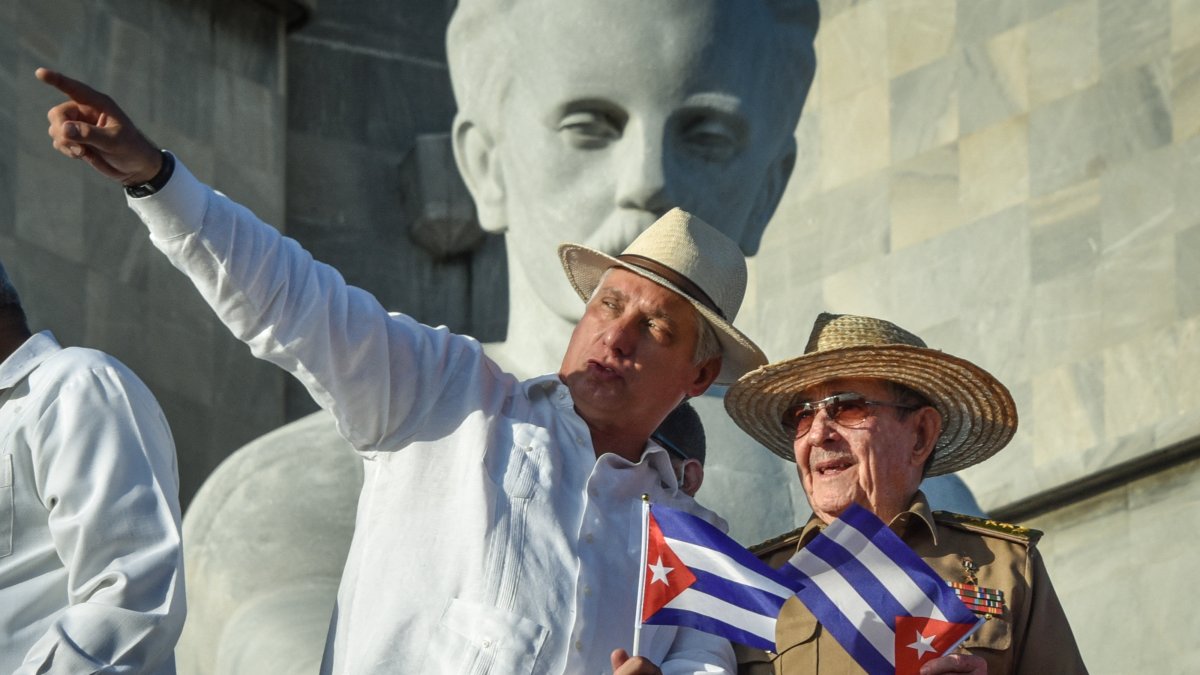
The top leadership of the Cuban regime: Miguel Díaz-Canel and Raúl Castro
Six years ago, as law-abiding Americans were confined to their homes, left-wing radicals were organizing riots and anarchy across the country. Cities burned, statues fell, people and police were assaulted, and elected officials allowed public order to collapse.
The most radical elements sought not to reform America but to dismantle its institutions, erase its history, and portray our nation as fundamentally evil. What many Americans did not realize was that the communist Cuban regime, 90 miles from our shores, had spent decades cultivating ties with American revolutionary movements.
The State Department recently released a report tracing Havana’s campaign of espionage, subversion, and ideological influence against the United States. It argues that Cuba’s revolutionary ideology helped shape radical movements tied to the unrest of 2020 and should prompt a reckoning with Havana’s efforts to export revolutionary leftism.
The report provides concrete examples. Ana Belén Montes was recruited by Cuban intelligence while a graduate student at Johns Hopkins SAIS before rising to become the Defense Intelligence Agency’s senior Cuba analyst. Victor Manuel Rocha secretly served Havana for decades while holding senior positions at the State Department and the National Security Council, and as U.S. ambassador to Bolivia. The report also describes Cuba’s use of university exchanges and activist travel programs to identify sympathetic Americans, cultivate future leaders, and encourage participants to amplify Havana’s propaganda through social media and political organizing after returning home.
For me, this issue is personal. My mother was born in Cuba and fled Castro’s dictatorship in search of freedom. Like many Cuban Americans, I grew up hearing what happens when a government promises equality but delivers censorship, repression, poverty, and fear.
Socialism is communism lite as Vladimir Lenin the first leader of Soviet Union proclaimed, “Socialism is the first stage of communism.” It begins with promises of free programs, government-controlled prices, and punishment of the supposedly wealthy. It ends with shortages, economic collapse, and a government powerful enough to take away citizens’ rights, property, and livelihoods.
That is what happened in Cuba and Venezuela. Millions fled because America protects free speech, private property, free enterprise, and opportunity.
Yet several more self-described “democratic socialists” have won congressional primaries and could enter Congress next year, joining existing far-left members in what should be called the “Commie Caucus.” They reject the communist label but embrace the same failed ideas: hostility toward private enterprise, dismantling law enforcement, price controls and unlimited taxpayer-funded programs, and abolishing private property rights. Most recently, they are doubling down on their quest to pack the Supreme Court just like Hugo Chávez and Nicolás Maduro did in Venezuela, where they added 12 loyalist justices, leading to the destruction of the legal system and, subsequently, the richest country in South America.
These ideas do not spread in a vacuum. They are reinforced by organizations that defend or collaborate with the Cuban regime. The People’s Forum welcomed dictator Miguel Díaz-Canel to its New York headquarters and supported the Venceremos Brigade, which brings American activists to Cuba. CODEPINK has organized delegations to the island. The National Lawyers Guild advocated for the Cuban Five, members of Cuba’s Wasp Network convicted on charges including conspiracy to commit espionage and acting as unregistered foreign agents.
Lawful protest is constitutionally protected. The national-security concern arises when hostile governments finance, direct, coordinate with, or exploit domestic organizations without public disclosure.
These networks also create channels America’s other adversaries can exploit. Cuba serves as a bridge between sympathetic organizations and governments, including China, Russia, and Iran. Beijing and Moscow have pursued intelligence, security, military, and political ties with Havana, while Tehran benefits from Cuba’s role in a wider anti-American coalition. Cuba’s value lies less in its strength than in its proximity to America, intelligence services, and regional networks.
Members of Congress have also helped legitimize the regime. In 2024, Reps. Pramila Jayapal and Ilhan Omar met with Cuba’s oppressive President Díaz-Canel to discuss human rights and call for easing restrictions, ridiculously claiming that the embargo, not communism itself, was to blame for the poor humanitarian conditions on the island.
Even after President Trump took action to combat the threats to the United States posed by the government of Cuba this year, left-wing members of Congress traveled there in solidarity with the communist dictatorship instead of our own country. In April, Pramila Jayapal and Jonathan Jackson conducted a five-day trip to meet with Díaz-Canel and his foreign minister and criticize U.S. sanctions. Last month, Reps. Mark Pocan, Teresa Leger Fernández, Maxine Dexter, and Delia Ramírez also met with Díaz-Canel and condemned the Trump administration’s Cuba policy. Such visits risk legitimizing a dictatorship that has starved, tortured, and even killed its own citizens, and are a slap in the face to the political prisoners, journalists, and dissidents who remain persecuted.
The State Department’s report is an important first step, but Congress and the administration should enforce sanctions, investigate evidence of foreign direction or undisclosed coordination, require transparency regarding support from hostile governments, and strengthen counterintelligence protections against Cuban and allied services.
Those who escaped Cuba and Venezuela did not come to America to recreate the systems they fled. My mother’s generation escaped communism in search of freedom. Our generation must ensure that ideology never gains the power to dismantle the freedoms we enjoy here.
LATEST