TRAGEDY IN VENEZUELA: At least 188 people have died in two devastating earthquakes that have ravaged Caracas, La Guaira, and other cities in the central part of the country
In Caracas, residents evacuated swaying buildings and remained on the streets. Collapses were reported in the Altamira and Palos Grandes neighborhoods, and a Bancaribe bank branch collapsed. Simón Bolívar International Airport in Maiquetía, the country’s main airport, sustained damage and rescheduled operations; videos showed passengers running for cover as the terminal shook.
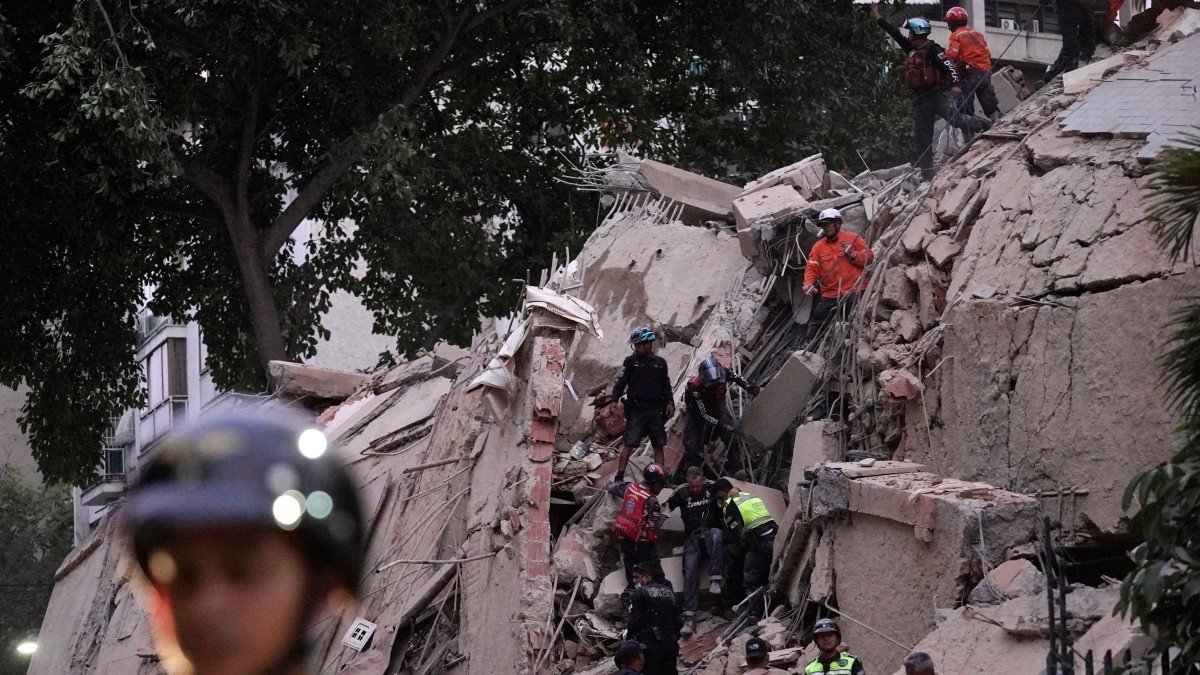
Rescue teams evacuate an injured person from a collapsed building following an earthquake in Caracas

Two powerful earthquakes struck Venezuela on Wednesday night, just one minute apart, leaving buildings and homes collapsed in Caracas and other cities in central Venezuela. The tremor, which was also felt in Colombia, Curaçao, and Aruba, triggered tsunami warnings for several areas in the Caribbean. In the hours following the incident, authorities have confirmed at least 188 deaths and more than 1,500 injuries, figures that are likely to rise as time goes on.
The U.S. Geological Survey (USGS) reported an initial earthquake with a magnitude of 7.1—a figure it later revised to 7.2— at 6:04 p.m. local time, with its epicenter off the Caribbean coast, west of Morón, at a depth of 13 kilometers. One minute later, the agency recorded a second earthquake with a magnitude of 7.5, at a depth of 10 kilometers and with an epicenter 16 kilometers southwest of Morón. Both are among the strongest to have struck the country in more than a century.
The U.S. Pacific Tsunami Warning Center issued a warning for the coasts of Puerto Rico, the U.S. and British Virgin Islands, and predicted waves along the coasts of Venezuela, Bonaire, Curaçao, and Aruba.
In Caracas, residents evacuated swaying buildings and remained on the streets. Landslides were reported in the Altamira and Palos Grandes neighborhoods, and a Bancaribe bank branch collapsed. The Simón Bolívar International Airport in Maiquetía, the country’s main airport, sustained damage and rescheduled operations; videos showed passengers running for cover as the terminal shook. Users in Caracas, Miranda, and La Guaira also reported outages in telecommunications services, particularly from the carrier Movistar.
According to the official statement released by the Ministry of Communication and Information, the earthquake was felt in the states of Yaracuy, Lara, Mérida, Aragua, Carabobo, La Guaira, and Miranda, as well as the Capital District. Citizen reports compiled by local media expanded that list to include states such as Falcón, Zulia, Táchira, Barinas, Portuguesa, Guárico, Anzoátegui, Sucre, Monagas, Bolívar, and Delta Amacuro, although there was no official confirmation.

Society
5.6-magnitude earthquake strikes Northern California: Authorities are assessing potential damage
Williams Perdomo
Many Venezuelans were at home during a holiday commemorating the Battle of Carabobo in 1821. Some gave chilling accounts of the events.
"It was unbelievable; I don’t even know how long it lasted. I was on the top floor. A lot of things fell from some of the stores. We went out through the emergency stairs; that’s how they got us out,” AFP reported that Heidi Romero, a 42-year-old shopkeeper, told the agency after evacuating a shopping mall in the capital.
VOZ received several videos from residents in Caracas showing firsthand the intensity of the earthquake. One of the people who sent in a video said: “This was horrible. It lasted forever; I felt like the building’s walls were coming apart”. The video, which lasted about 50 seconds, showed residents leaving their apartments and standing in doorways or rushing down the stairs. Several videos circulated on social media showing cracks in the asphalt of several major roads, completely collapsed buildings, injured people, and Venezuelans running to help others or seeking shelter and assistance.
Rodríguez declares state of emergency and acknowledges deaths after the earthquakes
Interim leader Delcy Rodríguez declared a nationwide state of emergency following Wednesday's two earthquakes in a first bulletin nearly five hours after the events. Later, in a second official report, she gave the first casualty toll: 32 dead and more than 700 injured. In a message broadcast on state television, Rodríguez announced the activation of an Emergency High Command to coordinate search-and-rescue operations, placing Major General Juan Ernesto Sulbarán at its head as the sole authority.
Rodríguez reported that Maiquetía International Airport, the country's main air terminal, remains closed due to severe damage to its infrastructure. She also ordered the suspension of classes nationwide for the rest of the week, along with Caracas Metro service, the railway and non-essential activities, and domestic gas was disconnected in buildings in the affected areas. She reported at least 20 aftershocks and the collapse of structures in several Caracas parishes and in the states of Miranda, La Guaira, Aragua, Carabobo and Falcón. "The first message for our people is to maintain unity in order to save lives," she said. The mayor of the Caracas municipality of Chacao, Gustavo Duque, also acknowledged deaths in his jurisdiction, without specifying the number.
The U.S., El Salvador, Chile and other countries announce aid shipments to Venezuela
As Venezuelan officials and civilians begin to organize to save lives, the United States announced the dispatch of search-and-rescue teams and humanitarian supplies to Venezuela. Jeremy Lewin, the senior State Department official in charge of Foreign Assistance and Humanitarian Affairs, said Washington had already activated a response operation in coordination with Venezuela's interim regime. "The State Department has already mobilized a disaster assistance team and task force to deliver and coordinate critical assistance to the Venezuelan people," Lewin wrote. "Working with our partners in the interim Venezuelan government, the U.S. will be sending search and rescue teams, medical and humanitarian supplies and other resources in the crucial first days after this tragic natural disaster."
Deputy Secretary of State Christopher Landau had signaled Washington's support hours earlier. "The US stands with the Venezuelan people in the aftermath of this evening's devastating earthquakes. We're in touch with the authorities and mobilizing assistance. May God bless our Venezuelan friends at this difficult moment. ¡Fuerza Venezuela! ¡Estamos con Ustedes!" he wrote on 'X'.
The @StateDept has already mobilized a disaster assistance team and task force to deliver and coordinate critical assistance to the Venezuelan people. Working with our partners in the interim Venezuelan government, the U.S. will be sending search and rescue teams, medical and… https://t.co/mZ2Wo4WsyN
— Senior Official Jeremy Lewin (@UnderSecretaryF) June 25, 2026
Secretary Chris Wright, for his part, conveyed his condolences to the families of the victims and wished a swift recovery to the affected communities.
From the region, El Salvador led the offers of aid. President Nayib Bukele announced the deployment and dispatch to Caracas of 300 rescue workers and paramedics, along with 50 tons of equipment, medicine and essential supplies, after noting that his government had offered the assistance through its Foreign Ministry. Chile's government, for its part, made available "humanitarian and rescue aid," while Mexico, Brazil, Bolivia and Costa Rica joined in with messages of support. Rodríguez herself thanked the aid pledged by the United States, Colombia, Brazil, Mexico, the United Kingdom, Panama, Qatar, Turkey, Cuba, Nicaragua, Jordan, Barbados, Curaçao and the United Nations.
En este momento, hemos ofrecido ayuda al Gobierno de Venezuela a través de nuestra Cancillería.
— Nayib Bukele (@nayibbukele) June 25, 2026
300 rescatistas y paramédicos, junto con 50 toneladas de equipo, medicamentos e insumos de primera necesidad, están listos para partir hacia Caracas 🇸🇻🇻🇪
This is a developing story
LATEST