LIVE | 'The upcoming days will be decisive' in the war against Iran, says Hegseth
Volatility is driving oil prices, which remain without a clear direction amid contradictory signals about next steps in the war.

The USS Thomas Hudner fires a Tomahawk missile.
The uncertainty about the next steps in the Middle East war is setting the international agenda. The contradictory messages from the Trump administration and the Iranian regime point equally to a coming resolution of the war via ground invasion or massive strikes that destroy as much of the other side as possible.
Meanwhile, the attacks continue, with explosions in Tehran and Jerusalem, as well as in major cities in the Gulf countries. Israel's casualty list in Lebanon rose to 10 early Tuesday, following the deaths of four other military personnel.
Oil prices and stock markets, with no clues as to what is really happening, continue to be volatile, with marked ups and downs. After the Asian trading day, the price of oil gave way slightly, despite continuing above $100 a barrel. North Sea Brent, the global benchmark, fell 1.37% to $105.92. Its U.S. equivalent, West Texas Intermediate (WTI), gave up 0.92% to $101.93.
All times are Eastern Standard Time (EST).
Iran has the “will” to end the war but seeks guarantees, president says
Iranian President Masoud Pezeshkian said his country has the necessary “will” to end the war with Israel and the United States, but is seeking guarantees that the conflict will not be repeated.
“We have the necessary will to end this conflict, provided that essential conditions are met, especially the required guarantees to prevent renewed aggression,” Pezeshkian said during a phone call with European Council President Antonio Costa, reiterating a key demand from Tehran.
Ten European countries call for guaranteeing the "security" of UN peacekeepers in Lebanon
Ten European countries, including France and the United Kingdom, on Tuesday urged all parties to ensure the safety of the United Nations Interim Force in Lebanon, after three peacekeepers were killed in recent days, AFP reported.
"We urge all parties, in all circumstances, to ensure the safety of FINUL personnel and facilities, in accordance with international law," the foreign ministers of Belgium, Croatia, Cyprus, France, Greece, Italy, Malta, the Netherlands, Portugal and the United Kingdom, as well as the European Union's top diplomat, said in a joint statement.
Iran says it will target U.S. tech companies
Iran's Revolutionary Guard declared Tuesday that it will target major U.S. technology companies, including Apple, Google and Meta, if more Iranian leaders are killed in "targeted attacks."
"These companies, as of 8:00 pm on Wednesday, April 1, should expect the destruction of their relevant units for each assassination committed in Iran," the Guardians said in a statement that includes the names of 18 companies they accuse of being complicit in the "targeted elimination" of officials.
"We recommend the employees of these institutions to immediately leave their workplaces in order to preserve their lives," they added.
"Iran will be at the World Cup," says FIFA president
"Iran will be at the World Cup," FIFA president Gianni Infantino, present in Antalya in the south of Turkey for a friendly match between the Iranian national team and Costa Rica.
"We are here for this. We congratulate ourselves because it's a very, very strong team. I'm very happy," the world soccer skipper added during halftime of the match.
"I have seen the team, I have spoken with the players, with the coach, so everything is going well," Infantino added, specifying that "the matches will be played where they have to be played, according to the draw."
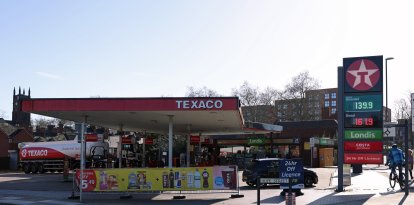
U.S. gasoline tops $4 per gallon, highest price since 2022
The average price of gas in the United States surged above $4 per gallon on Tuesday, reaching its highest level in nearly four years amid the war with Iran, the American Automobile Association (AAA) reported.
The jump from prices below $3 per gallon at the end of February represents another challenge for President Donald Trump following his recent attacks on the Islamic Republic.
Early Tuesday morning, the average price stood at $4.018 per gallon, according to AAA data published on its website.
The last time gasoline exceeded $4 per gallon was in August 2022, when prices spiked to $5 amid the COVID-19 pandemic and following Russia’s invasion of Ukraine, according to the U.S. Energy Information Administration.
This latest increase reflects Iran's de facto blockade of the Strait of Hormuz, a key shipping route through which roughly one-fifth of the world’s oil and gas passes.
Trump expressed confidence that a negotiated agreement would be reached soon but warned that, if not, severe strikes on Iranian oil facilities would follow.

JNS
Iran urges Houthis to resume Red Sea terrorism if US campaign continues
JNS (Jewish News Syndicate)
“The upcoming days will be decisive” in the war against Iran, says Pentagon chief
The next days of the war with Iran will be “decisive,” Pentagon chief Pete Hegseth said Tuesday, revealing that he visited U.S. troops in the Middle East over the past weekend.
“The upcoming days will be decisive. Iran knows that, and there's almost nothing they can militarily do about it,” Hegseth said at a press conference, his first in nearly two weeks.
According to Hegseth, “The past 24 hours have recorded the lowest number of enemy missiles and drones fired by Iran.”
Standing alongside him, Gen. Dan Caine, chairman of the Joint Chiefs of Staff, stated that the United States had struck more than 11,000 targets in the past 30 days, AFP reported.
When asked about concerns from some supporters of President Donald Trump regarding the possible use of ground troops in Iran, Hegseth declined to reveal his plans. “You can't fight and win a war if you tell your adversary what you're willing to do or not do, including boots on the ground,” he added.
Talks with Iran “gaining strength”
“[The negotiations] are very real. They are ongoing, they are active, and I think, gaining strength,” Hegseth told reporters.
Trump criticizes France for being “of little use” in war against Iran
President Donald Trump on Tuesday criticized France for being “very little use” in the war waged by the United States and Israel against Iran.
“The Country of France wouldn't let planes carrying headed to Israel, loaded up with military supplies, fly over French territory. France has been VERY UNHELPFUL against the ‘Butcher of Iran,’ who has been successfully eliminated!” Trump wrote on Truth Social.
Three Chinese ships allowed to pass through Strait of Hormuz
A spokesperson for China’s Foreign Ministry, Mao Ning, stated that three Chinese vessels passed through the Strait of Hormuz and expressed “gratitude to the parties involved.”
Indonesia freezes fuel prices
Iran executes two men convicted of belonging to banned group
Iran’s judiciary announced the execution of two men found guilty of belonging to a banned opposition group and conspiring against the Islamic Republic.
A day earlier, two other men were executed on similar charges. All were accused of ties to the Mujahedin-e Khalq (MEK), an opposition organization in exile since the 1980s.
Israel says it intercepted Iranian missiles
An AFP journalist reported hearing at least 10 explosions over Jerusalem after the Israeli military said it was attempting to intercept missiles launched from Iran.
Iran’s state broadcaster, IRIB, meanwhile announced the launch of rockets toward Israel.
Iranian media also reported further explosions and power outages in Tehran.
Iran approves imposing tolls on Hormuz and veto on Israeli and U.S. vessels and Rubio warns that "no one in the world can accept it"
A committee of the Iranian parliament approved charging tolls for ships passing through the Strait of Hormuz, and state television reported that Iran would ban passage to the United States and Israel.
The decision generated the rejection of the United States, whose Secretary of State Marco Rubio told Al Jazeera that "no one in the world can accept it."
Markets contain losses on a possible change in Trump's stance announced by the 'Wall Street Journal' to exit Iran even without reopening Hormuz
Asian stock markets contained their losses and oil was down on Tuesday following press reports that U.S. President Donald Trump is considering ending military intervention in Iran, even without achieving the reopening of the Strait of Hormuz.
Following the publication of the information in the WSJ, the Hong Kong, Shanghai, Sydney, Singapore, Wellington and Jakarta stock exchanges recorded rises, while Tokyo fluctuated. In addition, Seoul, Taipei and Manila remained in the red, although they pared losses.
Netanyahu notes that the war "is more than half over."
Netanyahu claimed his armed forces achieved key objectives, such as "eliminating" Iranian industrial plants and are "close to wiping out their arms industry."
"It (the war) is definitely more than half over, but I don't want to put a timetable" for ending it Netanyahu told the U.S. Newsmax network.
Explosions and power outages in Tehran
Iranian media reported detonations and power outages in Tehran Tuesday morning.
Fars news agency reported "several explosions" and power outages "in some parts" of the Iranian capital. Tasnim agency mentioned bursts heard in the east and west of Tehran, as well as power outages in the east, before claiming that an electrical substation had been attacked.
The Iranian Fars news agency also reported on Tuesday shelling at "military sites" in Isfahan in central Iran, according to an "initial" information relayed by Akbar Salehi, a security official of the provincial governorate
Number of Israeli soldiers killed in Lebanon rises to 10
The Israeli army announced Tuesday the death of four soldiers in southern Lebanon, bringing to 10 the number of military personnel killed since the resumption of hostilities with the pro-Iranian group Hezbollah amid the Middle East war.
The military identified three soldiers from a reconnaissance brigade killed "in combat" on Monday, adding that a fourth had been killed.
Iran fires missiles across Middle East after Trump threats
Iran fired missiles across the Middle East on Tuesday as its capital was rocked by explosions after U.S. President, Donald Trump threatened to destroy its main oil export hub and power and water desalination plants.
In Dubai, four people were injured by falling debris from intercepted shells, while an Iranian attack caused a fire on a Kuwaiti tanker in the port of Dubai.
In Saudi Arabia, officials said they had intercepted eight ballistic missiles, after Iran called on Riyadh to "expel U.S. forces."
Check out highlights of the war so far

LATEST