Iran closed 2025 with more than 2,200 executions: The deadliest year amid protests and crisis
An unprecedented 376 hangings were recorded in December alone, capping a year marked by a dramatic acceleration of state executions.
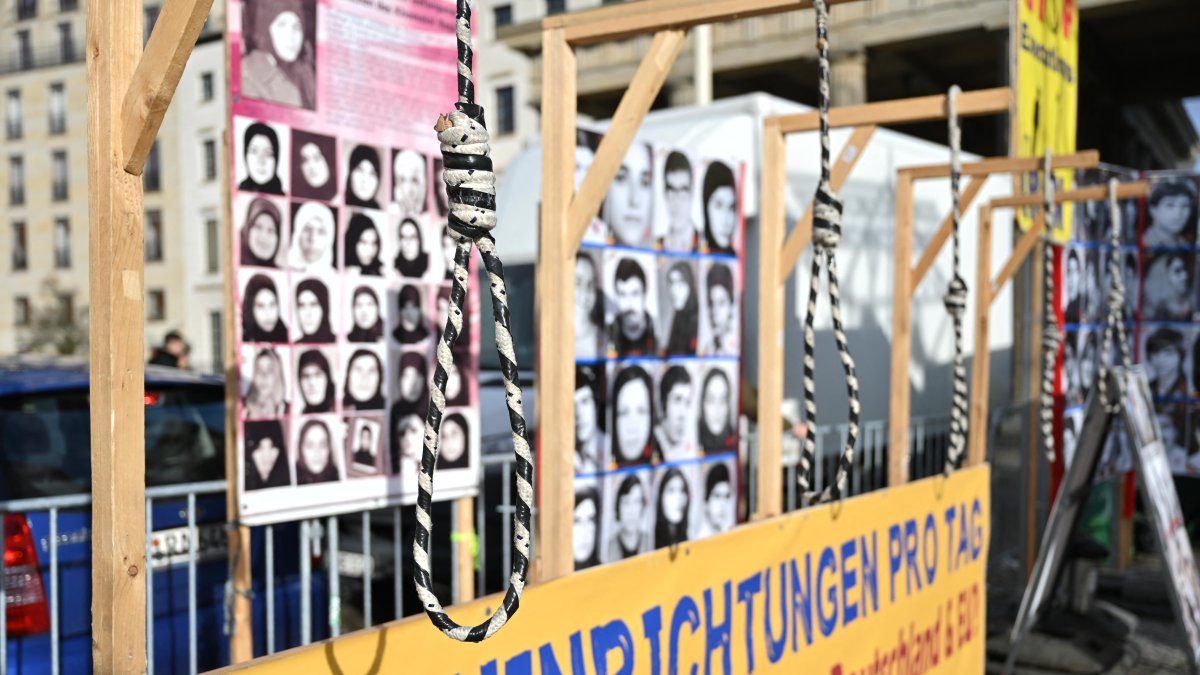
Protests against executions in Iran (File).

Iran concluded 2025 immersed in one of the most violent stages of its recent history. According to data released on December 31 by the National Council of Resistance of Iran (NCRI), the regime executed more than 2,200 people during the year, marking the bloodiest period in the 37-year rule of Ayatollah Ali Khamenei.
In December alone, 376 hangings were recorded, a record number that capped a year marked by a dramatic acceleration in state executions. The NCRI stated that the total number of executions in 2025 was more than double the figures of previous years: it was 120% higher than in 2024 (1,006), 160% higher than in 2023 (853) and almost 280% higher than in 2022 (582).
NCRI president-elect Maryam Rajavi called the wave of executions an "organized crime" and a "crime against humanity," and argued that the mass hangings reflect the regime's fear of an enraged population and a society she described as "explosive."
Territorial expansion and final escalation
The report indicated that the executions were carried out in 97 cities in 31 provinces, up from 77 the previous year, which the opposition group interpreted as a deliberate attempt to spread terror nationwide. The NCRI further warned that the actual figure could be higher, due to difficulties in documenting executions in remote prisons and small towns.
The second half of the year proved particularly lethal: in the last six months, the number of executions more than doubled that recorded in the first half, culminating in the December peak.
Women, minors and public executions
The victims ranged in age from 18 to 71. Of the 881 prisoners whose ages could be confirmed, the average age was 36.
Political prisoners and death sentences
The NCRI warned of a significant increase in death sentences against political prisoners charged with membership in the People's Mujahedin Organization of Iran (PMOI/MEK). According to the group, 18 prisoners, aged between 22 and 68, currently remain on death row after receiving convictions this year or following confirmation of their sentences by the Supreme Court.
The opposition also denounced a trial in absentia against 104 members and officials of the Resistance, which, it warned, paves the way for further executions and repressive acts, even qualifying participation in demonstrations abroad as 'baghy' (armed rebellion), a crime punishable by death.
World
Social protest grows in Iran as university students unite over rising cost-of-living
Diane Hernández
Internal resistance and crisis context
Despite the crackdown, the NCRI highlighted an "unprecedented" expansion of the anti-execution movement inside the country. The campaign 'No to Execution Tuesdays' reached its 101st week, with weekly hunger strikes in 55 prisons.
The figures came as Iran went through its fourth consecutive day of nationwide unrest, with shopkeepers' strikes, student protests and street clashes in Tehran and other cities, against a backdrop marked by the collapse of the rial and rising inflation.
An independent report by the Human Rights Activists News Agency (HRANA) documented at least 1,922 executions as of Dec. 20, not counting the last 11 days of the year, a period in which, according to the NCRI, saw a sharp escalation.
LATEST