UN experts link Guatemala Attorney General to illegal adoptions
The group said the minors were given up for adoption after being taken to the Elisa Martinez Temporary Home, where Consuelo Porras was director and also "legal guardian of the children from Jan. 21 to Aug. 30, 1982," according to the statement.
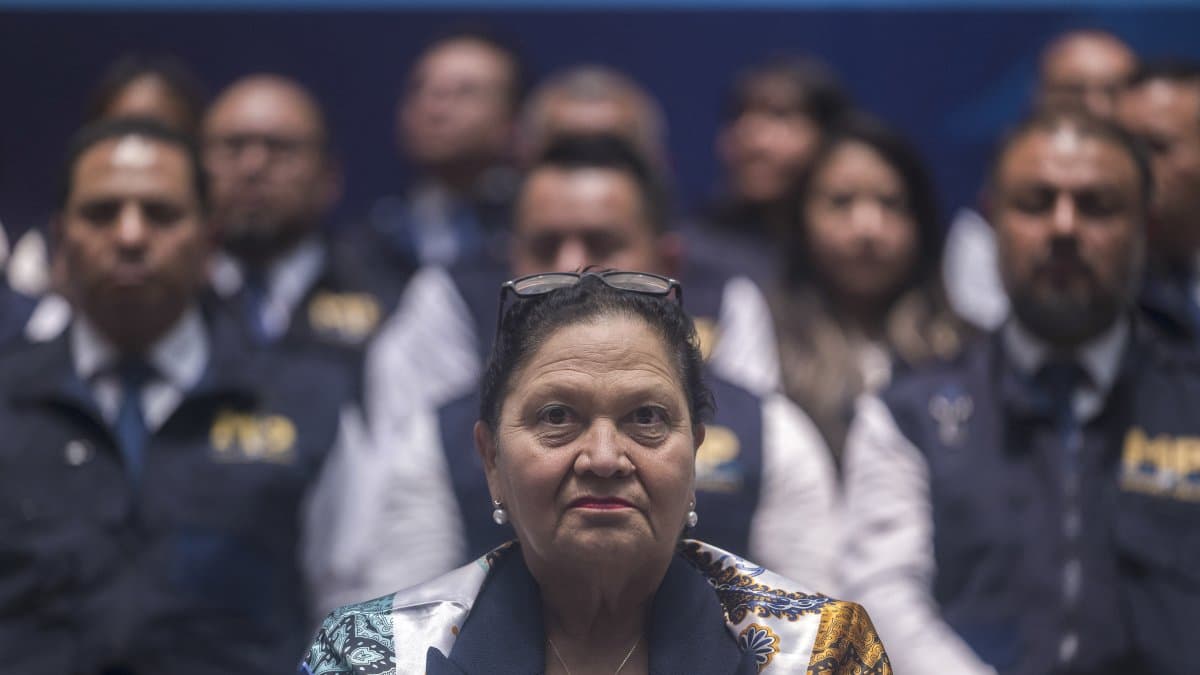
(AFP) UN experts on Monday linked Guatemala's powerful Attorney General, Consuelo Porras, to illegal adoptions of indigenous children that occurred in the 1980s, during the civil war, which she said she "categorically" rejected.
The allegation came in a statement released in Geneva on the same day that Porras, who will finish her term in May, failed in her bid to be elected as a magistrate in the Constitutional Court (CC), a position that would give her immunity.
UN specialists said they had received information on "at least 80 indigenous children who were subjected to illegal international adoptions," following "their capture and forced disappearance between 1968 and 1996."
The group said the minors were given up for adoption after being taken to the Elisa Martinez Temporary Home, where Porras was director and also "legal guardian of the children from Jan. 21 to Aug. 30, 1982," according to the statement.
"I categorically reject once again, as I have done repeatedly, the false and politically instrumentalized accusations," Porras wrote in a message on the social network X addressed to UN Secretary-General Antonio Guterres.
The 72-year-old prosecutor assured that she will demand that those accusations "be subject to review, clarification and correction."
The experts called for "independent investigations into allegations" that "illegal international adoptions allegedly involved public officials, including" Porras.
The prosecutor is being sanctioned by the United States and the European Union who consider her "corrupt" and "anti-democratic" for opening criminal proceedings against former anti-mafia officials, journalists and social leaders.
In addition, for having attempted two years ago to block the inauguration of President Bernardo Arévalo, whom she has also sought to strip of his immunity.
Not a single vote
A United Nations panel of experts criticized the prosecutor for putting herself forward as one of the 10 justices—full and alternate—of the Constitutional Court, the country’s highest judicial body, and urged those responsible for the selection to exercise "caution" in light of the "serious allegations" raised.
The election of the magistrates, a process that lasts more than two months, is key in the battle for control of justice in Guatemala, influenced by a political and economic elite accused of corruption.
The Attorney General failed to receive a single vote Monday in the election held by the state-run Universidad de San Carlos.
In a statement sent to AFP, the Attorney General's Office said it regrets "the constant harassment" and "the use of unsubstantiated arguments to try to condition" Porras' participation "in election processes."
Despite Monday's setback, Porras could present another candidacy since the president, the Supreme Court and the Congress must still choose six magistrates. Two were already appointed by the Bar Association last week.
The CC is known as the "heavenly court" for its unappealable rulings. The elections are closely watched by international human rights bodies, the United States and the OAS.
Guatemala will also appoint this year a new attorney general, electoral tribunal magistrates and the comptroller.
In the midst of these sensitive elections, Arévalo has attributed a wave of violence that recently shook the country to an alleged plot to destabilize his government forged, according to him, by that "alliance" between politicians and criminals to which he links Porras.
This Monday concluded a state of siege declared by the president after several armed attacks by the Barrio 18 gang that left 11 policemen dead.
Among the experts signing the Geneva communiqué are the special rapporteur on the independence of judges and lawyers, Margaret Satterthwaite and members of the Working Group on Enforced or Involuntary Disappearances, Gabriella Citroni, Grażyna Baranowska, Aua Baldé and Mohammed Al-Obaidi.
🛠 Do you think there is an error in this article?
Recommendations

LATEST