ANALYSIS
Russian incursions reopen divisions in NATO and test their collective defense
Estonia invoked Article 4 after violations of its airspace, while other allies fear an escalation with Moscow.
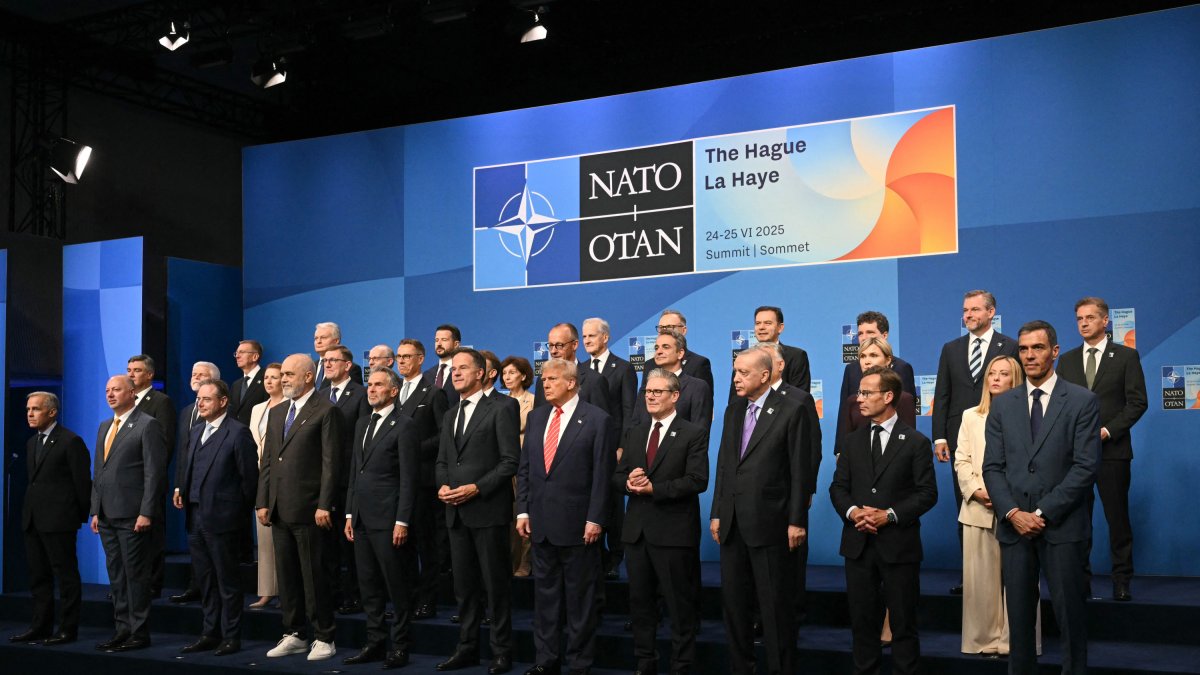
Leaders of NATO member countries.

A series of Russian air raids in recent weeks has reignited tensions within NATO by exposing differences over how the alliance should respond. Estonia invoked Article 4 of the treaty after Russian fighter jets entered its airspace, leading to a harsh exchange with Secretary General Mark Rutte.
According to European officials, Rutte warned that repeated recourse to Article 4 could detract from his strategic strength, while the Estonian prime minister, Kristen Michal, defended the decision as a necessary sign of unity vis-à-vis Moscow.
An escalation of incidents in Eastern Europe
The tension is not explained by an isolated event, but by a chain of recent episodes. Poland activated the same mechanism after detecting 19 Russian drones over its territory, forcing the mobilization of fighter jets for the first time since World War II. In Estonia, Italian F-35 fighter jets escorted Russian aircraft out of its airspace. In countries such as Romania, Lithuania, Germany and Norway, drone activity led to temporary airport closures and airspace restrictions.
Faced with this situation, NATO launched Operation Sentinel East to reinforce its eastern flank; however, experts warn that current resources are insufficient to deal with hybrid threats, such as swarms of drones.

Warnings without consequences
The debate within the alliance reflects a growing dilemma: how to respond to Russian provocations without risking direct confrontation? For Eastern European governments, warnings without concrete action only reinforce the perception of weakness and encourage Moscow to persist in its challenges. Others, on the other hand, fear that too firm a response could unleash a spiral of escalation that would be difficult to contain.
Credibility at stake
For the most vulnerable allies, the central issue is the credibility of NATO. Each new Russian incursion tests internal cohesion and the seriousness of collective defense commitments. The next violation of their airspace, they warn, could require more than declarations or rounds of consultations in Brussels.

World
Putin's foreign affairs minister accuses European Union and NATO of declaring war on Russia
Luis Francisco Orozco
U.S. role and the Trump factor
LATEST