Trump-Starmer summit: President discusses conflicts, tariffs, freedom of speech and gives Putin deadline of '10 or 12 days' to end war in Ukraine
Donald Trump held a meeting on Monday with British Prime Minister Keir Starmer. During the meeting, the two leaders discussed the situation in Gaza, the war in Ukraine, illegal immigration and freedom of speech.

Donald Trump and Keir Starmer meet in Scotland.

Donald Trump met Monday with British Prime Minister Keir Starmer. During the meeting, which took place at the president's property in Turnberry, Scotland, the two leaders discussed the humanitarian situation in Gaza, the war in Ukraine, the problems of illegal immigration and the defense of freedom of speech.
Before the meeting, Trump told the media, "Europe is a much different place than was just five years ago, 10 years ago. They've got to get their act together. If they don't, you're not going to have Europe anymore as you know it, and you can't do that. This is a magnificent part of the world, and you can't ruin it," the president said, referring to the problems brought about by mass immigration.
As for a journalist's question about freedom of speech in the United Kingdom, Trump said that "free speech is very important. I don't know if you're referring to any place in particular," the Republican front-runner said as he addressed Starmer.
"We've had free speech for a very, very long time here," the British prime minister replied, a bit startled.

World
Digital repression in the UK: Alarming rise in 'thought crime' arrests and convictions
Carlos Dominguez
On the other hand, Trump also said he loves the British government's plans to build three nuclear reactors, calling nuclear power "safe." As for pharmaceuticals, Trump said he wants them to return to the United States, claiming that the U.K. has a good pharmaceutical business.
Trump also assured that "a large part" of the U.K.-U.S. trade deals will go to Scotland.
An increase in aid for Gaza
During the meeting, the leaders discussed possible actions to speed up the entry of humanitarian aid and release hostages kidnapped by Hamas. Trump said he considers it "possible" to reach a ceasefire in the Gaza Strip.
"A ceasefire is possible," the Republican leader declared from his Turnberry estate.
The president also announced Monday that the United States will set up "food centers" in Gaza, saying there are signs of "real starvation" there, and said much of the food sent to the territory "gets taken by Hamas."
"We're going to set up food centers where the people can walk in – and no boundaries. We're not going to have fences," the Republican told reporters.
"We're giving a lot of money and a lot of food," Trump declared, recognizing that "other nations are now stepping up" because it is an international problem.
The British government announced Saturday that it wants to send aid to Gaza and evacuate children in need of medical assistance.
Trump said it has been "very difficult" to deal with Hamas, and it is exacerbated with the hostages who remain in captivity.
A new deadline to end the war in Ukraine
As for the conflict between Russia and Ukraine, Trump announced Monday that he will "reduce" the 50-day deadline he gave on July 14 to his Russian counterpart, Vladimir Putin, to put an end to the war, under threat of major American sanctions against the Kremlin.
The Republican leader claimed to be "very disappointed" with Putin and added: "I'm going to reduce that 50 days that I gave him to a lesser number."

World
Russia launches hundreds of drones against Odessa hours after meeting in Istanbul
Diane Hernández
In doing so, Trump gave his Russian counterpart 10 to 12 days to end the war in Ukraine.
"I'm going to make a new deadline of about ... 10 or 12 days from today. There's no reason in waiting. ... We just don't see any progress being made," the U.S. president said.
Mayor of London is a "nasty person"
During the meeting, a reporter asked Trump if he would go to London during his state visit, to which Trump replied:
"I will. I'm not a fan of your mayor. ... I think he's done a terrible job, the mayor of London. [He's] a nasty person," the president said, referring to Labour's Sadiq Kahn, who is a practicing Muslim.
Tariff agreement with the E.U.
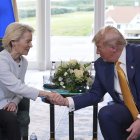
The previous day, European Commission President Ursula von der Leyen also went to Turnberry to negotiate a trade agreement under which the E.U. is subject to 15% tariffs on its exports to the United States.
Economy
Trump announces 15% tariff deal with EU after meeting with Von der Leyen in Scotland
Agustina Blanco
The agreement, announced just days before the White House deadline to impose punitive tariffs on the E.U. expired, seeks to avoid an escalation of trade sanctions that could have severely impacted global economies.
A moment of celebration
On his arrival Friday in Scotland, the land of his mother's birth, Trump said it would be a moment of "celebration" with Starmer following May's trade deal, which provides for reduced tariffs on British goods.
"We're in great shape," Trump said Sunday, asserting that the British prime minister is "did a great job."
A favorable deal with the U.K.
Despite this, the British government is still negotiating exemptions for steel and aluminum. Currently, these products are taxed at a 25% rate, half the 50% rate applied to the rest of the world.
In exchange for these tariff reductions, the U.K. pledged to further open its market to American ethanol and beef, raising concerns in the chemical industry and among British farmers.
LATEST