Analysis: The devastating global economic cost of Iran closing the Strait of Hormuz
In the context of the war in the Middle East, the Iranian regime has repeatedly threatened to close it, which would cause the price of oil to soar and inflation to rise.
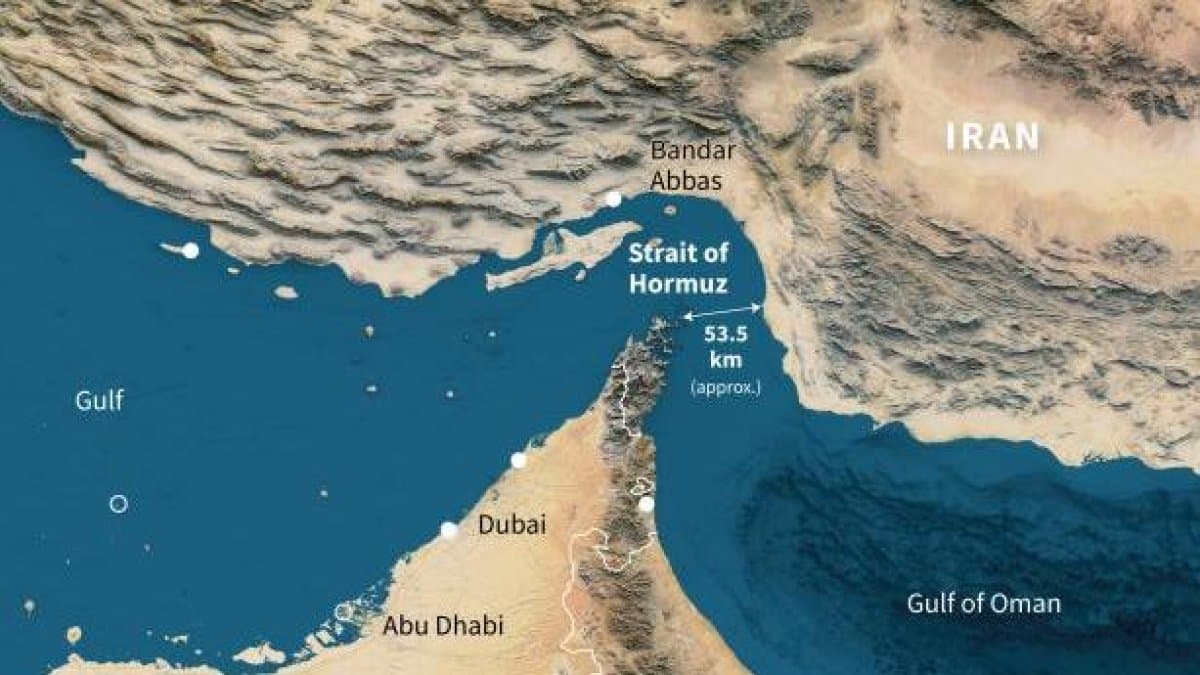

The Strait of Hormuz, located between the coasts of Iran and Oman, is one of the world's most critical sea passages. Just over 20 miles wide at its narrowest point and with two navigation channels of only 2 miles each, this waterway connects the Persian Gulf with the Gulf of Oman and the Arabian Sea. Through its waters, between 17 and 21 million barrels of oil are transported per day, representing approximately 20% of the world's crude oil trade, in addition to 30% of liquefied natural gas (LNG), mainly from Qatar. Countries such as Saudi Arabia, Iraq, Kuwait, the United Arab Emirates and Iran depend on this route to export their energy resources, while Asia, especially China, India and Japan, is the main destination for these shipments.
Its relevance lies not only in the volume of hydrocarbons it transports, but also in the lack of viable alternative routes. Although countries such as Saudi Arabia and the United Arab Emirates have developed pipelines to partially circumvent the strait, their capacity is limited and cannot compensate for a total block.
The Iranian threat
In the context of rising geopolitical tensions in the context of the war between Israel and Iran and the recent U.S. attack against the Iranian nuclear power plants of Fordow, Natanz and Isfahan, the Islamist regime has repeatedly threatened to close the Strait of Hormuz in response to international sanctions and military offensives. On June 22, the Iranian Parliament passed a motion to block the strait, although the final decision rests with the supreme leader, Ayatollah Ali Khamenei.
Iran has multiple tools at its disposal to disrupt maritime traffic. It can deploy sea mines, attack ships with missiles or drones from its coast, or use Revolutionary Guard Corps speedboats to harass or capture vessels. In 2019, for example, incidents attributed to Iran, such as mine explosions near oil tankers, generated tensions in the region. In addition, there have been reports of electronic interference affecting navigation systems, with around 1,600 vessels-nearly a quarter of all ships in the area-according to data from maritime analytics firm Windward experiencing problems in recent days, adding to uncertainty in the area.
A total closure of the strait, although considered unlikely by some analysts due to its impact on the Iranian economy, which relies heavily on exporting oil to China through this route, would be a catastrophic scenario. Ninety percent of Tehran's oil exports are destined for Beijing.
Alternatively, Iran could opt for less drastic tactics, such as intermittent harassment of ships, which would force tankers to sail in convoys protected by Western navies, increasing costs and reducing trade efficiency.
The impact on oil prices
Blocking the Strait of Hormuz would have immediate and devastating consequences on energy markets. According to some estimates, a prolonged closure could reduce global supply by some 5 million barrels a day, triggering a severe blow to the global economy. Brent crude oil prices, a type of oil extracted mainly in the North Sea, could soar above $100 per barrel, with extreme scenarios putting it between $120 and $300, depending on the duration and severity of the disruption.
Significant rises have already been observed: last June 23, following the Iranian parliamentary approval, Brent reached $77.95, and WTI, a stream of crude produced in Texas and southern Oklahoma, hit $74.75, with daily peaks of $81 and $77, respectively. These rises reflect the volatility generated by the mere threat of shutdown.
Higher oil prices would raise gasoline, diesel and gas costs, affecting consumers, industries and supply chains. In addition, global inflation would soar, complicating central banks' efforts to stabilize economies.
The harsh geopolitical and economic implications
Speaking to Fox News, Secretary of State Marco Rubio urged China to mediate to avert the block. He further noted that a prolonged shutdown would be "economic suicide" for Iran, as it would cut off its own oil exports. However, desperation in the face of a perceived existential threat from the Iranian regime could lead Tehran to take this risk as a strategic option.
For that reason, Rubio added, "we retain options to deal with that. But other countries should be looking at that as well. It would hurt other countries’ economies a lot worse than ours. It would be a, I think, a massive escalation that would merit, a response not just by us, but from others. So look, they’re going to they’re going to say what they need to say."
Trump hints at possibility of "regime change" in Iran
Such comments by Trump represent the first time the U.S. president has mentioned the possibility of regime change in Iran since Israel's initial bombings. While the Republican leader did not explicitly call for the fall of the Islamic regime or say that his administration would play any kind of role in toppling the Iranian regime, his words appear to be on a different track from messages that have been issued in recent hours by several top members of his administration, such as Vice President J.D. Vance and Defense Secretary Pete Hegseth. Both insisted this Sunday that the only interest of the United States was to dismantle Iran's nuclear capabilities.
🛠 Do you think there is an error in this article?
Recommendations




LATEST