Scandal in Germany: How the Office for the Protection of the Constitution (BfV) became a political weapon against the AfD
Hans-Georg Maaßen, former president of the BfV, reveals that Germany watches the AfD and not far-left parties. In 2016, he was asked to watch the AfD "at first cautiously and then increasingly insistently."
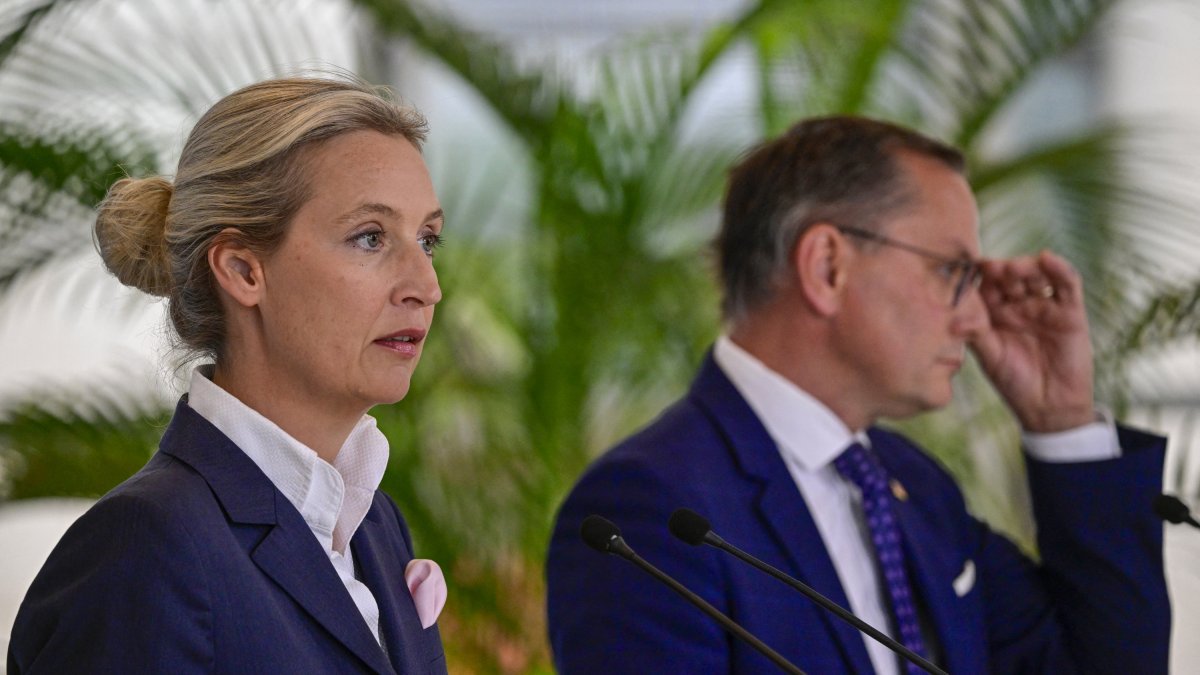
AfD leaders Alice Weidel and Tino Chrupalla

The German political landscape has been shaken up this week. Just days after the election of Friedrich Merz as Germany's new chancellor, that country's intelligence services on Friday labeled the Alternative for Germany (AfD) party a "proven right-wing extremist" movement.
The Office for the Protection of the Constitution, a body under the Ministry of the Interior, did not specify what consequences this qualification will have, but the measure gives the authorities significant means of surveillance and control, including of private communications between party members.
In its statement, the BfV highlights the overall hostile attitude towards migrants and Muslims, on the part of the party.
Also, the announcement could reignite the debate on a possible illegalization of the AfD.
For their part, the leaders of the formation, Alice Weidel and Tino Chrupalla, have denounced on X that "the AfD is being publicly discredited and criminalized as an opposition party shortly before the change of government."
The party also declared it a "hard blow for democracy," assuring that the party "will continue to defend itself legally against these dangerous defamations for democracy."
On Monday, the AfD filed a court appeal against the BfV's decision, a spokesman for the formation said.
Following the court action, the BfV decided on Thursday to pause the application of the AfD's classification as a far-right "extremist" organization, pending the courts' ruling on the lawsuit filed by the political formation.

What is the Federal Office for the Protection of the Constitution (BfV)?
German media outlet Nius published on Sunday an article written by Hans-Georg Maaßen, former president of the BfV.
In his note, Maaßen states that "apart from Austria, Germany is the only Western country in which the secret services are authorized to monitor political parties. In other Western democracies, it is unthinkable that a secret service that reports to the government investigates and controls the opposition parties."
"The Constitution Protection Office is neither a neutral nor a politically independent authority. At the federal level, it reports to the Federal Ministry of the Interior and is subject to its instructions. The Ministry of the Interior can even tell the agency how to act in specific cases," Maaßen adds.
The former BfV chairman says that "the leadership of the Office for the Protection of the Constitution is made up of political officials," and explains that these officials know what makes their minister ‘rattle’."
The BfV, a political weapon against the AfD
In 2013, Maaßen stopped monitoring the far-left party Die Linke, with the approval of the then interior minister.
The reason Maaßen discontinued the observation of this formation was not because it was no longer an extremist party, but because he believed that the BfV "should finally become a normal European intelligence service, which, like all other Western services, should concentrate on investigating and preventing terrorism, espionage, subversion and cyberattacks."
A year ago, Die Linke leaders came out in favor of banning the AfD and its youth organization, Junge Alternative (JA), saying the party represents "a danger to democracy."
Likewise, Maaßen recounts that in 2016 he was asked to observe the AfD "at first cautiously and then increasingly more and more insistently." At the time, the former official recounts that he felt compelled to say publicly that "the Office for the Protection of the Constitution is not the auxiliary force of established parties in order to get rid of political competition."
Hans-Georg Maaßen left the BfV in 2018 and says he realized that Germany "continued the special focus of party surveillance by the secret services exclusively against the AfD and not against left-wing parties."
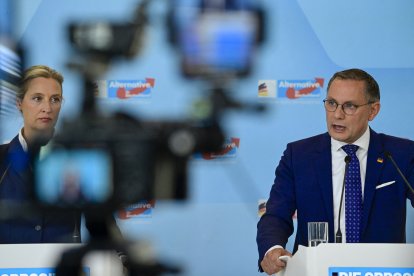
Alice Weidel and Tino Chrupalla
For the former president of the Office, "the first thing that had to be resumed would have been surveillance of the Left party, due to the proximity of extreme left-wing organizations" and the anti-constitutional statements of party members, it would also have made sense to examine the monitoring of the Greens and their youth organizations." For Maaßen, "it is obvious that both were not investigated for political reasons."
It should be noted that just a year ago, Die Linke leaders came out in favor of banning the AfD and its youth organization, Alternativa Junge (JA), stating that the party represents "a danger to democracy."
Maaßen believes that the Office for the Protection of the Constitution "must no longer be misused for the surveillance of political rivals."
What does the report against the AfD contain?
In the article for Nius, Maaßen says that "it is more likely that the decision as to whether or not the report should be issued will initially be made at the political level and that the respective development phases of the report have been closely followed by the specialized department of the Ministry of the Interior over the past months."
"It is therefore unlikely that the more than 1,100-page report of the Office for the Protection of the Constitution is neutral, objective or political," the former BfV chairman adds.
The Office for the Protection of the Constitution was unscrupulously used to combat political opponents as enemies within the framework of the government's 'anti-right-wing' project
Maaßen states that "only insiders know exactly what it contains, as it is kept secret from the public and also from the AfD in question."
This is how, for Maaßen, the BfV "should refrain from disclosing the rating of a political party if it is not willing to present the evidence on which its assessment is based."
"The fact that the report is kept secret from the public and from the party in question, but that it was passed on to a journalist from Spiegel, closely linked to the government for information, only allows one conclusion to be drawn: this is not a fair assessment of the AfD," the former BfV chairman explained.
For Maaßen, "the Office for the Protection of the Constitution was unscrupulously used to fight political opponents as enemies within the framework of the government's 'fight against the right wing' project. Under this minister (Nancy Faeser / SPD), the Office for the Protection of the Constitution became a danger to the free democratic basic order."
Friedrich Merz, a candidate of empty promises and clumsy alliances
One of the BfV's reproaches to the AfD is the fact that it holds positions that they consider to be extreme vis-à-vis illegal immigration and Muslims.
The BfV has also said that "continued agitation against refugees or migrants is conducive to the spread and deepening of prejudice, resentment and fear towards that group of people."
Despite this, in January, Merz's CDU had joined forces with the AfD to pass "a five-point plan" that called for greater efforts to prevent illegal immigration, intensify deportations and other immigration controls, following multiple terrorist attacks perpetrated in Germany by suspected asylum seekers.
Merz went so far as to state, "Democracy is also endangered when a social and political minority uses radicals as a tool to permanently ignore the will of the majority of the population. That is why we will no longer let you, the Social Democratic Party (SPD) and the Greens, tell us what to do."
In late March, AfD co-chairwoman Alice Weidel noted, "According to the current state of the coalition negotiations, there will be no changes in migration and naturalization policy. Turbo-naturalization will continue, and the borderlands will remain open. There is nothing left of Merz's five-point plan."
Ironically, Merz finally decided to lend a hand to the SPD who in late April approved a coalition agreement to form a government.
Also, this Tuesday Friedrich Merz was painfully elected German Chancellor by the deputies, having to go through two rounds of voting in the Bundestag, a sign of the difficulties awaiting him in power.
According to The Spectator, "in the short term, the only winner is the AfD."
Likewise, Bernd Baumann, an AfD deputy, has stated, "This government starts in a situation of extreme instability. And it will remain unstable. It is the opposite of what Germany needs."
US accuses Germany of "rebuilding the Berlin Wall"
On the other side of the Atlantic, Secretary of State Marco Rubio called it "tyranny" for Germany's intelligence services to designate the AfD as "extremist," a party that came in second in February's legislative elections.
"Germany has just given its spy agency new powers to surveil the opposition," Rubio said on the social network X.
"That's not democracy: it's tyranny in disguise," he added.
"What is truly extremist is not the popular AfD, which came second in the recent elections, but the deadly immigration policies of open borders of the establishment that the AfD opposes," Rubio reckoned.
For his part, US Vice President JD Vance has accused Germany of erecting a new Berlin Wall.

The countries of "the West tore down the Berlin Wall together. And it has been rebuilt, not by the Soviets or the Russians, but by the German establishment," Vance declared.
Elon Musk said banning the AfD "would be an extreme attack on democracy."

LATEST