Florida Prepares for a 'blood moon': Here's what Thursday's lunar eclipse will look like
The phenomenon will reach its peak shortly after midnight, allowing observers to see about 96% of the moon's surface darkened by the Earth's shadow.
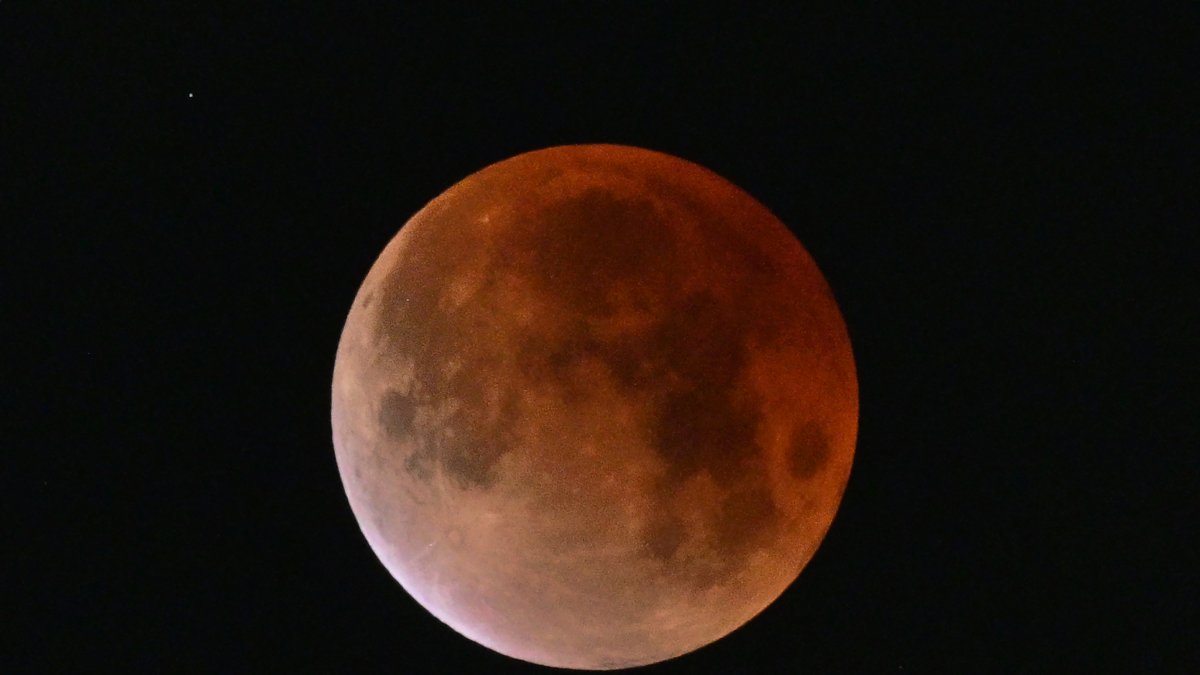
The "blood moon" lunar eclipse turns the moon red (File photo)

The sky over Florida will offer a rare spectacle between the night of Thursday, Aug. 27, and the early hours of Friday: a deep partial lunar eclipse that will cause much of the moon to take on reddish and orange hues.
Although it is commonly referred to as a "blood moon," the phenomenon will not be a total eclipse. According to astronomical data from Time and Date, approximately 93% of the moon's diameter will be covered by the Earth's umbra at the moment of greatest intensity, which is equivalent to about 96% of its visible surface being darkened.
In Florida, the penumbral phase will begin around 9:23 p.m., while the partial eclipse will become clearly visible later in the night. The peak will occur at 12:12 a.m. Eastern Time on Friday, and the entire event will conclude around 3:01 a.m.
Society
'Chills': Artemis II astronauts say lunar flyby still gives them the shivers
Virginia Martínez
Why will it appear red?
The eclipse will be visible from Miami, Fort Lauderdale, Tampa, Jacksonville and other locations in Florida, provided weather conditions allow for good visibility. It will also be visible from much of the Americas.
No special glasses or eye protection needed
Unlike a solar eclipse, no special glasses or eye protection are needed to view it. Nor is a telescope essential: it will be visible to the naked eye, although binoculars or other optical equipment will allow you to appreciate the moon's hues in greater detail.
The eclipse on Aug. 28, 2026, is officially classified by NASA as partial and will be visible, in different phases, from the Americas, Europe, Africa and the eastern Pacific.
LATEST