Massachusetts: What is known about the charges against mayor Brian DePena for pandemic-related fraud and money laundering
The indictment, unsealed Wednesday, alleges that Brian DePena obtained more than $1.5 million in federal small business loans during the pandemic and used part of the money to fund his election campaign, pay off personal tax debts, and settle more than $880,000 in high-interest mortgage loans tied to properties he owned in Lawrence.
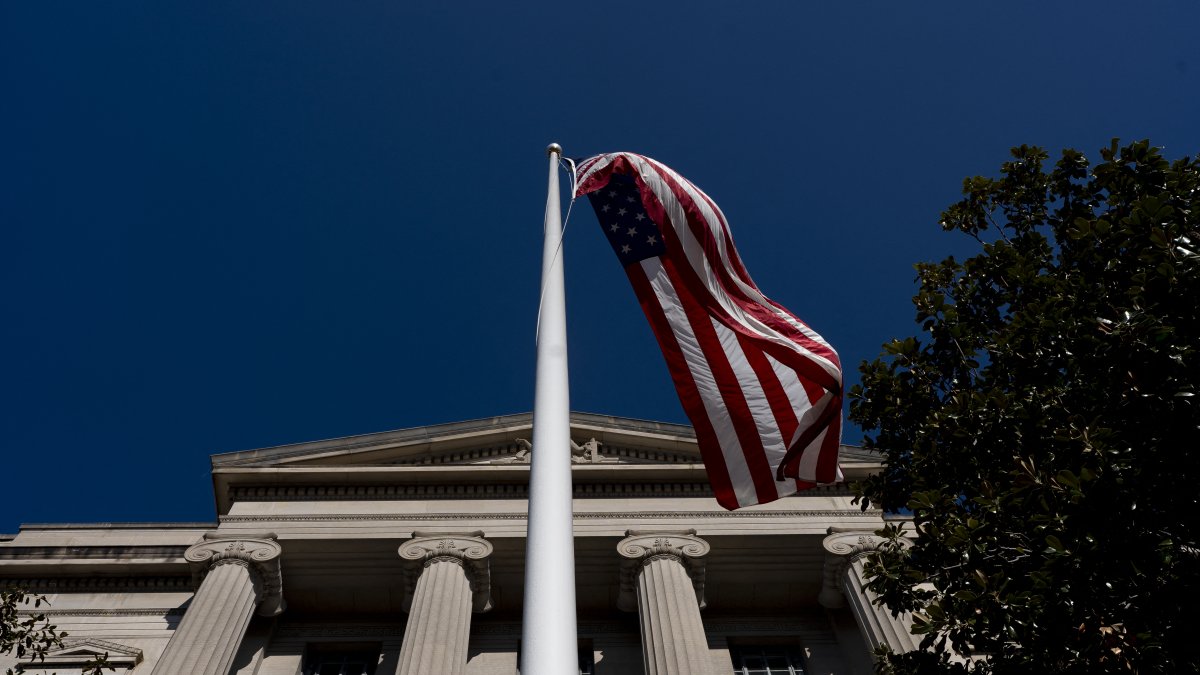
The Department of Justice (DOJ) in Washington (Files)

Brian DePena, mayor of Lawrence, Massachusetts, was formally indicted by a federal grand jury on 11 counts related to alleged fraud involving small business loans during the COVID-19 pandemic and money laundering.
According to the Department of Justice, the indictment, unsealed on Wednesday, alleges that DePena obtained more than $1.5 million in federal small business loans during the pandemic and used part of the money to finance his election campaign, pay off personal tax debts, and settle more than $880,000 in high-interest mortgage loans linked to properties he owned in Lawrence.
DePena, 61, faces four counts of wire fraud and seven counts of money laundering. The mayor had previously been charged in a criminal complaint and arrested on August 14, 2026. He is scheduled to appear in federal court for an arraignment at a later date.
Who is Brian DePena?
DePena was elected mayor of Lawrence in November 2021 and reelected in November 2025. Before becoming mayor, he served on the Lawrence City Council from 2016 to 2021.
The case involves loans from the Economic Injury Disaster Loan (EIDL) program, designed to help small businesses that were economically impacted by the pandemic.
According to court documents cited by the Department of Justice, DePena was the owner of Tenares Tire Services Inc., a tire and automotive service company in Lawrence.
What does the indictment allege?
Prosecutors allege that Tenares Tire initially received a $150,000 EIDL loan in June 2020. These loans carried an interest rate of 3.75% and could only be used as working capital to alleviate the economic hardships caused by the pandemic.
Subsequently, according to the indictment, DePena requested an increase to the loan amount. In July 2021, the Small Business Administration (SBA) approved an increase of $350,000, bringing the loan total to $500,000.
The documents indicate that the $350,000 was deposited into Tenares Tire's bank account on August 16, 2021. The account balance prior to the deposit was $20.23.
The Department of Justice alleges that, shortly thereafter DePena used $85,000 of those funds to pay personal tax debts to the IRS and transferred another $120,000 to a personal account.
Of that amount, he allegedly issued checks totaling $90,000 to The Committee to Elect Brian DePena, which were deposited into his campaign account and recorded as loans to the campaign in September and October 2021.
A second increase raised the loan to over $1.6 million
In October 2021, DePena reportedly requested a second loan modification. On October 27, the SBA approved an increase of $1,154,400, bringing Tenares Tire's total loan to $1,654,400.
On November 30, 2021, $1,154,188 was electronically deposited into Tenares Tire's account. That same day, according to the indictment, DePena transferred all the money to one of his personal accounts, which had a balance of $1,401.
Prosecutors allege that he subsequently used $42,112.96 of those funds for his mayoral campaign via two checks: one for $10,000 and another for $32,112.96.
The first was deposited into the campaign account on December 2, 2021, when, according to the documents, that account had been overdrawn for approximately 20 days.
Just The News
Justice Department creates National Fraud Detection Center to combat fraud in government programs
Misty Severi
What did he spend the money on?
One of the main allegations in the indictment is that DePena used $883,293 of the EIDL loan funds to pay off debts to two private lenders.
The documents indicate that those loans were tied to several of DePena's properties in Lawrence and had interest rates of 12% and 8%, respectively, higher than the 3.75% rate on the EIDL loan.
On December 9, 2021, DePena allegedly purchased a treasurer's check for $538,109.03 to pay off one of those loans. On December 18, he purchased another one for $345,184.13 to pay off the second loan.
According to the Department of Justice, as of August 5, 2026, DePena had made only 16 payments on Tenares Tire's EIDL loan, whose outstanding principal balance was approximately $1,654,420.
Messages sent to his advisor
While waiting for the funds corresponding to the $350,000 loan increase to be disbursed, DePena allegedly sent several text messages to his accountant and financial advisor, who was helping him with the EIDL application and modification.
In one of the messages, sent on July 22, 2021, and originally written in Spanish, DePena reportedly said: "Brother, call me, I'm in trouble. I don't want to pressure you, but I don't have time to wait for this loan. I'm in your hands."
In subsequent messages, dated July 25 and 28, he reportedly insisted that he needed help to resolve the loan issue.
What penalties could he face?
Each of the seven money laundering charges carries a potential sentence of up to 10 years in prison, three years of supervised release, and a fine of up to $250,000.
Any sentence that may ultimately be imposed would be determined by a federal judge in accordance with applicable laws and the U.S. Sentencing Guidelines.
The Department of Justice emphasized that the facts described in the indictment are allegations.
DePena is presumed innocent unless proven guilty.
LATEST