The future is Hispanic: An interview with Carlos Leáñez Artimuño
The professor and language policy expert argues that the expansion of Spanish, the growing digital interconnection and the cultural links between Spanish-speaking countries are shaping a new geopolitical reality for the Hispanic world.
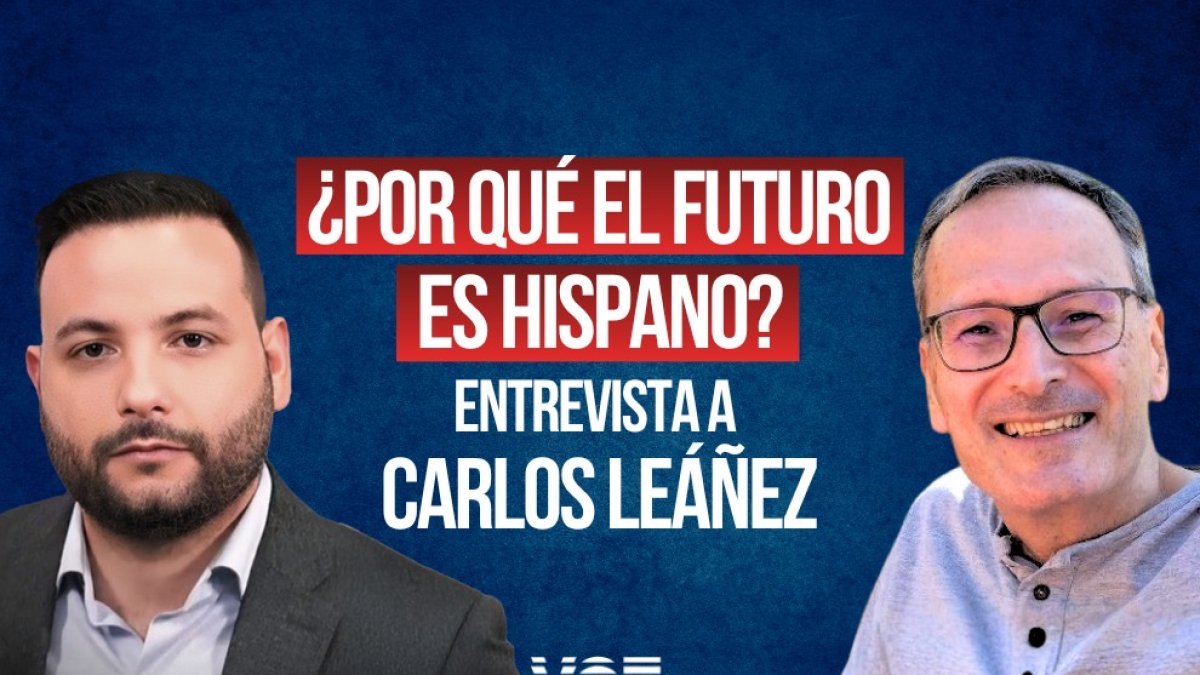
Imagen sobre Carlos Leáñez

In an increasingly interconnected world, professor and language policy specialist Carlos Leáñez argues that Hispanic identity is going through a decisive historical moment. On the occasion of the publication of his book "Por qué el futuro es hispano: El poder global de la hispanidad a través de la población, la lengua y el ciberespacio," the author reflects on the impact of the internet, the role of Spanish and the cultural challenges facing the Hispanic world.
Leáñez assures that the idea for the book arises from the need to understand phenomena for which there are still insufficient categories. In his opinion, the irruption of cyberspace has profoundly transformed human relations and is favoring the emergence of large cultural communities that transcend national borders.
"Thanks to cyberspace, there are no distances," he says. "Before, Venezuelans, Chileans, Mexicans, Uruguayans and Spaniards were each on their own. But now, thanks to the linguistic community and the Catholic-based culture, we are in real contact 24 hours a day.”
As he explains, this new reality is generating an unprecedented amount of exchanges between people from different Spanish-speaking countries. "The amount of inter-Hispanic exchanges is of such magnitude that I am convinced that sooner or later there will be a knowledge of Hispanics among us, not academic, not taught in school, but practical through the internet and real through mutual interests."
For Leáñez, this process will end up generating new forms of articulation among Hispanic peoples. "Cyberspace is generating linguistic macrocommunities," he argues. "The Hispanic linguistic macrocommunity is the third largest in the world."
The cultural battle over history
During the conversation, Leáñez also addressed the debate on the so-called black legend and its influence on the perception of the history of Spain and America.
The author considers that a good part of the dominant narratives have contributed to distort the understanding of the common Hispanic past. "You have to justify an atrocity," he points out when referring to the political rupture between Spain and the American territories. "You have to justify no longer being part of a world power."
In his opinion, many Spanish-American societies have built their identity on an incomplete vision of their own history. "We before the so-called independence what we have is a black hole," he says. "It's as if your childhood had been erased."
Leáñez maintains that the recovery of historical memory is a necessary condition for strengthening cultural ties between Hispanic countries. "We have to reclaim our true lineage," he says.
A "Hispanic rebellion" from below
The author rejects the idea of an abrupt or revolutionary transformation. When he speaks of a future "Hispanic rebellion," he describes it as a gradual cultural change.
"I don't see it as the seizure of the Winter Palace during the Russian Revolution," he explains. "I see it more like a process of gradual cultural battle where the air we breathe changes."
For Leáñez, change will come as Hispanics get to know each other better and overcome certain inherited prejudices. "When we change that film and when we start to know each other better, basically the ideological climate is going to change."
Spanish as a territory
One of the central themes of the book is the role of the Spanish language. Leáñez argues that language is not simply a tool for communication, but the very foundation of the human experience.
"Language is the oxygen of the human," he says. "Language is not just another piece of knowledge, it is the basis of knowledge."
As he explains, the way people perceive reality depends largely on the concepts they possess. "We don't talk about what we see; we see what we talk about," he says.
From this perspective, Spanish constitutes a shared space that transcends political borders. "Language is human territory," he points out. "Language organizes reality, it makes its perception possible.”
Despite technological changes, he does not believe that Spanish is under threat as a global language. "In today's world there are three megalanguages, which are Mandarin Chinese, Spanish and English. I think those are the languages of the future."
Artificial intelligence and language
However, he warns of the challenges posed by the development of artificial intelligence and natural language processing systems.
"The impact that artificial intelligence is going to have on languages is going to be brutal," he asserts. "It is a great collector of speech and returns it in the form of other speeches."
Leáñez believes that, if at some point there were political interests behind these technologies, there could be a deliberate impoverishment of language. "You could, in a matter of lustrums or even years, propitiate a cognitive shrinkage of the population by generating a poor language in an induced way."

A community called hispanidad
In concluding the interview, Leáñez insisted that technological progress is creating the conditions for greater cultural integration among Hispanic peoples.
"We are facing a new world where linguistic-cultural communities are going to come together very easily," he says.
He also recalled his experience living abroad with Spanish speakers from different countries, where he clearly perceived the shared elements that unite the Hispanic community.
"When you put yourself in the context of the world, you realize that yes, of course we are different, but we have so much in common that the opportunity cost of not being together is tremendous.
For the author, the future of Hispanics will depend on the ability of Hispanics to recognize each other, take advantage of technological possibilities and strengthen the ties built around a common language. "We must and can transcend that stage," he concludes. "We can do it because the technical means are there for that construction to emerge spontaneously."
LATEST