ANALYSIS
The slippery slope of euthanasia: Deaths have soared in several countries in recent years
In 2024, there was a significant increase in cases worldwide, with more than 30,000 assisted deaths in countries where euthanasia is legalized or regulated.
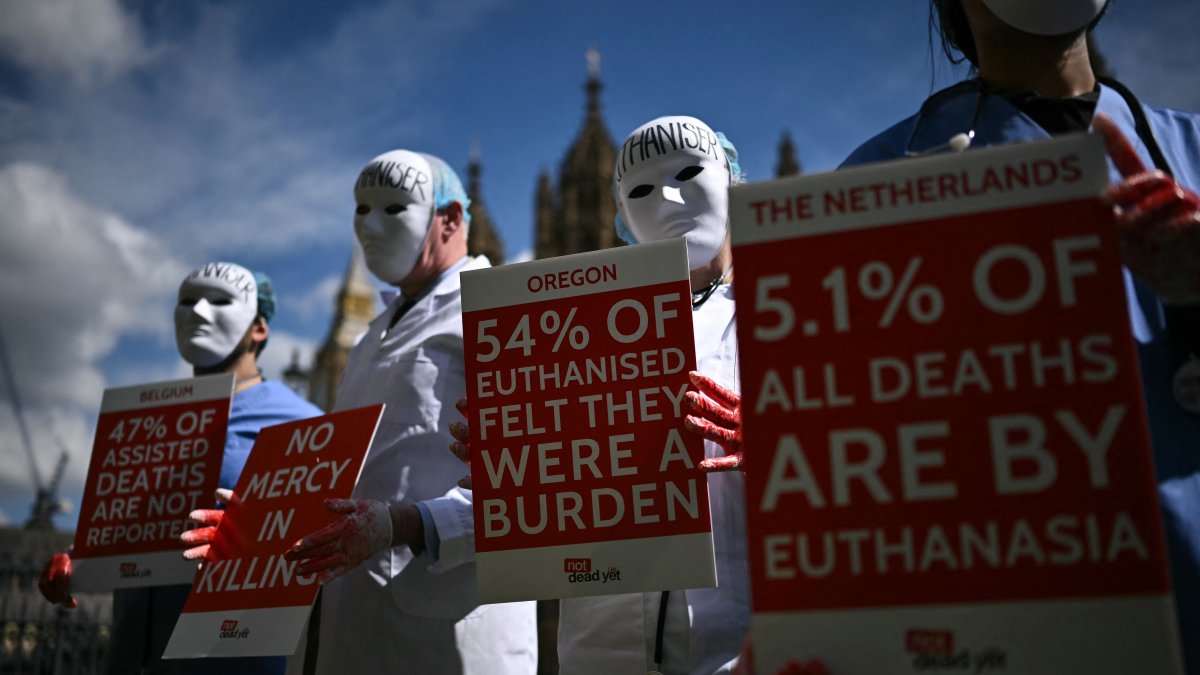
Activists protesting against euthanasia - File Image.

Euthanasia and assisted dying are legal in a limited number of countries and jurisdictions. However, in recent years, the landscape has changed, resulting in a notable increase in the number of people resorting to these procedures globally.
Euthanasia comes in different forms: active, in which a professional directly causes death; passive, which consists of withdrawing or not initiating life-prolonging treatments; and assisted suicide, in which the patient puts an end to his or her own life with means provided by a physician.

Society
Canada: Bereaved parents demand change after their son was euthanized under controversial law
Carlos Dominguez
In 2024, there was a considerable increase in cases worldwide, with more than 30,000 deaths assisted in countries where euthanasia is legalized or regulated. This increase was especially observed in places such as Canada, the Netherlands and Belgium.
As of February 2026, official, globally consolidated data for all of 2025 is not yet available.
Sustained growth
The 2024 figure marks a record worldwide, surpassing previous years due to sustained growth in the main countries where euthanasia is practiced.
- In Canada, about 16,499 cases were recorded in 2024. This represents an increase of 6.9% over 2023 (when there were 15,343). The practice accounted for 5.1% of all deaths in the country in 2024.
- In the Netherlands, there were 9,958 cases in 2024, which is an increase of 10% over 2023, when there were 9,068. The figure represents 5.8% of all deaths in the country.
- Belgium recorded 3,991 cases of euthanasia in 2024, an increase of 16.6% over 2023. This represents 3.6% of all deaths occurring in the country.
- Spain had lower figures in comparison, although it stands out in growth. In 2024, 426 euthanasia or assisted suicide cases were registered, an increase of almost 30% over the previous year. In contrast, in 2022, there were 288 deaths by euthanasia.
The Dr. Gordon MacDonald, chief executive of Care Not Killing in the United Kingdom, told The Telegraph: "These figures show once you legalise assisted suicide or euthanasia, the numbers of those being killed and the reasons why, only ever go in one direction. Just look at Canada."
Canada, a "slippery slope"
The Medical Assistance in Dying (MAID) system, implemented in Canada in 2016, is considered one of the most permissive in the world and has come under fire for its rapid expansion.
It is estimated that one in every 25 people who died in that country in 2024 received legal aid in dying.
According to The Telegraph, in 2016, just over 1,000 people died by euthanasia in Canada. Seven years later, estimates for 2023 put that figure at 15,343 cases.
Unlike many other countries, patients in Canada are not required to have exhausted all treatment options before requesting the procedure.

Moreover, The Telegraph revealed in October 2024 that members of the British Columbia Civil Liberties Association (BCCLA), the group that led efforts to legalize assisted dying, had expressed concern that the practice is being "abused."
"In my view, that's not proper," they pointed out, adding that healthcare professionals should not bring up MAID with patients, as "it’s far too easy for that to become coercive."
Data revealed by the British newspaper also showed that people with lower incomes who were offered assisted dying were more likely to accept it.
The dangerous expansion of MAID
In 2021, amendments introduced through Bill C-7 established a two-track system for determining MAID eligibility and safeguards, depending on whether the person's natural death is reasonably foreseeable.
- Track 1: Applies when natural death is reasonably foreseeable (usually in terminal or end-of-life cases). It includes fewer safeguards, such as the elimination of the mandatory 10-day waiting period, and allows for more simplified processes.
- Track 2: Applies when natural death is not reasonably foreseeable. It covers people with serious and incurable diseases, illnesses or disabilities that cause them intolerable suffering (physical or psychological) that cannot be alleviated in a manner acceptable to them, but are not in a terminal stage. Examples include certain neurological conditions, chronic pain, frailty or other debilitating states with long durations.
Death tourism
In Switzerland, assisted suicide has been legal since 1947, although the law prohibits doctors from directly administering life-ending medication.
According to The Telegraph, that country, where the Dignitas clinic is located, has become one of the main destinations for so-called "death tourism."

According to the organization's data cited by the British newspaper in 2024, only 6% of the 3,916 assisted suicides performed corresponded to people residing in Switzerland. In contrast, those who make most use of these services are German (37%), British (15%) and French (14%) citizens.
Expansion in the U.S. and boom in Latin America
Similar rules on physician-assisted suicide exist in the United States. Death with Dignity, a U.S. pressure group cited by The Telegraph, claims that 10 states have some form of physician-assisted suicide, including California, Oregon and Washington.
In California, hundreds of prescriptions have been recorded annually in recent years, with steady growth. In 2023 alone, there were 1,281 prescriptions issued and 884 ingestion-induced deaths, including some stemming from prescriptions from previous years, a notable increase versus 2022, when 1,270 prescriptions and 853 deaths were counted.

World
Uruguay approves euthanasia law, despite opposition from Church and 'gift of life' advocates
Carlos Dominguez
In Oregon, 560 prescriptions were issued in 2023 and there were 367 ingestion-induced deaths, an increase of about 20% over 2022. These deaths represented 0.8% of the total in the state.
In Colombia, euthanasia has been allowed since 2015 under strict regulation. Even so, according to figures reported by the British newspaper, 271 procedures were carried out in 2023, an increase of 50% over 2022.
Countries where euthanasia is legal
- The Netherlands (since 2002)
- Belgium (since 2002, with one of the most extensive regulations, including minors in exceptional cases)
- Luxembourg (since 2009)
- Canada (since 2016, known as "medical assistance in dying" or MAID)
- Spain (since 2021)
- New Zealand (since 2021)
- Colombia (decriminalized by the Constitutional Court since 1997, progressively regulated)
- Ecuador (decriminalized by the Constitutional Court in 2024)
- Portugal (approved in 2023, but pending full regulation in some aspects)
- Uruguay (approved by parliament in October 2025 as "dignified death," the first in Latin America by legislation, in the process of implementation)
Moreover, in Australia euthanasia is legal in all states—New South Wales, Queensland, South Australia, Tasmania, Victoria, and Western Australia—but not at the federal level or in the Northern Territory.
LATEST