ANALYSIS
POLL: Abbott on track for reelection in Texas, which is projected to remain Republican
With just over two months to go before Election Day, TPOR's first monthly poll shows Abbott 7 points ahead of his Democratic rival and nearly all key elected offices in Republican red: the U.S. Senate may be the exception, with the emergence of James Talarico.
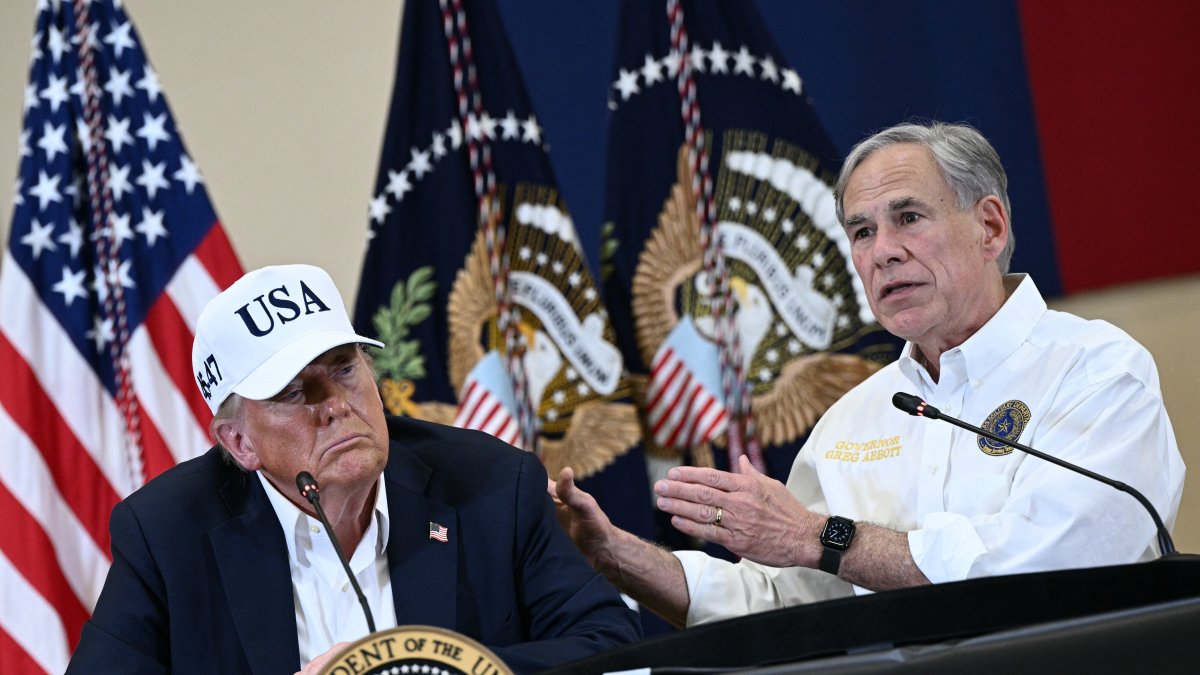
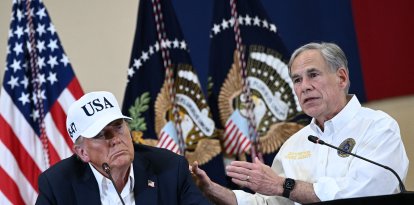
Gov. Greg Abbott with President Donald Trump, in July 2025.

The first monthly tracking poll by Texas Public Opinion Research (TPOR), published this Thursday, paints a promising electoral picture for Republicans: Governor Greg Abbott is widening his lead, and it is highly likely that the state will remain Republican red.
The TPOR poll, conducted Aug. 21–24 among 1,000 likely voters (margin of error: ±3.3), gives Governor Abbott a 7-point lead over Democratic state Rep. Gina Hinojosa. These percentages already include leaners—undecided voters who are asked which way they are leaning. In a close race, this group often tips the outcome.
The data is significant because it represents an improvement over previous polls, which at one point showed Abbott's lead at three points. Now, just over two months before Election Day, the governor has once again widened his lead.

Just The News
Federal judge sides with Texas instead of Minnesota in extradition of ICE agent
Misty Severi
Abbott maintains the lead
According to the poll data, Abbott stands at 49% support and Hinojosa at 42%, with 6% still undecided. Libertarian Pat Dixon and independent Jenn Mack Raphoon each barely reach 1%.
Abbott's job approval rating stands at 48% approval and 48% disapproval. In a year when the cost of living dominates the conversation, an incumbent with three terms under his belt who continues to lead in voter intent is by no means in a bad position in a state that has become a magnet for businesses, families and capital.
As for his rival, Hinojosa has a name recognition problem that the poll lays bare: 35% of those surveyed have not yet formed an opinion about her. Her support may grow, but she may also remain an Austin-based candidate who fails to connect with Texans living outside that Democratic stronghold.

Politics
Summer tuition discounts of up to $1,000: Greg Abbott's strategy to speed up college graduation
Andrés Ignacio Henríquez
Other races
Lieutenant Governor Dan Patrick leads Democrat Vikki Goodwin 47% to 41%, with 8% undecided. Patrick has held the office since 2015, serves as president of the state Senate and is seeking a fourth term. Goodwin, a representative from Austin, faces a real challenge in pulling off an upset.
In the race for attorney general, Mayes Middleton leads Nathan Johnson by 3 points, 44% to 41%, with 10% of voters undecided. Middleton is a state senator from Galveston. He won the GOP nomination in May's runoff against Chip Roy and is now vying to replace Ken Paxton, who is running for U.S. Senate.
In the race for state comptroller, Republican Donald Huffines leads Sarah Eckhardt by a narrow margin of 43% to 41%, with 11% undecided. Huffines is neither a classic incumbent nor a candidate starting from scratch. Glenn Hegar stepped down in June 2025 to become chancellor of the Texas A&M University System, and Kelly Hancock served as acting comptroller for a year. After winning the Republican primary, however, Huffines was formally appointed by the governor and took office on August 1, 2026. He therefore enters the race with the position in hand, but without the cushion of a full term behind him.
Republican Nate Sheets leads Clayton Tucker 44% to 40% in the race for agriculture commissioner, with 11% undecided. The incumbent was Republican Sid Miller, who had been in office since 2015; Sheets defeated him in the March 3 primary (52.7% vs. 47.3%), with the backing of Governor Abbott.
Dawn Buckingham leads Benjamin Flores 44% to 40% in the land commissioner race, with 10% still undecided and 2% favoring Libertarian Neil Snider. There is indeed an incumbent here: Buckingham has been commissioner of the General Land Office since 2023, after winning in 2022. That office manages more than 13 million acres of state land, as well as oil and gas royalties that fund the school fund, coastal protection and the preservation of the Alamo.
Politics
Fewer bureaucrats and more funding for students: Greg Abbott sets a strict cap on administrative spending in Texas schools
Andrés Ignacio Henríquez
On the Railroad Commission, Bo French leads Jon Rosenthal 45% to 41%, with 9% undecided. The name of this agency is misleading: it does not regulate trains, but rather oil, gas, and mining. French, a former GOP leader in Tarrant County, defeated incumbent Jim Wright—whom Abbott supported in the primaries—in the runoff. Once nominated, the Republican leadership rallied behind him. Rosenthal, meanwhile, is a Democratic state representative for District 135.
In the three races mentioned above, the pattern in the TPOR poll is the same: a four-point Republican lead, a bloc of undecided voters at around 10%, and a statewide map that, although more competitive than four years ago, remains painted red. Buckingham is the incumbent. Sheets and French are running as nominees who already defeated a incumbent Republican in March.
The Senate: A weak spot for Republicans
The exception is the U.S. Senate. James Talarico leads Ken Paxton 48-42%, with 7% of voters undecided. Among independents, the gap widens to 21 points in favor of the Democrat. Paxton leads among white voters and those over 55, while Talarico leads among black voters, young Hispanics, college graduates and women.
Paxton is plagued by an image problem that the poll itself quantifies: his net favorability is -15 and his approval rating as attorney general is -10. This is undoubtedly the most precarious race for the Republicans. In fact, the GOP could see its governor reelected, retain the attorney general's office, the state Senate and the commissions, while at the same time struggling in a high-stakes federal race. That, at least, is what these numbers show.

What concerns Texans most
Talarico leads Paxton when respondents are asked who would be better at combating the rising cost of living (48% vs. 38%). He also leads—albeit by a smaller margin—on the handling of artificial intelligence and data centers. These are real numbers. It is also true that a generic Republican continues to have a higher net favorability rating (+9) than a generic Democrat (-1). Voters may punish a specific candidate while still preferring the Republican framework for governing the state.
LATEST