ANALYSIS
Trump posts a controversial historical ranking of US presidents and includes Woodrow Wilson and FDR at the top
Trump posted an image on his Truth Social account showing a hierarchical ranking of what he considers to be the best and worst U.S. presidents. The categories were clear: "the best of all time," "great," "almost great," "average," "below average," and, naturally, "the worst."
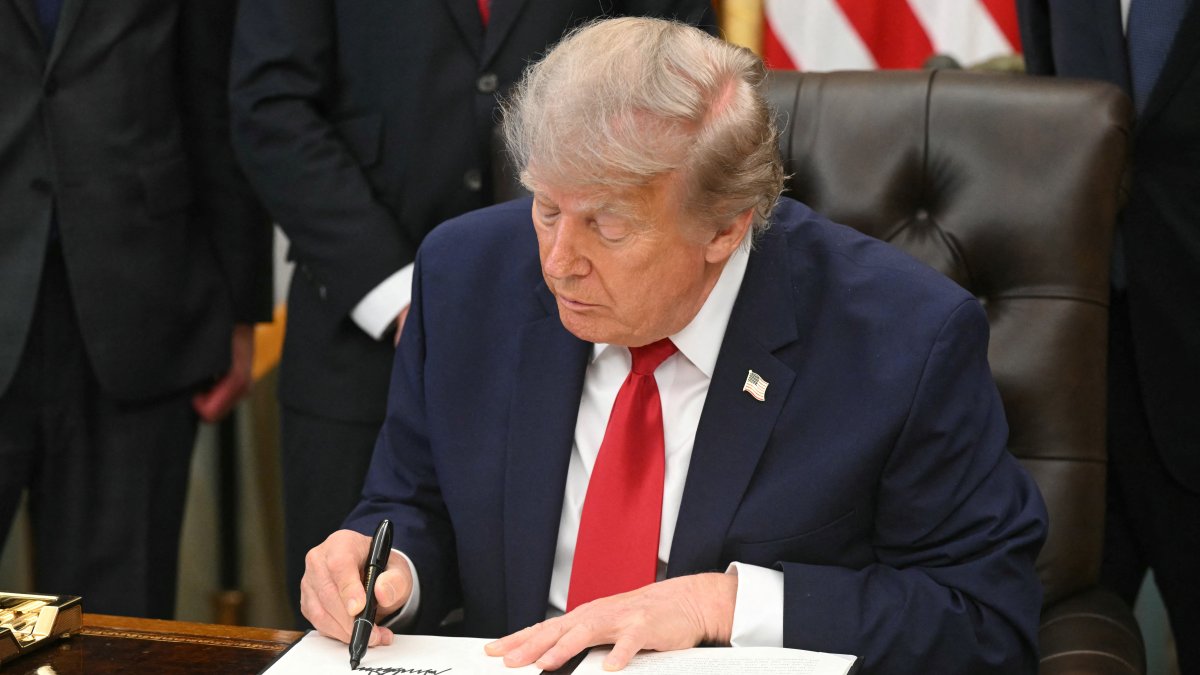
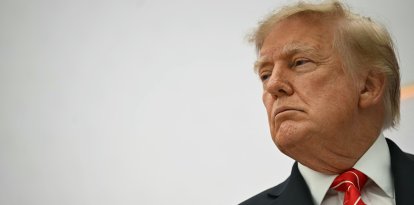
Donald Trump in the Oval Office/ Saul Loeb

Donald Trump surprised everyone by posting a historical presidential ranking, in which he placed himself as "the best." The list quickly went viral, featuring Democrats such as Woodrow Wilson and Andrew Jackson among the best, a low ranking for Calvin Coolidge, and notable absences such as Ronald Reagan, Richard Nixon, and John F. Kennedy.
On Thursday night, Trump posted an image on his Truth Social account showing, in his view, a hierarchical ranking of the best and worst U.S. presidents. The categories were clear: "the best of all time," "great," "almost great," "average," "below average," and, naturally, "the worst."
With surprises, no surprises, and some controversy, the ranking continued to rack up interactions and comments on social media.
Surprises at the top: Woodrow Wilson on par with Washington and Lincoln
The publication of the ranking followed a recent CNN poll that showed Trump as the president most admired by Republicans, ahead of Abraham Lincoln and Ronald Reagan.
In this context, Trump posted a list ranking him as the "best" U.S. president. But perhaps the most striking part came in second place, where the president placed the following names on equal footing: George Washington, Abraham Lincoln, Woodrow Wilson, Andrew Jackson, Franklin D. Roosevelt, and Thomas Jefferson.
In this mix of leaders, many different visions emerge regarding the moral role and scope of the federal government. On one hand is Jefferson, a great advocate of limited government, the defense of individual freedoms, and low taxes. On the other is Wilson, the proponent of a much broader and more active vision of federal power, who strengthened the role of the executive branch and promoted greater government intervention in the economy, in public life, and even on the international stage.
Among Wilson's key measures were the creation of the Federal Reserve in 1913, the enactment of the federal income tax, and the expansion of the federal regulatory apparatus, particularly through the creation of the Federal Trade Commission.
An even more profound transformation came with FDR, whose presidency marked a turning point in the relationship between the federal government and the U.S. economy. In addition to his decisive leadership during World War II, the New Deal expanded Washington's reach and made the federal government a much more prominent player in the country's economic and social life.
As for Andrew Jackson, Trump has never hidden his admiration for the first Democratic president. Already regarded as a national hero following the Battle of New Orleans in 1815, Jackson arrived at the White House with a much more populist view of the presidency and a deep distrust of political and financial elites.
One of his major confrontations was with the Second Bank of the United States, an institution that performed functions similar to those of a central bank and managed part of the federal government's funds. Jackson believed it concentrated too much power and favored the economic elites. In 1832, he vetoed the renewal of its charter and then ordered the withdrawal of government deposits, a decision that openly defied Congress.
Interestingly, Jefferson, who was also part of this group, despised Jackson. According to the book "Confronting the Presidents" by Bill O'Reilly and Martin Dugard, before Jackson took office, Jefferson described him as a "dangerous" man. His predecessor, John Quincy Adams, refused to attend his inauguration. According to the authors, he described Jackson as "a barbarian who could not write a sentence of grammar and could hardly spell his own name."
Perhaps one of the most prominent characteristics of Trump's group of "great" presidents, at least as far as Jackson, FDR, and Wilson are concerned, is their vision of a strong executive branch and a presidency that actively leads the country.
In total, Trump included only one Republican among the great presidents (Lincoln), three Democrats (Jackson, Wilson, and FDR), one without party affiliation (Washington), and one Democratic Republican (Jefferson).
More Democrats than Republicans among the "great" presidents
In a third tier, Trump placed John Adams, Theodore Roosevelt, James Polk, and Grover Cleveland. Again, the group is predominantly Democratic and presents several differences.
Roosevelt is also on the list of presidents who expanded the role of the federal government. He advocated for active government intervention to limit the power of large corporations, protect consumers, and preserve natural resources. In addition to his strong character and leadership, he also adopted a much more active foreign policy. During his presidency, the United States expanded its international presence, intervened in Latin American affairs, and strengthened its military and naval capabilities. He even won the Nobel Peace Prize for mediating the conflict between Russia and Japan.
As for Polk, he was one of the most effective leaders at implementing his agenda. In just four years, he reduced tariffs, won the Mexican-American War, and greatly expanded U.S. territory. He incorporated the present-day states of California, Nevada, and Utah, much of Arizona and New Mexico, and parts of Colorado and Wyoming. At the end of his term, Polk felt fulfilled and decided not to seek reelection.
Cleveland, also a Democrat, shares a historical trait with Trump: he served two non-consecutive terms as president. According to O'Reilly's book, his successor, William McKinley, struggled to identify any achievements during Cleveland's presidency: "What in the world has Grover Cleveland done?"
The New Jersey native also starred in one of the most unusual episodes in American presidential history. In 1893, in the midst of an economic crisis and just a few months after taking office for his second term, he secretly underwent surgery to remove a tumor from his jaw. The surgery was performed aboard a yacht off the coast of New York, under the guise of a fishing trip, while his doctors and aides kept the procedure a secret.
Clinton, Andrew Johnson, Madison, and Monroe among the "average" presidents
In the "average" category, Trump included a dozen presidents: Bill Clinton, John Quincy Adams, James Monroe, Rutherford B. Hayes, James Madison, Martin Van Buren, William Howard Taft, Chester A. Arthur, William McKinley, Andrew Johnson, Herbert Hoover, and Benjamin Harrison.
One of the new additions is Andrew Johnson, who was one vote away from being impeached by the Senate. He became president following Lincoln's assassination. He allowed the Southern states to implement the so-called "Black Codes," laws that restricted the rights and freedoms of newly emancipated African Americans and sought to keep them in a state of economic dependence
Coolidge, the surprise among those rated "below average"
The inclusion of Calvin Coolidge among the "below-average" presidents is one of the biggest surprises in Trump's ranking, especially since Republicans typically highlight his advocacy for limited government, tax cuts, and fiscal discipline.
He was joined by John Tyler, Millard Fillmore, Zachary Taylor, James Buchanan, and Franklin Pierce.
At the bottom of the list: Biden, Obama, and Grant
In the last category, Trump placed Joe Biden, Barack Obama, Ulysses S. Grant, Warren Harding and Jimmy Carter. Among them, Grant is perhaps the most unique historical case: he became president as a Civil War hero and defender of African American rights during Reconstruction, but his administration was marred by numerous corruption scandals involving officials in his government.
Notable absences: Reagan, Nixon, Eisenhower, Kennedy, and the Bushes
Finally, users noted the notable absences from the ranking. Trump failed to mention important Republican presidents such as Reagan, Dwight Eisenhower, Richard Nixon, or the Bushes. He also did not include John F. Kennedy or Lyndon Johnson on the list.
LATEST