The Senate confirms Markwayne Mullin as the new Secretary of Homeland Security
The former senator will be tasked with replacing Kristi Noem, who was fired by Trump himself after a tenure filled with controversy and noise, including immigration operations that resulted in civilian deaths in Minneapolis.

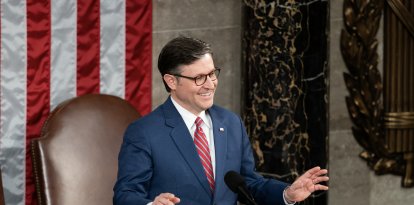
Former lawmaker Markwayne Mullin on Capitol Hill

The Senate on Monday confirmed former mixed martial arts fighter Markwayne Mullin as the new secretary of the Department of Homeland Security (DHS) in a vote that again reflected partisan support for his nomination.
The former Republican lawmaker from Oklahoma, a loyal ally of President Donald Trump in Congress, was approved by 54 votes to 45 to head one of the most important departments in the current administration. Only two Democratic senators joined the Republican majority: John Fetterman, whose endorsement was certain, and, surprisingly, Martin Heinrich, who justified his backing by claiming that Mullin is an independent figure qualified for a position as complex as the head of DHS.
Mullin's arrival in the Cabinet comes at a crucial and sensitive time for DHS, which faces a number of internal political conflicts, pressure over deadly immigration operations in Minnesota and a partial shutdown of the agency that has been going on for weeks now due to bickering between Democrats and Republicans.
"I am not a micromanager"
Mullin will be tasked with replacing Kristi Noem, who was fired by Trump himself aftera tenure filled with controversy and noise, including immigration operations that resulted in the deaths of civilians in Minneapolis.
That episode further fractured the relationship between Democrats and Republicans, contributing to the legislative gridlock that keeps the department without full funding.
In addition to the immigration operations that ended very badly in Minneapolis, Noem was also criticized for her provocative style and overexposure on social networks to spread messages about the various DHS campaigns on immigration and Homeland Security. In fact, according to The New York Times, Trump did not like that Noem had credited him during a hearing with approving an expensive $200 million ad campaign where she seemed the center of attention.


Although Mullin promised to distance himself from Noem's style, his nomination process was complicated.
During her Senate hearing, Mullin faced questioning about her temperament, past statements and regular criticism from Democrats, who contend that her stance against DHS, rather than because of a particular name, is due to the Trump administration's immigration policy.
However, one of the most tense moments of the process was not with the Democrats, but with Republican Senator Rand Paul, with whom he had a strong crossover.
The conflict came from previous statements in which Mullin had said he "understood" an attack Paul suffered in 2017, when he was assaulted in his own home. During the hearing, Paul confronted him directly and demanded he retract it, further questioning whether someone with those kinds of comments could set the right example for ICE and Border Patrol agents. Mullin responded that he did not justify the assault but repeatedly insisted that his words had been misinterpreted, escalating the exchange between the two politicians, who until a few weeks ago were colleagues.
When asked about public policies and Noem's style, Mullin sought to mark differences with his predecessor. Basically, the former senator put forward a less visible leadership style and criticized decisions that, he said, hindered internal management, such as excessive centralization in the approval of contracts exceeding $100,000.
“That’s called micromanaging,” Mullin said. “And I don’t know if the Secretary put that in or someone else did. I’m not a micromanager.”
He also maintained that he will maintain the requirement for warrants to enter property in immigration operations, except in exceptional situations.
Despite the Senate approval, the confirmation does not resolve the underlying conflict over DHS. Democrats again made clear that their opposition to funding for the department stems from policy disagreements, especially over immigration agent practices.
In short, Democrats want greater restrictions on ICE, such as mandatory identification, an end to the use of masks and requiring warrants for raids.
While both benches remain at odds, the impact of the shutdown is already being felt. Thousands of DHS employees are working without pay, which has led to operational problems, including long lines at major airports across the country due to a lack of security personnel. Also, more than 400 agents have resigned since the beginning of the crisis.
Therefore, Mullin's arrival is fundamental and initiates a new stage, as his leadership could open a negotiation window to end one of the most problematic shutdowns for the Trump Administration at this time.
LATEST