Prevost v. Trump
As is usually the case when it comes to Trump, many expressed indignation at the audacity to criticize the leader of the Catholic Church and were quick to rebuke him. However, to understand this clash, one must forget the forms of the messenger, focus on the message and on the hidden tension, a more complex reality where the pontiff uses the same strategy used these days by the always opportunistic and decadent European leaders

Pope Leo XIV and Donald Trump
The confrontation between Donald Trump and the Pope Leo XIV is going to transcend mere controversy, because it comes from afar and because it goes on for a long time. Much has been made of the president's recent publication criticizing the Pope for being "weak on crime and lousy on foreign policy." As is usually the case when it comes to Trump, many expressed indignation at the audacity to criticize the leader of the Catholic Church and were quick to rebuke him. However, to understand this clash, one must forget the forms of the messenger, focus on the message and on the hidden tension, a more complex reality where the pontiff uses the same strategy used these days by the always opportunistic and decadent European leaders, which brings them political benefits, while avoiding condemning in a forceful way the elephant in the room: Islamist terrorism and its perpetrators.
This confrontation did not begin at Easter but some time ago, almost since the American Pope became pope. A few months after taking office, Leo XIV attacked Trump because of illegal immigration control operations. Continuing with the progressive order ideology of his predecessor, Pope Bergoglio, he rebuked the president for holding accountable those who entered the country illegally. The pontiff considered the control measures cruel and urged the U.S. bishops to be "more united and energetic" in the protection of undocumented immigrants.
It is paradoxical that this stance, rooted in his days as a bishop in Chicago and diametrically opposed to Trump's conviction about secure borders, should come from a leader who resides in Vatican City, a state surrounded by a huge wall and boasting one of the crudest immigration laws in the world.
Faced with this first attack, Trump's response was almost nil. Quite elegantly, for him, he simply ignored the comments and said, "I'm sure he's a lovely man."
But the attacks continued. In December, the Pope questioned the strategy and planning of military operations against Venezuelan dictator Nicolas Maduro. Leo XIV even had the audacity to suggest the option of diplomacy with a murderous tyrant of the caliber of the former Venezuelan dictator, disregarding years of failed diplomatic attempts against a man who ordered tanks to crush protesters. It is hard to justify Prevost's words, who urged resolving differences through dialogue and non-violent pressure. After Maduro's capture, the pope, instead of celebrating the departure of a brutal dictator who stole elections and violently oppressed his citizens, expressed his deep concern.
Such comments by the pontiff became commonplace and tensions built up. The breaking point came with the Iranian conflict. Weeks after the Islamic Revolutionary Guard killed thousands of Iranian citizens participating in protests against the regime, an event to which the pope remained painfully silent, Trump authorized Operation Epic Fury. Trump's goal was to prevent the theocratic regime from obtaining nuclear weapons and persisting in its criminal plans at home and abroad, such as those that led to the horrors of October 7. Yet Leo XIV returned to attacking the president instead of criticizing Iran, the country that promotes terrorism around the world. That the ayatollahs would have a nuclear bomb at their disposal seemed a better option to the Holy Father? Then, during the Angelus prayer on March 15, the Pope called for a cease-fire:
"Cease-fire so that ways of dialogue may be reopened. Violence can never lead to the justice, stability and peace for which peoples yearn."
A week later, he returned to the charge calling the war a "scandal for all humanity" and demanding a halt to the air strikes. On Easter Sunday, the rhetoric peaked: he urged leaders to lay down their arms, to abandon the "desire to dominate others" and condemned "the imperialist occupation of the world," warning that God rejects the prayers "of those who wage war."
Several things the pope did in these appeals. To begin with, he drew a parallel between the regime in Iran and the US and Israel. This is not only deeply unjust, but speaks of an alarming moral relativism. He then spoke of avenues of dialogue forgetting all the ways in which Trump tried to establish those avenues prior to the start of Epic Rage.
As a finishing touch, he added to the left's narrative of "imperialist occupation," a rope no Western leader should pull if he doesn't want to validate a version of history that leaves the entire West as an evil oppressor, and this includes, especially, the Catholic Church. It was, ultimately, almost a self-accusation.
But the Pope thought not of this but of his apparent disdain for Trump. And it was only after this in crescendo of attacks that Trump finally replied, true to his style.
The next day, the pope declared, "I am not afraid of the Trump administration," a clear misrepresentation, given that the president had never threatened him. In parallel, he held a meeting with Alex Axelrod, chief strategist for Barack Obama, campaigns, and rumors persist of a formal meeting with Obama himself, who has expressed his desire to visit him. To make matters worse, the Vatican’s agenda suggests it is unlikely the pope will visit the U.S. in 2026, an election year, and he has never met with Trump, although he did meet in November with Illinois Gov. JB Pritzker, a staunch opponent of the president, along with several mayors from that state.
There is a remarkable asymmetry: while the Pope is systematically critical of U.S. wars and Trump's geo-strategy, he remains complicitly silent or barely comments on the atrocities of dozens of other wars in the world and omits to expressly condemn the persecution of Christians in the Islamic world. The growth of this scourge should have the Pope tirelessly making calls and condemnations that put an end to it. A handful of tweets or a few prayers here and there are not enough.
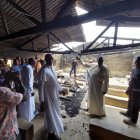
The Pope's recent visit to Algeria, a country where professing Christianity has been persecuted since 2006, ended without a single word of condemnation. In the case of Nigeria, the Pope was asked about the killing of Christians and his response argued that there is "a question that has a lot to do with the economy... and with the control of land" claiming that Christians and Muslims are being slaughtered alike, without expressly naming the Islamist terrorist gangs responsible. Vatican Secretary of State Cardinal Pietro Parolin reinforced this narrative, maintaining that it was a social conflict between herders and farmers and repeating the Nigerian government's arguments.
Nina Shea, commissioner of the U.S. Religious Liberty Commission, denounced in the National Catholic Register that such statements minimize persecution against Catholics. Aid to the Church in Need's own report confirmed that the wave of violence is driven by extremist groups such as Boko Haram and ISWAP, clearly based on religious affiliation. In stark contrast, on Nov. 3 the Trump administration declared Nigeria a country of special concern for its serious violations of religious freedom.
On X account, the Pope recently posted that "war does not solve problems," and that is not true. Should Europe have allowed itself to be invaded without putting up a fight against Hitler because that would not solve the problem? Are there just wars or not?
Because speaking abstractly against war is simple and tenderhearted, especially for those who are safe from monsters like the ayatollahs, Maduro, Diaz-Canel, Putin or terrorist groups like FARC, Hamas and Hezbollah. War is, in many cases, the last resort to protect the innocent against an implacable aggressor. Taking up arms in defense of the nation against enemies who use like-minded groups to murder Americans and allies is a virtuous act.
Preaching about the evils of war always bestows an air of moral superiority, but opposing a war against immoral regimes seeking to obtain nuclear weapons is a truly difficult act to qualify. If the Vatican pretends to claim that war never solves anything, it flagrantly ignores history, and demanding a cease-fire today before subduing the jihadists is like calling for a cease-fire before unconditional surrender in 1945. Doing so means allowing Iran, Hamas and Hezbollah to rearm and resume a nuclear project focused on perpetrating a second Holocaust against the State of Israel, for example.
The denial of legitimate force contradicts the very existence and institutional survival of Catholicism.
Without its application, Europe itself would have succumbed. It was military might that stopped the expansionist advance of the Ottoman Empire in crucial battles such as Lepanto in 1571, where the Holy League destroyed the Turkish fleet to protect the Christian Mediterranean, or the siege of Vienna in 1683, which saved the continent from Islamic domination. It was the protracted struggle of the Reconquest in the Iberian Peninsula, culminating in 1492 after nearly eight hundred years of uninterrupted warfare against Muslim rule, that forged Spain's Catholic stronghold. Even the Papal States themselves maintained armies and fought wars to guarantee their sovereignty in the Italian peninsula. It is thanks to armed conflicts in history that the Vatican State exists today, allowing its current leader to live sheltered behind impenetrable historical walls, enjoying a life without the uncontrolled immigration he demands for others.
Criticizing Donald Trump is the easiest, most gratuitous and fashionable sport among the bureaucrats who pontificate from the safety of the Old Continent. However, it is he who is bearing the cost of reining in Iran with a determination that his predecessors and their European counterparts lacked outright. Taking sides, whether by action or omission, against an effort aimed at disarming the terrorist machine is not a call for peace; and that warrants a firm response. And Trump gave it. To be scandalized by the forms rather than horrified by the substance of a theocratic nuclear program is, in short, the greatest confession of part.
LATEST