The great lesson of Trump's visit to China: The world is bipolar and we must accept it
A confrontation between China and the United States that goes beyond trade and escalates into the most extreme manifestation of Schmittian politics, a war, would be devastating for the world.
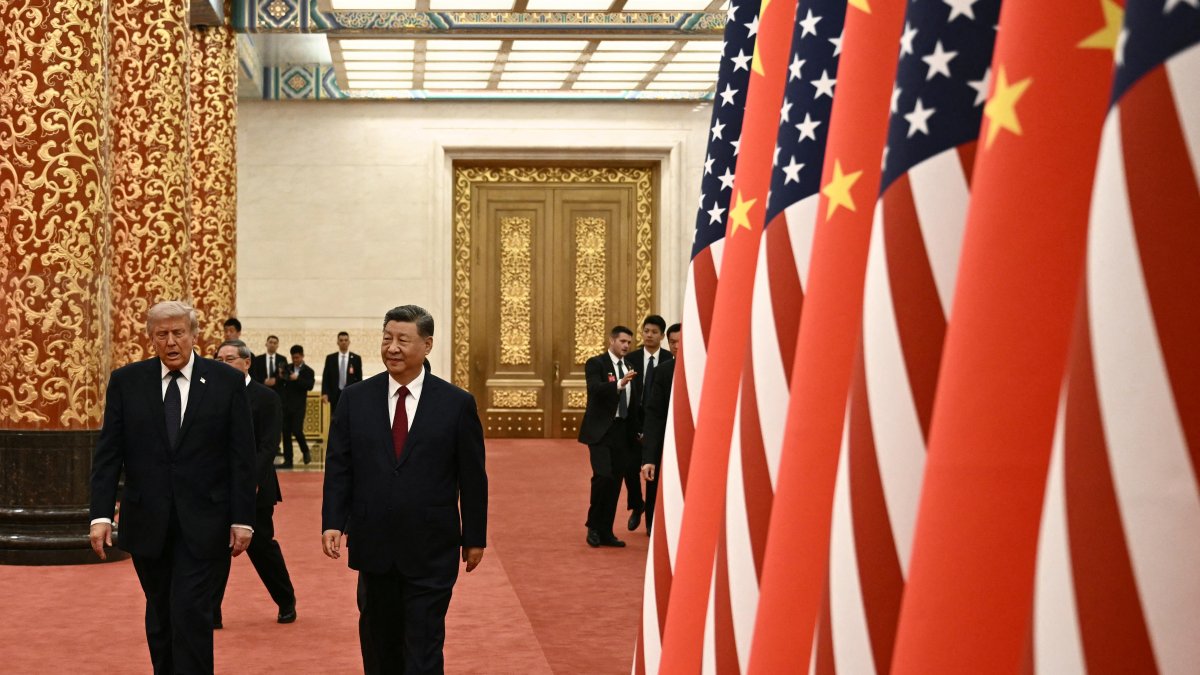
Chinese President Xi Jinping, right, and U.S. President Donald Trump arrive at a state banquet at the Great Hall of the People in Beijing on May 14, 2026.
Donald Trump stomped his foot in Beijing. Or, rather, the United States did. Because the powerful entourage that deployed to China was a show of American muscle. On the government side: President Trump; the representative of his military power, Pete Hegseth; and the representative of diplomatic force, Marco Rubio. And on the economic side: Elon Musk of Tesla; Tim Cook of Apple; Jensen Huang of Nvidia; David Salomon of Goldman Sachs; and other entrepreneurs, heads of companies such as Boeing, Citi or Visa.
The president Xi Jinping received them with all the honors, entertainments and luxuries. The Chinese regime tried to be a host to match, with a display that also demonstrated the power of the Asian giant. Several gestures that might seem superficial, such as the musical entertainment with the song YMCA, specially chosen for Trump, gave evidence of the respect for the visitor.
The United States and China share a bitter history. Filled with tensions, both countries have subscribed to a war that claims one over the other. From the days of the Maoist revolution, their alignment with the Soviet Union, when the quarrel was more ideological, to post-Deng Xiaoping China, where the rivalry is, above all, commercial.
And part of President Trump's economic policy has been framed in that antagonism. So has Xi Jinping. And part of it has been demarcated by episodes of hostilities such as China's multiple spying inside the United States, the regime's expanding influence in Latin America or Africa, aggressions against Taiwan, its support for historical enemies of Americans or its own domestic policies of oppression and persecution.
Tensions could continue to escalate until eventually sparking a conflict in which one attempts to impose itself on the other. But perhaps that is not desirable. At least that is what Donald Trump and Xi Jinping agreed on during their meetings. And, beyond the rhetoric, it is fair to say that Xi Jinping is right when he brandishes a warning: "Let us not fall into the Thucydides Trap."
What is Xi Jinping referring to? He's talking about an article written by political scientist Graham Allison in 2015 and published in The Atlantic titled "The Thucydides Trap: Are China and the United States Approaching War?"
In his "History of the Peloponnesian War," the classical military historian Thucydides states that "it was the rise of Athens and the fear this instilled in Sparta that made war inevitable." In this regard, Allison wrote in The Atlantic:
"The key question about world order for this generation is whether China and the United States will be able to escape the 'Thucydides trap.' The Greek historian's metaphor reminds us of the dangers that arise when an emerging power rivals a dominant power, just as Athens challenged Sparta in ancient Greece, or as Germany did with Britain a century ago."
It is clear that Trump respects Xi Jinping. In Beijing, from the Great Hall of the People, he lavished praise on the Chinese leader. And Xi also respects Trump. It was self-evident. Considering that, there are many obviously tense points, most notably Taiwan. And that tension was acknowledged by Secretary of State Marco Rubio during an interview on Fox News: There will, always, be differences, because there are times when interests will be at odds.
But those differences should not lead to the "Thucydides trap." It's in no one's interest. A confrontation between China and the United States, which transcends trade and becomes the most extreme manifestation of Schmittian politics, a war, would be devastating for the world.
At this point, after what happened in Beijing, the world can only be described as bipolar. Neither Russia, nor Iran nor Saudi Arabia play in these leagues. That is fine. The best approach is to accept it. Then the points of disagreement that are vital to the interests of the West and the East can be addressed more honestly.
LATEST