Trump’s strike on Tehran exposes Europe’s blindness
The Western debate focuses on imperialism, while ignoring Tehran’s decades-long war against the free world.
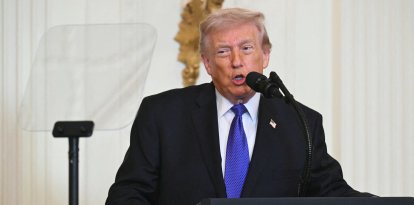
Donald Trump en la Casa Blanca/ Saul Loeb
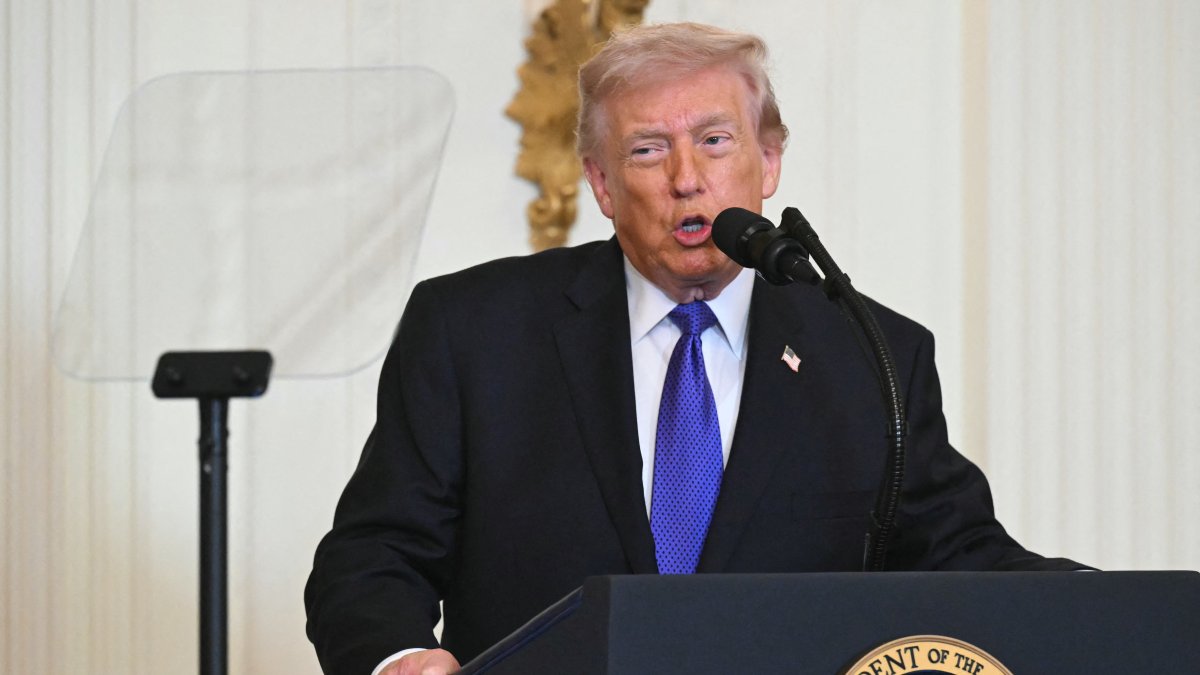
Why did U.S. President Donald Trump attack Iran?
Ask many newspapers and television panels across Europe, and you will hear a familiar answer: because he is an imperialist, reckless and aggressive. That is the dominant explanation repeated across much of the continent’s media and political discourse.
According to this narrative, Trump acts out of arrogance and geopolitical ambition. Following closely behind him, critics say, is Israeli Prime Minister Benjamin Netanyahu, often portrayed in the same commentary as a dangerous provocateur. Together, they become convenient symbols of Western aggression.
Yet this interpretation ignores the central fact that has defined Middle Eastern politics for more than four decades: The Islamic Republic of Iran has built a vast system of ideological warfare, military expansion and terrorism directed not only at Israel but at the West as a whole.
Since the Iranian Revolution of 1979, the regime has declared its intention to destroy both Israel and the United States—the “Little Satan” and the “Great Satan.” This was not rhetorical excess. It became the organizing principle of the regime’s foreign policy.
The seizure of the U.S. Embassy in Tehran was the opening act. In the years that followed came the creation of the Islamic Revolutionary Guard Corps, the rise of Hezbollah, the spread of proxy militias throughout the Middle East and the systematic export of terrorism.
That history includes many chapters, the latest being the atrocities of Oct. 7, 2023.

Yet large segments of European commentary prefer to dismiss the Iranian threat as exaggerated or imaginary. Ballistic missiles, enriched uranium, nuclear ambitions—these are often treated as speculative claims or diplomatic bargaining tools that can always be resolved through another negotiation.
The assumption is that an agreement is always possible if only the West shows patience.
But the facts tell a different story. Even the head of the International Atomic Energy Agency, Rafael Grossi, has warned that Iran possesses hundreds of kilograms of highly enriched uranium that could soon be transformed into nuclear weapons.
Negotiations have hardly reassured Western officials. According to reports from diplomatic discussions, Iranian officials have openly suggested that their program could quickly reach the capacity to produce multiple nuclear devices.
Meanwhile, Tehran continues to deepen strategic cooperation with Russia, particularly through drone technology used in the war in Ukraine, while maintaining strong ties with China.
Yet many European commentators remain convinced that the Iranian regime is stable, resilient and perhaps even part of a broader “axis of resistance” deserving of political legitimacy.
In this interpretation, Trump’s strike on Iran becomes an act of senseless belligerence rather than a strategic response to a mounting threat.
Critics now accuse the U.S. president of abandoning his earlier pledge to seek peace. War, they argue, contradicts that promise.
But this argument fails to recognize a basic strategic reality. Sometimes a war of necessity prevents a far more devastating war of aggression.
History repeatedly demonstrates that confronting expansionist regimes early can avert catastrophe later. The alternative—waiting for the threat to fully materialize—often leads to far greater destruction.
Trump’s decision has also revived another familiar accusation: that the United States is acting at Israel’s behest.
Trump himself rejected that characterization, insisting that Washington is leading the effort. Israel and the United States have long shared intelligence and strategic concerns regarding Iran’s ambitions.
Israel’s position is not difficult to understand. Iranian leaders have repeatedly called for its destruction while building a regional network of armed proxies designed precisely for that purpose.
For many critics in Europe, however, the deeper discomfort lies elsewhere: the idea that Western powers might openly fight alongside Israel.
When U.S. Defense Secretary Pete Hegseth described it as “refreshing to fight shoulder to shoulder with such a capable ally,” the remark captured a reality that unsettles many commentators.
Israel today is a powerful and capable military actor. It is also a state that has endured decades of threats calling for its elimination from the face of the earth.
Supporting Israel’s right to defend itself—and defending the broader Western order threatened by Iran—should not be controversial. Yet for some observers, it remains deeply problematic.
During the Holocaust, the decision to fight Nazi Germany to save Europe and the Jewish people was long delayed and painfully difficult. Ultimately, it proved indispensable to the survival of European civilization.
Today, cooperation with Israel’s military is portrayed by some critics as unacceptable.
Trump, however, has not hidden behind Israel nor been dragged reluctantly into confrontation. He has chosen to act alongside an ally while also calling on the Iranian people themselves to reclaim their freedom from a regime that has ruled them through repression and fear.
What makes Trump’s decision so remarkable—and so difficult for many Europeans to understand—is that he has chosen to stand alongside the Jewish people and defend them from an existential threat.
Instinctively, he seems to grasp the profound moral significance of that choice. After centuries in which Jews were left alone to face persecution, defending them is itself a historic achievement. Today, that defense means standing with Israel and its army. It marks a turning point—historically and morally.
It is a complex strategy, but one rooted in a clear understanding of the stakes.
For much of Europe, however, the situation appears easier to interpret through a simpler narrative of imperialism and aggression.
Reality, unfortunately, is far more complicated.
LATEST