Let Israel start, and let the Iranians win
Strategy in the Middle East emanates not from Western concepts or culture, but from a mastery of manipulation, even irrespective of balance of power.
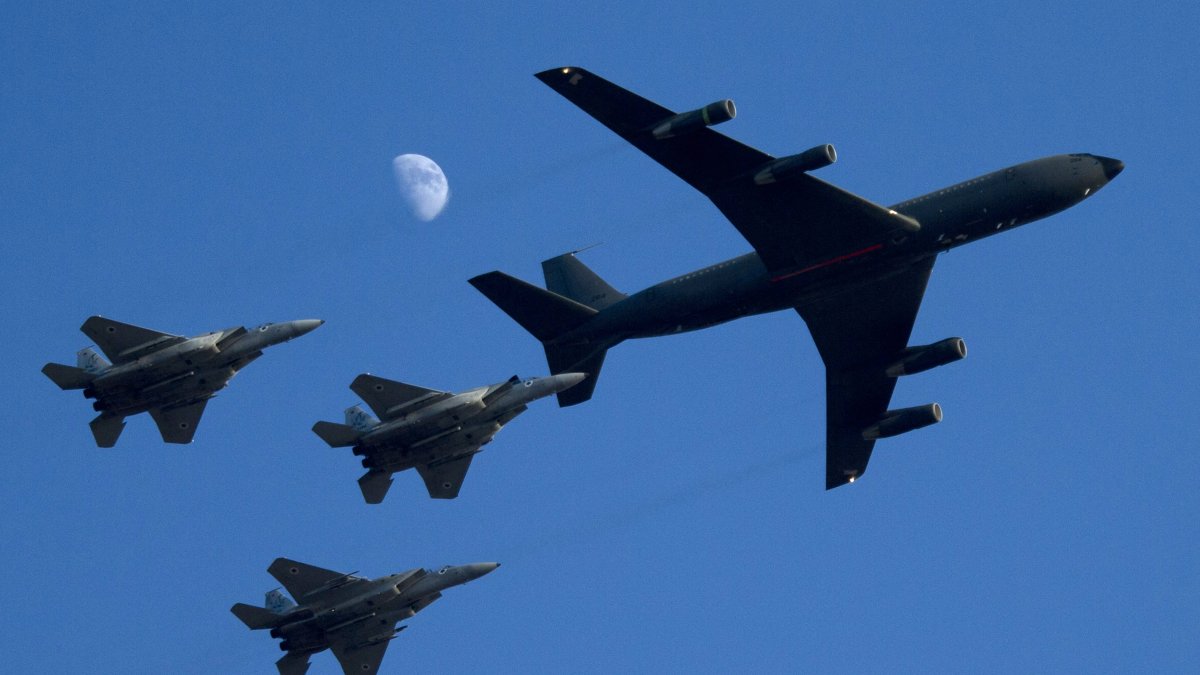
Israeli F-15 fighter jets are refueled by a Boeing 707 (Files)
U.S. President Donald Trump has done much to stabilize the Middle East and support Israel, but as during the Iran-Israel 12-day war in June 2025, it is imperative that Israel should once again do this operation as much alone as it can. Not only should it initiate and go first, but it must also remain the heavy-lifter and guide this through.
In retrospect, one can argue that it would have been better last summer to avoid having “Operation Rising Lion” become “Operation Midnight Hammer,” although managing American pressure to intervene was complicated. And yet, had the war required another week for Israel to have done alone in June without U.S. participation, it may have been less elegant, less efficient and more risky, but it likely would have been nonetheless effective.
Why advocate Israel’s initiating the campaign, even though voices on the American right—some of whose isolationism increasingly emanates from antisemitism—will argue that “Israel started this war, got bogged down and is in over its head, so we now should get entangled because of them”? This ill-informed mindset is a nightmare for sure, but in this circumstance, fidelity to strategic clarity, which Israel possesses, is more important. Victory can eventually be sold, but strategic failure cannot. A long, muddled, seemingly endless campaign, strategically adrift and descending into periodic half-measures to cope with a festering strategic threat, cannot be sold.
So what constitutes this strategic clarity?
To note, wars are not won through power alone, nor even by power wedded to grit and willpower, but by strategy. The West has, through the ages produced great strategists, but there is undeniably a dearth of astute practitioners of the art of strategy dominating Western policy elites. Even were there strategists aplenty, strategy begins and ends with culture and the political nature of the ideas informing that culture. No people on earth understand that better—and master the art of strategy better—than the Iranians. Arabs are a close but still distant second.
Strategy in the Middle East emanates not from recent Western concepts or culture, but from a mastery of manipulation, even irrespective of the balance of power. No amassing of power or clear display of the will to use it impresses the more strategically minded Middle Easterners. Indeed, theirs is a politics of how weakness overpowers absolute strength and brutality, as the most important political text of the Middle East, A Thousand and One Nights, reveals.
The fatal flaw of such Middle Eastern concepts of strategy, however, is reliance on an opponent’s consistency and predictability. To manipulate an adversary, one must be able to read him. The antidote to such strategic manipulation must necessarily be to display uncontrollability. There is no greater strategic asset Israel has acquired in the region than the image of being a bit out of control—namely, that Israel is possessed by the Jinn (“Genies,” and becomes a “Majnoun”) and draws fatal blood from its enemies. Cultivating the paralysis imposed on one’s adversary through such unpredictability is imperative to restore regional order and establish long-term deterrence.
America is culturally not adept at such dissembling and manipulation, nor is it comfortable with being perceived as out of control. There has yet to be an American tourist, no matter how curmudgeonly, who has emerged from a Middle Eastern market with a good deal on a carpet. Westerners find this general Middle Eastern mindset so alien, but in the case of Iran and other Islamists (Sunni and Shi’ite), they also cannot fathom the depths of evil animating them.

The United States once did, but Hitler and Stalin are too distant to have left scars on younger Americans. The American people are happily too normal to conceptualize the reigning regional psychopathy not only in Iran, but with several other prominent regional actors informed by Islamist ideology, and sadly, even a few distorted communities such as the Palestinian Arabs. Until Western nations experience that mindset more pervasively, which Europe soon will and America eventually will, they culturally cannot comprehend the nature of what they face, and thus cannot understand the strategic concept required to advance toward victory and stability.
As such, it is fortunate that Israel exists as the premier, most loyal and most capable American ally in the region. But Washington should rely not only on the fortune of having such a strong, loyal and willing ally as Israel to do heavy lifting for all the civilized world, but also on the fact that this ally—through failures, pain and blood—has had seared into its outlook the full extent of that evil and thus comprehends it better.
To be clear, Israel still struggles with the concept. It had made grave missteps before (the “Oslo” mindset of the 1990s and the Oct. 7 Hamas-led terrorist attacks in 2023) for failing to understand the illness of the Islamist mindset. For not only Israel, but Judaism itself, is not a revolutionary, destabilizing civilization. It is introverted, stability-seeking and reactive. And yet, Israel is now so singed by the fire of Islamism that it reluctantly gets it … sort of.
While Israel struggles with being a “Majnoun,” America is at this point incapable as a modern, secular culture wedded to a concept of personal and material self-interest to understand the Islamist apocalyptic mindset and how it fears only the “Majnoun.” Thus, only Israel has at least partial ability to understand the strategic path required.
Of course, even if Israel strikes alone, Iran likely will strike back at the United States. America should respond, but it is imperative at that point to let Israel carry this through to victory and not then pressure to hit, stop and try to negotiate a ceasefire. Washington must let its ally win. And victory means that not only does Iran’s leadership feel fear before it falls, but that fear should be projected to other potential threats. Others who seek the West’s demise in the region should also fear the Majnoun. While harsh, that is the reality with which one is dealing when confronting Shi’ite and Sunni apocalyptic Islamists.

JNS
US offers passport services to Judea, Samaria communities for first time
JNS (Jewish News Syndicate)
One other community understands this well, and is aligned with Israel and the United States: the Iranian people.
Hope lies with the power of a rising Iranian nation, which has also learned bitterly and now understands through pain and blood the nature of the monster with whom the world must face. They, too, know this must go all the way. They too know, as do Israelis, that no deal or ceasefire is possible with any element of the current evil leadership.
This war must be informed by an understanding that it must be carried through to the very end. And that Israel must guide and shape strategy to both achieve victory and jolt the region into understanding that Jerusalem cannot be manipulated, but must be respected and even feared. Israel should initiate and do the primary lifting both in military force and strategic concept.
In other words, let Israel start, and then let it and the Iranian people win.
LATEST