Riyadh international airport under fire: Houthi attack leaves 12 dead and more than 300 injured; Saudi Arabia vows a response
The Saudi-led military coalition said the target was a passenger terminal and announced that it would respond firmly. Authorities have not yet provided details on how the incident occurred, but this is not an isolated incident, as the same airport was struck three times this week.
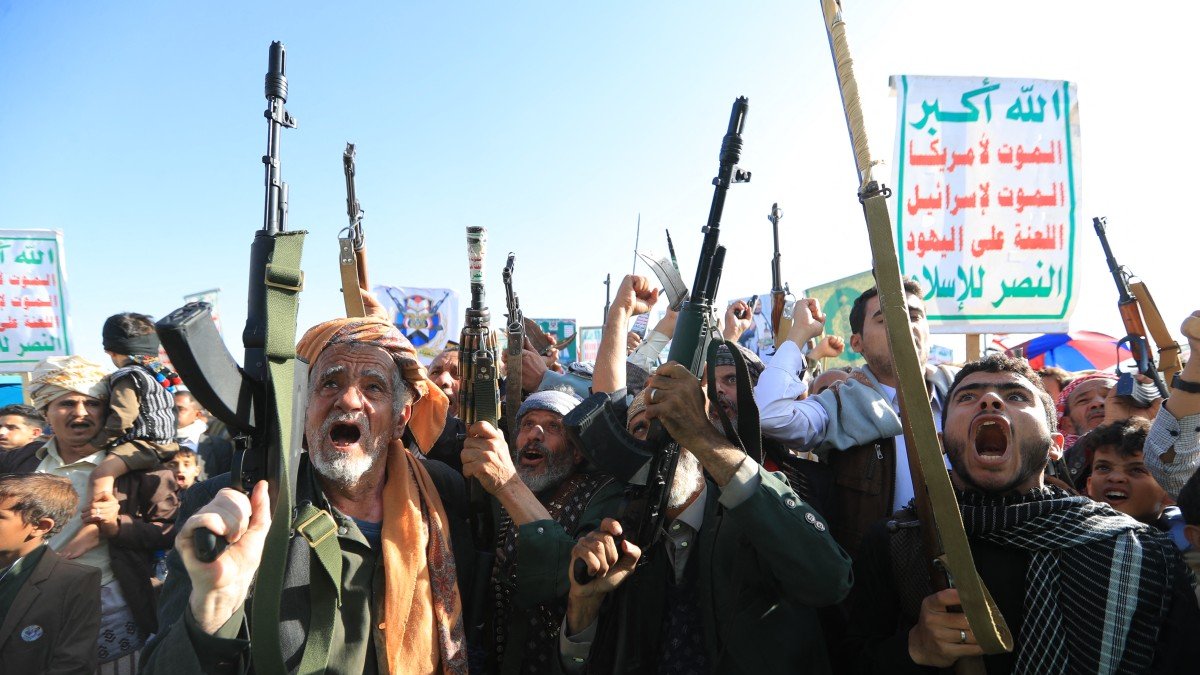
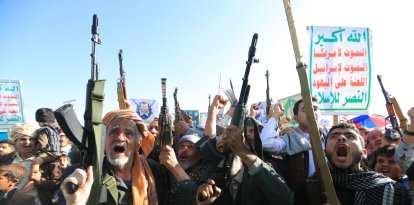
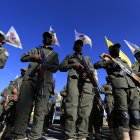
Supporters of the Houthi authorities display their weapons during a protest against the Saudi authorities

Riyadh airport was paralyzed on Saturday after an attack that left at least 12 dead and 309 injured, some in critical condition, according to a report from the General Authority of Civil Aviation (GACA) of Saudi Arabia, cited by various international and U.S. media outlets. Among the dead are four Saudis and one American.
According to The New York Times, this was the deadliest incident in the Arabian Gulf since February, when Washington and Israel began their war with the Iranian regime. The Houthis, a Yemeni militia allied with Iran, claimed responsibility for the attack through the head of their press office, who posted on X that the group "closed Riyadh International Airport."
Likewise, senior Houthi official and spokesperson Mohammed al-Bukhaiti presented it as a response to Saudi airstrikes in Yemen. He said the goal was to show that Yemeni airports, hospitals, and markets are "civilian facilities" and that the rules protecting them there must also apply in other countries.
The military coalition led by Saudi Arabia said the target was a passenger terminal and announced that it will respond firmly. Authorities have not yet provided details on how the incident occurred, but this is not an isolated incident in the Kingdom of Saudi Arabia. On Tuesday, another attack struck Abha airport in the south, and on Wednesday, Riyadh airport was hit, resulting in deaths and injuries according to the Saudi Civil Aviation Authority. On Thursday, there was another attack on King Khalid Airport, which killed three Saudis, including a pilot, and operations resumed on Friday. Prior to Saturday's attack, Air India, flydubai, Lufthansa, and Pakistan International Airlines had already suspended flights to Riyadh and other airports in the kingdom, according to CNBC.
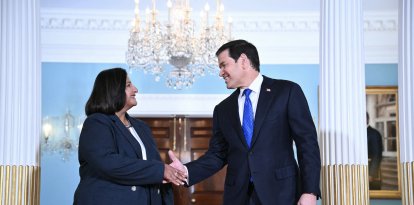
Senator Marco Rubio issued a statement on X.
"The United States strongly condemns the recent attacks on the Kingdom of Saudi Arabia by the terrorist Houthis, including today’s strike on King Khalid International Airport in Riyadh that took numerous innocent lives, including an American citizen. These reprehensible attacks demonstrate a blatant disregard for innocent civilian life. They must stop now. We stand with the Kingdom of Saudi Arabia and its people and extend our condolences to the victims and their families."
The United States strongly condemns the recent attacks on the Kingdom of Saudi Arabia by the terrorist Houthis, including today’s strike on King Khalid International Airport in Riyadh that took numerous innocent lives, including an American citizen. These reprehensible attacks demonstrate a blatant disregard for innocent civilian life. They must stop now. We stand with the Kingdom of Saudi Arabia and its people and extend our condolences to the victims and their families.
— Secretary Marco Rubio (@SecRubio) October 10, 2026
The escalation between the Houthis and Saudi Arabia comes amid a war that reignited this week. The Yemeni government, which supports Riyadh, launched an offensive against the Houthis, and the Kingdom of Saudi Arabia resumed its airstrikes against the rebels. The Houthis, in turn, declared Saudi airspace a military operations zone, warning airlines to avoid it. They claim that the kingdom launched hundreds of attacks on their territory, and the Health Ministry affiliated with their authorities maintains that 91 people have died since September 3, most of them women and children. However, no independent verification supports these figures.
The conflict dates back to 2015, when Saudi Arabia led an air campaign against the Houthis after they seized Sana'a and ousted the government. At that time, hundreds of thousands of people died as a result of fighting, famine, and disease. A 2022 truce brought a fragile peace, which this year's regional war shattered. In July, tensions flared again following the bombing of Sana'a International Airport, and in September, the Houthis seized Yemen's Red Sea coastline, which, according to the NYT, gave them greater leverage over the Bab al-Mandab Strait, a key chokepoint for global trade.
World
Battle for the Red Sea: US officials hold secret meeting with Houthis as conflict threatens maritime routes
Luis Francisco Orozco
For Riyadh, this attack, in addition to the damage to infrastructure and the loss of life, also comes at a cost to its image. Crown Prince Mohammed bin Salman wants to turn the capital into an international hub for tourism and business, and the kingdom is expecting major events in the coming weeks, including the W.P.C. Energy Congress, which begins this Sunday and which organizers say will proceed as planned, and the annual Future Investment Initiative, which has not announced any changes so far.
In Washington, meanwhile, President Donald Trump described the attack as "terrible" to reporters and said he would make a decision on whether or not to get involved in the conflict. He also said he would speak with Crown Prince Mohammed bin Salman. The U.S. Embassy in Riyadh advised its citizens to avoid the area.
The casualty toll may change as the hours pass, as some of the wounded are in critical condition. The coalition also reported that a projectile landed near Dammam airport in the eastern part of the kingdom, but it did not provide further details.
LATEST