ANALYSIS
The limits of euthanasia: An elderly Canadian woman receives a lethal injection against her will and without final consent
The case, which has shocked Canada's conservative community and reignited the debate over safeguards for the MAiD program, occurred on July 10 at The Pearl, a nursing home in Cannifton, Ontario, and is currently under investigation by the Belleville Police Department.

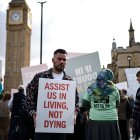
Anti-euthanasia activists—File photo

The family of Brigitte Stegemann, an 83-year-old Christian grandmother affectionately known as "GG" or "Oma," has alleged that she was euthanized against her will under Canada's medical assistance in dying program (MAiD) at a nursing home in Ontario, dying covered in blood while her hands remained clasped in prayer.
The case, which has shocked Canada's conservative community and reignited the debate over the safeguards of the MAiD program, occurred on July 10 at The Pearl, a care home in Cannifton, Ontario. The case is currently under investigation by the Belleville Police.
A traumatic and controversial death
Brigitte Kranendonk, Stegemann's granddaughter and her medical proxy for six years, reported to the Daily Mail that her grandmother had explicitly rejected euthanasia on multiple occasions, citing her religious beliefs and the fear of "displeasing God" as the main reasons. However, two days before the procedure, when Kranendonk explained to her in frank terms that she would die on Friday, the elderly woman burst into tears for 45 minutes and exclaimed: "I made a mistake."
The moment of death was anything but peaceful. According to Kranendonk's testimony, a nurse who was not wearing gloves attempted to insert the IV catheter into Stegemann's right arm, failed repeatedly, and pricked her "three or four times," causing profuse bleeding that soaked her nightgown, the sheets and the pillow. The nurse then moved to her left arm and continued the procedure without gloves, her hands covered in blood.
When the doctor arrived and asked Stegemann if she agreed to receive the "medicine," the elderly woman, already unconscious or deep in prayer, did not respond, did not open her eyes and did not nod. The doctor proceeded anyway, saying, "I'm going to continue." In less than 10 minutes, Stegemann was pronounced dead, without her pulse being checked either before or after the procedure.

Society
Cardinal Cupich and two orders of nuns sue Illinois days before a law on assisted death takes effect
Carlos Dominguez
Warning signs ignored
Kranendonk, who had cared for her grandmother for 12 years, pointed out multiple irregularities in the process:
- Flawed cognitive assessment: During the assessment to determine whether Stegemann had the mental capacity to consent, the elderly woman answered all the questions incorrectly, stating that she had no living siblings when in fact two of her 13 siblings are still alive and she had seen one of them just a month and a half earlier.
- Consent never verified: Kranendonk asserts that she never heard her grandmother clearly say, "I want MAiD," and that the consent forms allegedly signed by Stegemann were completed without any family members present. To date, the family has not been able to access those documents.
- Pressure from medical staff: The granddaughter described how a nurse became "very aggressive and defensive" when she questioned who had initiated the conversation about MAID, and she felt that the staff viewed her as an "obstacle" to the procedure.
- Rushing the process: Staff attempted to move Stegemann's death up from Friday to Thursday simply because "the doctor had an early opening," which would have prevented her pastor and son from being present, contradicting her wishes to die surrounded by prayer and family.
Belleville police confirmed to the Daily Mail that the case is "open and under investigation" by its Criminal Investigations Division, but declined to provide further details. The Pearl, the care home, has not commented publicly.

Other documented cases:
- A woman in her 80s in Ontario, identified in official documents only as Mrs. B, was euthanized on the same day she had said she no longer wanted MAiD. According to the report by the Ontario MAiD Death Review Committee, released in early 2026, she first requested assisted dying and then told the assessor that she was withdrawing her request for personal and religious reasons, and that she preferred palliative care or hospice care. She was not admitted to a hospice. Her husband, exhausted as her caregiver, requested an urgent second assessment; another doctor declared her eligible, and despite the first doctor's warnings about haste, a change of heart and possible coercion, a third doctor confirmed her eligibility, and MAiD was administered that same night. The committee criticized the fact that everything was resolved in a single day.
- In May 2026, the Ontario College of Physicians and Surgeons sanctioned Dr. James MacLean for two cases of MAiD from 2024. On Sept. 25, at the home of Bradley Stewart, a 67-year-old man with liver cancer, he failed to administer the muscle relaxant, pronounced him dead and left; the patient began breathing again, and MacLean had to return to complete the procedure. In another case, he assessed a man outside a Tim Hortons and drove him in his car to the location where the euthanasia took place. He received a reprimand and at least six months of supervision; he was able to continue practicing.
- Kiano Vafaeian, 26, died via MAiD on Dec. 30, 2025, in Vancouver. He had had type 1 diabetes since the age of four, vision problems (he lost an eye in 2022), and, according to his mother, Margaret Marsilla, often seasonal depression following an accident at age 17. In Ontario, his application was denied or his approval was revoked; he traveled to British Columbia, where a doctor approved his case based on diabetes-related blindness and neuropathy, not terminal illness. The family says the system failed to protect him and is calling for reforms; the death certificate attributes the MAiD to those diabetic complications.
- The MAiD Death Review Committee of Ontario's chief coroner described the case of "Mrs. 6F," a woman in her late 80s with moderately advanced dementia who lived in a nursing home. A family member interpreted a "wish to die" as a request for MAiD, and the team initiated the referral. She signed illegibly, and an employee of the provider signed on her behalf. On the day of the procedure, she was overwhelmed by visitors; they were asked to leave to calm the atmosphere. The final consent was deemed valid because she repeated the question and squeezed the doctor's hand. Some committee members accepted this as a choice; others argued that repeating a phrase does not prove she understood the decision, and they urged against relying solely on a handshake.
- An internal report from British Columbia, cited in July 2026 by The National Post, found that in 2024, 51.9% of MAiD cases (about 4,169 requests) required follow-up, with 2,807 errors, almost all of which were paperwork-related. In 353 cases, professionals received training due to legal compliance failures; the province did not explain what happened next in each case.

Society
The slippery slope of euthanasia: Deaths have soared in several countries in recent years
Carlos Dominguez
What is MAiD?
- Be at least 18 years old and have the capacity to make health decisions.
- Be eligible for publicly funded health services in Canada.
- Have a "serious and irremediable medical condition."
- Have made a voluntary request.
- Have given informed consent.
However, critics such as Dr. Ramona Coelho, a family physician and member of the Macdonald-Laurier Institute, have denounced systematic failures in the implementation of these safeguards and have called for the creation of an independent national oversight body with the power to investigate irregularities and even pause MAiD deaths.
The Canadian government has postponed the expansion of MAiD to individuals whose sole underlying condition is a mental illness until March 2027, following multiple delays.
LATEST