The end of New START: The last nuclear pact between Washington and Moscow expires
The United States and Russia let the last arms control treaty expire, while China refused to join a trilateral negotiation.

A Russian missile launcher with nuclear capability.

The latest nuclear nonproliferation treaty between Washington and Moscow came to an end Thursday. The New START agreement came into force in 2011 as part of a succession of pacts that began during the Cold War to limit the spread of nuclear weapons. Expired, none remain in force.
The United States and Russia concentrate 87% of the nuclear arsenal, according to estimates by the Federation of American Scientists. The figures, however, are difficult to know with certainty: each country guards the size of its nuclear arsenal with suspicion.
What did New START provide for?
First initialed in 2010, it limited the nuclear arsenals of the United States and Russia:
- Warhead cap: they could have 1,550 nuclear warheads deployed on intercontinental ballistic missiles, submarines and heavy bombers. A reduction of almost 30% from the previous limit, according to AFP.
- Limit on missiles, submarines and bombers: could deploy 700 intercontinental ballistic missiles, submarine-launched ballistic missiles and heavy bombers equipped for nuclear armament.
- Loaders limit: could possess, deployed or not, 800 launchers for intercontinental and submarine-launched missiles, and nuclear bombers.
In its page devoted to the agreement, the State Department stresses that the pact enhanced "U.S. national security by placing verifiable limits on all Russian deployed intercontinental-range nuclear weapons." Including some that could reach the United States within 30 minutes.
It also provided for 18 annual inspections. They were on-site and were to be carried out by inspectors from both countries. However, they were suspended in 2023.
Putin assures that he will act "responsibly"
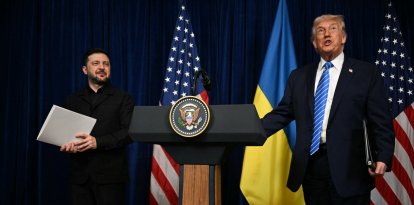
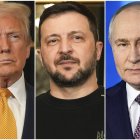
Vladimir Putin had proposed late last year to extend the terms of the treaty by one year. Although Donald Trump spoke in favor, the idea did not prosper.
In the last few hours, the Russian Foreign Ministry maintained that it assumed that "the parties to the New START treaty are no longer bound by any obligations or symmetrical declarations within the context of the treaty." "We view it negatively. We express our regret in this regard," Kremlin presidential spokesman Dmitry Peskov maintained for his part.
A day earlier, Russian adviser Yuri Ushakov assured that Putin had stressed that he would act prudently and responsibly. "We remain open to finding ways to negotiate and ensure strategic stability," Ushakov maintained at a press conference.
In recent years, with the invasion of Ukraine in the background, the Russian president has signaled in favor of using his nuclear weapons.
In 2024, he signed a decree allowing them to be used in response to the use of conventional weapons against its territory (shortly after Washington allowed Kiev to fire U.S. missiles inside Russia.)
A document that, according to official Russian sources, described as a "joint attack" any offensive by a nation without nuclear capabilities (such as Ukraine) with the "support" of "a nuclear power" (such as the United States.)
Just over two months ago, Putin ordered his military top brass to prepare for nuclear weapons tests. Tests that have not been conducted since the Soviet Union abandoned them in 1990. The United States did the same in 1992.
China rules out becoming part of a new treaty
The Trump Administration maintains that it only makes sense to sign a new version of the pact if it includes Beijing. A position reaffirmed by Secretary of State Marco Rubio at a press conference hours before the New Start expired:
"The President’s been clear in the past that in order to have true arms control in the 21st century, it’s impossible to do something that doesn’t include China because of their vast and rapidly growing stockpile."
While regretting the end of the U.S. and Russian agreement, China rejected the call to the negotiating table. The one in charge of dismissing the proposal was Foreign Ministry spokesman Lin Jian, who assured that his country will not participate "in nuclear disarmament negotiations at this stage."
"China's nuclear capabilities are of a totally different scale as those of the United States and Russia," he added at a press conference.
Which countries have nuclear arsenals?
By public information, historical records and leaks, the Federation of American Scientists estimated that the United States and Russia accumulate more than 87% of nuclear weapons. Seven other nations share the rest.
In total, it estimates that there are more than 12,200 nuclear warheads around the world. Of these, about 9,600 would be available for use on missiles, aircraft, ships and submarines. The rest would be retired, though relatively intact.
Approximately 3,900 would be deployed in operational forces, i.e. missile or bomber bases. About 2,100 would be on "high alert," in other words: "Ready for use on short notice."
The federation estimates the following total numbers of nuclear warheads per country:
- Russia: 5,459
- United States: 5,177
- China: 600
- France: 290
- United Kingdom: 225
- India: 180
- Pakistan: 170
- Israel: 90
- North Korea: 50
Reactions from NATO, the U.N., and the pope
"Restraint and responsibility in the nuclear domain is crucial to global security," a North Atlantic Treaty Organization (NATO) official assured AFP.
He also stated that both Russia and China have been increasing their nuclear capabilities. The alliance, he vowed, "will continue to take the necessary steps."
"This dissolution of decades of achievement could not come at a worse time, the risk of a nuclear weapon being used is the highest in decades," UN Secretary General Antonio Guterres maintained.
"I urge both States to return to the negotiating table without delay and to agree upon a successor framework that restores verifiable limits, reduces risks, and strengthens our common security," he added.
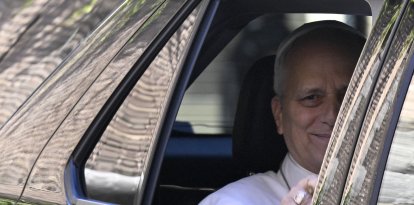
Pope Leo XIV also weighed in, warning of the risk of a "new arms race" and urging not to let "this instrument not be allowed to lapse without seeking to ensure a concrete and effective follow-up."
France, the E.U.'s only nuclear power, called on the United States, Russia and China to work for an international arms control system.
LATEST