Brazilian authorities confirm arms seized from Nicolas Maduro's army during mega anti-narcotics operation in Rio de Janeiro
The discovery of the Venezuelan weapons in Brazil reinforces suspicions that Nicolas Maduro's regime, in addition to being linked to the region's major cartels, may also have ties to regional criminal gangs, facilitating arms trafficking in the hemisphere.

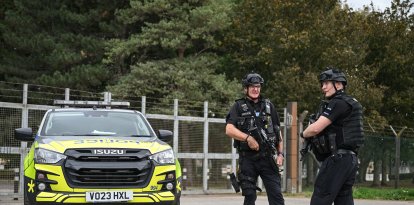
Police officers guard suspected criminals arrested during the operation in the Vila Cruzeiro favela

Brazilian authorities confirmed that some weapons from the arsenal seized this week from the Comando Vermelho, Brazil's most dangerous criminal gang, belong to the Bolivarian National Armed Forces (FANB) of Venezuela.
The discovery followed a mega-operation in the favelas of Penha and Alemão, in northern Rio de Janeiro, which left at least 132 dead and more than 80 arrested, according to official figures.
The coordinator of the Arms and Explosives Control Division (CEFAI) of the Civil Police, Vinícius Domingos, confirmed that two FAL rifles from the recovered arsenal were manufactured for the FANB and were in the possession of the Brazilian criminal organization. Among the 93 seized rifles, weapons of Brazilian, Argentine, and Peruvian origin were also found.
"Most of these weapons do not come from local collectors but from land routes from the Amazon, especially from Paraguay," detailed the official, who ordered a technical expertise to trace the exact origin of these weapons that were in possession of the fearsome Red Command.
#ÚLTIMAHORA Hallan armas de la FANB en poder del Comando Vermelho durante el operativo antinarcos en Río de Janeiro https://t.co/BsIkENXBsV pic.twitter.com/TRvtaM0jot
— Monitoreamos (@monitoreamos) October 30, 2025
The discovery of the Venezuelan weapons in Brazil reinforces the suspicion that the regime of Nicolás Maduro, in addition to being linked to the region's main cartels, could also have ties to regional criminal gangs, facilitating arms trafficking.


An unprecedented operation
The news follows the huge police deployment in Rio, which included more than 2,500 police officers, armored vehicles, and helicopters, in an operation aimed at capturing the main leaders of the Red Command. This criminal structure dominates a good part of the favelas in Rio de Janeiro and other parts of Brazil. It controls drug trafficking in the north of the South American giant.
During the raid, the criminals responded with rifles, drones equipped with explosives, and barricades made with hijacked buses, turning the north of the city into a veritable battlefield.
Videos released by neighbors showed bursts of up to 200 shots per minute, while public services were suspended and dozens of schools closed. Rio governor Cláudio Castro, an ally of former president Jair Bolsonaro, called the operation "the most lethal in the city's history," surpassing even the Jacarezinho massacre in 2021.
The operation culminated in the seizure of half a ton of drugs and 14 explosive devices, in addition to the weapons of war that are now part of an international investigation into cross-border trafficking.
Regional links and international pressure
According to War Department sources, more than a dozen "narcolanchas" have been destroyed and at least thirty suspected drug traffickers killed in international waters. U.S. authorities claim that these operations are aimed at cutting off drug trafficking routes that depart from ports controlled by the Venezuelan military and supply criminal groups in Central America and Brazil.
LATEST