Red Command: Origin, territories and allies of one of the world's most dangerous narco-gangs
The group originated from the alliance between common prisoners and left-wing militants who coincided in prisons under the Brazilian military dictatorship.

Operations in Brazil against the Red Command

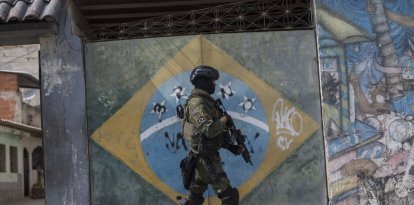
Brazil carried out the most lethal operation against drug trafficking in the history of Rio de Janeiro. The objective is to weaken the Red Command (Comando Vermelho), the country's main criminal group operating in the favelas, densely populated popular neighborhoods.
The group originated from the alliance between common prisoners and leftist militants who coincided in prisons during the Brazilian military dictatorship (1964-1985).
According to a report from InSight Crime, the harsh prison conditions of Cândido Mendes, on the island of Ilha Grande, Rio de Janeiro, motivated inmates to band together to survive within the prison system. In the beginning, they created a left-leaning militia called the Red Falange (Falange Vermelha), but eventually dropped that ideology as they became more involved in organized crime, eventually becoming known in the press as the Red Command.
"It has since grown into a sizable national and transnational threat. While still maintaining its power base in poorer neighborhoods around Rio de Janeiro, the Red Command has a major influence in prisons across the country, with the northern region of Amazonas and western state of Mato Grosso being its secondary strongholds," explained InSight Crime.

Places where it has a presence
In addition, the group also has a presence in Bolivia, where it sources much of its cocaine, and in other parts of Brazil. Its clashes with paramilitary groups and the Pure Third Command (TCP) are a frequent source of violence in Rio.
"The Red Command is also engaged in an ongoing turf war in the tri-border region between Colombia, Brazil, and Peru, where the group has expanded its influence," InSight Crime detailed.
Red Command leadership
The Red Command presents a relatively flexible leadership and is described more as a network of independent individuals than a hierarchical organization controlled by a single leader. Its structure resembles a franchise model, with local divisions and autonomous networks that act as allies.
"However, there are prominent bosses within the structure, including Luiz Fernando da Costa, alias 'Fernandinho Beira-Mar,' who is currently imprisoned, and Isaias da Costa Rodrigues, alias 'Isaias do Borel,' who was in prison for more than 20 years until his release in 2022. Márcio dos Santos Nepomuceno, alias 'Marcinho VP,' is another prominent figure in the gang, and recognized as one of its major leaders together with Fernandinho Beira-Mar," InSight Crime detailed.
Meanwhile, in December 2014, Paraguayan police captured Luiz Cláudio Machado, known as "Marreta," another prominent Red Command leader, who remains imprisoned.
Although behind bars, Fernandinho Beira-Mar has retained great power within the organization, and authorities continue to investigate the repercussions of his leadership.
Links and rivalries
The Red Command has also established both collaborative and rival relationships with other criminal groups over the years. On the one hand, in Brazil it has had ties with organizations such as the First Capital Command (Primer Comando da Capital or PCC) and the Family of the North (Familia do Norte or FDN); however, many of these alliances broke down and these groups are now considered enemies, which has generated violent clashes in different regions of the country.
"In addition to the PCC, the Red Command’s main enemies are militias composed of active and former security force officers, and the Rio-based criminal group Pure Third Command, a breakaway faction of the Third Command (Terceiro Comando), which was set up by dissident former Red Command members," stated InSight Crime.
On the other hand, its criminal network is not limited to Brazil. The Red Command is believed to have international connections, including links to former FARC members in Colombia. In addition, it is allegedly involved in drug trafficking networks: cocaine coming from the Andes and marijuana being transported from Paraguay.
The operation against the group
LATEST